
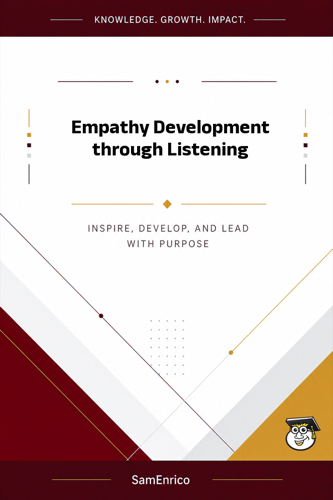
Empathy Development through Listening eBook
Practice active listening to understand others' em
Practice active listening to understand others' emotional worlds deeply.
Formats
Free sample
Chapter 1: The Hearing Paradox--–- Maria and David had been married for eleven years when they sat down for what they both called "the conversation that would decide everything." David had lost his job three months earlier. He hadn't told Maria for six weeks. When she finally discovered the truth—through a misdirected email from his former boss—she didn't scream. She didn't cry. She sat perfectly still on their beige couch and said, "I need you to explain this to me.
I need you to help me understand."David opened his mouth. And then he did what most of us do when someone finally offers us the floor to share something painful. He explained the timeline. The layoffs. The severance package.
The four interviews that went nowhere. He gave her facts, figures, dates, and rationalizations. He spoke for twenty-three minutes.When he finished, Maria nodded slowly and said, "So you've been pretending to go to work for six weeks?""Yes.""And our savings?""Forty percent gone."She stood up. "Thank you for telling me." Then she walked into the bedroom and closed the door. Not slammed.
Closed. Which was worse.Later that night, David called his brother and said, "I told her everything. Why doesn't she feel better?"His brother paused. "Did she ask you for the timeline? Or did she ask you how you were feeling?"David replayed the conversation in his head.
"I need you to help me understand," Maria had said. She hadn't asked for dates. She hadn't asked for severance details. She had asked for understanding. And he had given her a Power Point presentation instead of his trembling hands.Here is the truth that David learned too late: Maria wasn't asking for information.
She was asking for his emotional world. And he had no idea how to give it to her—because no one had ever taught him that listening requires something more than waiting for your turn to speak.This book exists to fix that.The Epidemic You Didn't Know You Had Let me start with a prediction. In the next twenty-four hours, you will be in at least seven conversations. With your partner, your children, your coworkers, your friends, the barista, the person on the phone with tech support. In those seven conversations, you will hear approximately 15,000 words.
You will remember roughly 17 percent of them. And the person you're speaking with will feel genuinely heard in exactly zero to one of those conversations.I'm not guessing. I'm citing data.Researchers at the University of Michigan tracked 750 adults over a two-week period, asking them to record one significant conversation per day. Participants rated each conversation on two scales: "Did the other person listen to me?" and "Did I feel understood?" The correlation was weaker than expected. Many people reported being "listened to" (the other person was quiet, made eye contact, nodded) but did not report feeling understood.
Something was missing.That missing element is the subject of this entire book. But before we can build empathy, we have to name the enemy.The enemy is not that people don't care. Most people care desperately. The enemy is that caring and listening have become disconnected in the modern brain. We have confused the intention to listen with the skill of listening.
And that confusion is costing you everything.The Hearing Paradox Defined I want to introduce you to a term you'll see throughout this book: The Hearing Paradox. Here it is in one sentence:The physical act of hearing is automatic, but the cognitive act of listening requires attention—and attention has become the scarcest resource of the twenty-first century.Let me unpack that.Your ears are open whether you want them to be or not. You cannot "close" your ears like you close your eyes. Sound waves enter your auditory cortex automatically, 24 hours a day, 7 days a week. This is a biological miracle.
It's also a trap. Because the automatic nature of hearing tricks us into believing that we're listening when we're merely receiving sound.Listening is different. Listening requires:Selective attention (choosing what to focus on amid noise)Working memory (holding what you've heard long enough to process it)Emotional decoding (inferring feeling from tone, pace, and word choice)Response inhibition (not interrupting, not planning your reply)Perspective-taking (imagining the speaker's internal state)Each of these is a cognitive task. Each requires energy. And each is competing with a dozen other demands on your attention at any given moment.Here's what that looks like in real life.You're having dinner with your partner.
They're telling you about a conflict at work. While they speak, your brain is simultaneously:Processing their words Noticing that your phone just buzzed (probably the babysitter)Remembering that you need to buy milk Feeling the texture of the food in your mouth Monitoring the time (you have an early meeting)Preparing your response ("Have you talked to HR about this?")Scanning their face for emotional cues Your partner's voice is one stream among many. You hear them—of course you hear them—but you are not listening in the full sense of the word. You are sampling. And sampling is not empathy.The Loneliness Epidemic as a Listening Failure We are told constantly that we live in an age of unprecedented connection.
Social media, texting, video calls, instant messaging—we have more ways to reach each other than any humans in history. And yet, loneliness has become a public health crisis.The numbers are staggering. In a 2023 survey by the Surgeon General's office, 58 percent of American adults reported feeling "meaningfully lonely" at least once per week. Among young adults aged 18-25, that number rose to 79 percent. The same survey found that the average person reported having only one conversation per week that felt "emotionally substantial"—a conversation where they felt truly seen.One conversation per week.Let that land.We are surrounded by people and starving for contact.
We text all day and feel empty at night. We attend meetings and parties and family gatherings and leave feeling more alone than when we arrived.Why?Because communication and connection are not the same thing. Communication is the transfer of information. Connection is the experience of being understood. You can communicate for hours—exchanging facts, updates, plans, opinions—and never achieve a single moment of connection.Connection requires listening.
Not the automatic kind. The kind where someone else's emotional world becomes, for a few minutes, the most important thing in your universe.The Four Levels of Listening Let me give you a framework you'll use for the rest of your life. It comes from the work of clinical psychologists Michael Nichols and Martha Straus, whose research on listening has shaped everything in this book. They identified four levels of listening, ranging from complete absence to full presence.Level One: Ignoring This is exactly what it sounds like. You are not listening.
Your attention is elsewhere—your phone, your thoughts, your to-do list. You might nod occasionally or say "uh-huh" on autopilot, but you are not processing anything the speaker is saying. Level One is not malicious; it's often just exhausted. But to the speaker, it feels like erasure.Level Two: Pretend…
This is the end of the free sample. Get the eBook to keep going. Buy now
About this book
Details
- Author
- Buckley Tomoko
- Publisher
- SamEnrico
- Language
- English
- Genre
- Non-Fiction, Self-Help, Empathy
- Released
- 2026-06-09
- Pages (approx.)
- 150
- Available as
- eBook, Audiobook

Read better in the ZLOADR app
Your eBooks on your phone or tablet. Sign in with your SamEnrico account and start reading.
More by Buckley Tomoko
 Battle Of The Bulge WinterBuckley Tomoko$11.99
 Hair Loss in Young Men GuideBuckley Tomoko$11.99
 Fitness Center AED ReadinessBuckley Tomoko$11.99
 Golden Shadows: The Untold Story of the First Olympic RefugeeBuckley Tomoko$11.99
 How to Start a Books (retail) Business (Beginners Guide)Buckley Tomoko$11.99
 How to Produce Bluetooth TransmittersBuckley Tomoko$11.99
 SA Turnover Based CreditBuckley Tomoko$12.99
 Billing AssistantBuckley Tomoko$11.99
You may also like
 Hong Kong Handover 1997Dunn Johnnie$11.99
 Zumba For Postnatal Recovery CourseNeal Christian$11.99
 Zumba for BeginnersLadner Nikia$11.99
 YouTube Comment Mining GuideHumes Pandora$12.99
 Worry Box MeditationCarlin Rudy$11.99
 Workplace Stress MeditationNguyen Lynn$11.99
 Workplace Stress and Sleep RepairHawley Ivory$11.99
 Workplace Perfectionism CureDelaney Jeffry$11.99
 Workplace Injustice Anger GuideWallen Isabelle$11.99
 Work Addiction and Burnout LinkGreenwood Ester$11.99
 Women in Yoga and WellnessBeattie Galina$11.99
 Women in Stand Up ComedyChun Evangeline$11.99