
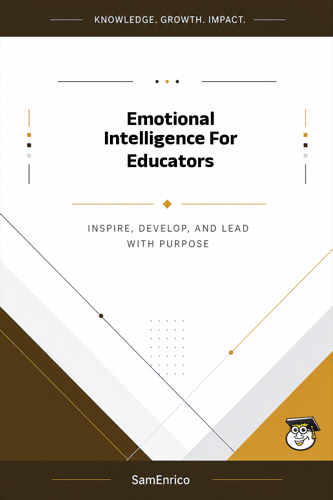
Non-FictionSelf-HelpEducational Psychology
Emotional Intelligence For Educators eBook
Manage classroom emotions and teach EQ skills to s
by Held Jay
Manage classroom emotions and teach EQ skills to students effectively.
Formats
Free sample
Chapter 1: The Quiet Crisis--–- You have had the moment. The one you have not told anyone about. The one where a student’s eye roll—just a flick of muscle and cartilage—ignited something primal in your chest. Your face heated. Your voice sharpened.
The words came out before you could catch them. And later, in the empty parking lot, with the engine idling and your forehead against the steering wheel, you thought: That was not the teacher I signed up to be.You are not alone. That moment happens to excellent teachers every single day. It happens to veteran teachers and first-year teachers. It happens in affluent suburban schools and under-resourced urban classrooms.
It happens because teaching is not primarily an intellectual act. It is primarily an emotional one. And no one prepared you for that.This book is not about becoming a saint. It is not about suppressing your feelings or pretending to be calm when you are drowning. It is about becoming a surgeon of your own nervous system.
Because here is what no one told you in graduate school, in student teaching, or in that stack of professional development binders: A dysregulated teacher cannot regulate a dysregulated classroom. Period.You have been trained in lesson planning, differentiation, assessment design, and classroom management systems. You have learned about Bloom’s Taxonomy, Webb’s Depth of Knowledge, and the latest instructional technology. But when a child throws a chair, when a parent screams at you in a conference, when the principal walks in during your worst moment—none of that intellectual training helps. What helps is your ability to recognize what is happening inside your own body and choose a response rather than react on impulse.That ability is called emotional intelligence.
And it matters more than IQ in the classroom.The Data You Cannot Ignore Let us start with what the research actually says, because you have heard the term “emotional intelligence” thrown around so much that it has begun to sound like corporate fluff. It is not fluff. It is neuroscience.A landmark study from the University of Virginia tracked over 400 teachers across five years and found that teachers with higher emotional intelligence had students who demonstrated significantly greater academic gains—equivalent to an additional two months of learning per year—compared to teachers with similar cognitive abilities but lower EQ. The reason was not magic. Emotionally intelligent teachers were better at noticing when students were confused, anxious, or disengaged.
They adjusted their instruction in real time. They did not blame the students for “not paying attention.” They asked themselves: What am I doing that is not working?Another study published in the Journal of Educational Psychology followed 1,200 elementary students and found that teacher emotional competence was a stronger predictor of student behavioral outcomes than the teacher’s years of experience, certification level, or even the student-teacher ratio in the classroom. In other words, how a teacher manages their own emotions matters more for student behavior than how many students are in the room.And then there is the neuroscience. When you become dysregulated—when your heart rate spikes, your breathing becomes shallow, and your amygdala (the brain’s threat detector) hijacks your prefrontal cortex (the thinking center)—you literally cannot access your best teaching skills. Your working memory shrinks.
Your ability to see multiple perspectives vanishes. Your creativity flatlines. You are teaching from a brain that believes it is under attack.Your students’ brains do the same thing. When a student feels humiliated, scared, or trapped, their amygdala hijacks their prefrontal cortex. They cannot learn.
They cannot reason. They cannot “choose better behavior” because the part of the brain that makes choices has gone offline. This is not an excuse. This is neurology.So here is the uncomfortable truth that this book will return to again and again: You cannot teach a dysregulated child to regulate if you are dysregulated yourself. You cannot co-regulate from a place of chaos.
Your nervous system is the single most powerful classroom management tool you possess. And no one taught you how to use it.The Two Roles You Must Hold One of the most confusing aspects of teaching is that you are expected to hold two seemingly contradictory roles simultaneously. The research on emotional labor in teaching has identified this tension, but it rarely offers a resolution. Let us name the two roles clearly.Role One: The Social-Emotional First Responder This is the role you play during active crises. A student is screaming.
Two students are shoving each other in the back of the room. A child is crying and cannot stop. In these moments, you do not have time for deep breathing exercises or extended reflection. You need split-second intervention. You need scripts.
You need to act before your amygdala hijacks your own thinking.This role is reactive, urgent, and physiologically demanding. It is called first responder for a reason. It is not sustainable for long periods. It is designed for emergencies.Role Two: The Emotional Architect This is the role you play during the other 95 percent of your day. You design the climate.
You build the routines. You model the steady presence that makes students feel safe before anything goes wrong. This role is proactive, slow, and intentional. It is the work that prevents emergencies from happening in the first place.Here is the critical distinction that most books get wrong: You are not supposed to be a first responder all day. If you are constantly in crisis mode, something is wrong with your emotional architecture.
The goal is to build a classroom environment where first responder moments are rare, not routine.Throughout this book, we will be explicit about which role each strategy serves. Chapter 3 focuses on first responder self-regulation (what to do in the first three seconds of a meltdown). Chapters 5 through 7 focus on emotional architecture (how to build a classroom that rarely melts down). You need both skills. But you need to know which tool to reach for in which moment.The Hidden Curriculum No One Taught You Let us talk about the gap between your training and your reality.Traditional teacher preparation programs are excellent at teaching the explicit curriculum: how to write a lesson plan, how to align assessments to standards, how to use educational technology.
But they are almost universally terrible at teaching the hidden curriculum of emotional labor.What is emotional labor? It is the work of managing your own emotions in order to manage the emotions of others. Every time you smile when you are exhausted, every time you stay calm when you want to scream, every time you put aside your own grief to comfort a crying student—that is emotional labor. It is real work. It burns real energy.
And when it is ignored, it leads to burnout.Research by sociologist Arlie Hochschild, who coined the term, found that professions requiring high levels of emotional labor (teaching, nursing, social work, air traffic control) have dramatically higher rates of burnout than professions that do not. But here is the crucial nuance: emotional labor is not inherently bad. It becomes destructive when it is unacknowledged, unsupported, and un-strategic.When…
This is the end of the free sample. Get the eBook to keep going. Buy now
About this book
Details
- Author
- Held Jay
- Publisher
- SamEnrico
- Language
- English
- Genre
- Non-Fiction, Self-Help, Educational Psychology
- Released
- 2026-06-11
- Pages (approx.)
- 144
- Available as
- eBook, Audiobook

Read better in the ZLOADR app
Your eBooks on your phone or tablet. Sign in with your SamEnrico account and start reading.
More by Held Jay
 Creative Failure Fear GuideHeld Jay$11.99
 The Caregiver Traumatic Brain Injury GuideHeld Jay$11.99
 Carson EPA Formation Influence GuideHeld Jay$11.99
 B Vitamin Homocysteine Reduction GuideHeld Jay$11.99
 The Summit Seekers: Everest’s Genetic Pioneers and the Race to the Roof of the WorldHeld Jay$11.99
 The Forgotten Codex: A Scribe’s Vanished ManuscriptHeld Jay$11.99
 Understanding Focal Or Multifocal Malformations In Neuronal MigrationHeld Jay$17.99
 How to Start a Printing By Embossers Business (Beginners Guide)Held Jay$11.99
 Promotion Case Length GuideHeld Jay$12.99
 User Paying Intent HandbookHeld Jay$12.99
You may also like
 Hong Kong Handover 1997Dunn Johnnie$11.99
 Zumba For Postnatal Recovery CourseNeal Christian$11.99
 Zumba for BeginnersLadner Nikia$11.99
 YouTube Comment Mining GuideHumes Pandora$12.99
 Worry Box MeditationCarlin Rudy$11.99
 Workplace Stress MeditationNguyen Lynn$11.99
 Workplace Stress and Sleep RepairHawley Ivory$11.99
 Workplace Perfectionism CureDelaney Jeffry$11.99
 Workplace Injustice Anger GuideWallen Isabelle$11.99
 Work Addiction and Burnout LinkGreenwood Ester$11.99
 Women in Yoga and WellnessBeattie Galina$11.99
 Women in Stand Up ComedyChun Evangeline$11.99