
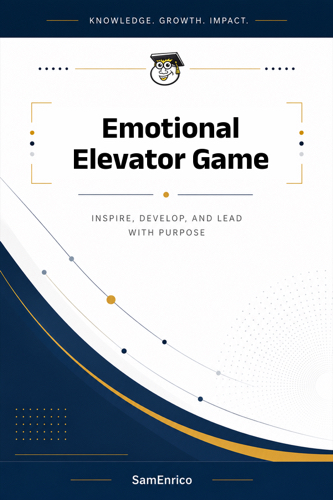
Emotional Elevator Game eBook
Change emotion each floor as elevator doors open.
Change emotion each floor as elevator doors open.
Formats
Free sample
Chapter 1: The Unpushed Button...--–- The elevator doors close behind you with a soft whoosh, and you feel it immediately—the subtle lurch downward, the slight increase in pressure in your chest. You didn't press any buttons. You didn't choose this ride. But here you are, descending into a floor you never wanted to visit. Again.This is how it feels to live without the Call Button.You know the experience.
Your partner makes an offhand comment about the dishes, and thirty seconds later you're sulking in the bedroom, not entirely sure how you got there. Your boss sends a vaguely critical email, and suddenly you're spiraling through three hours of impostor syndrome, constructing elaborate resignation fantasies. A friend cancels plans at the last minute, and you're drowning in a toxic cocktail of abandonment fears and self-righteous indignation.The elevator moves whether you press anything or not. And most of the time, it moves down.We have been taught, explicitly and implicitly, that emotions are things that happen to us. They are weather systems—unpredictable, uncontrollable, best waited out with a cup of tea and a distraction.
This is not entirely wrong. Emotions do arise spontaneously. The limbic system does not ask for permission before releasing cortisol. But the story that emotions simply happen leaves out the most important character in the drama: you.More precisely, it leaves out your awareness.Awareness is not the same as control. You cannot stop the elevator from moving.
You cannot prevent the chemical cascade that floods your system when you feel threatened, rejected, or humiliated. That would be like trying to stop your heart from beating. But you can, at any moment, press the Call Button. You can announce your presence to your own nervous system. You can say, I see that I am in an elevator.
I see that it is moving. I have not yet chosen a floor.That single act—that tiny, five-second pause—is the difference between being a passenger and being an operator.The Hidden Cost of Riding Unaware Let me ask you a question that most books on emotional intelligence are afraid to ask: What has autopilot cost you?Not in theory. In actual, measurable, lived experience. Think back over the last month. How many times did you say something you immediately regretted?
How many times did you eat something you didn't want, buy something you didn't need, or scroll through a screen for an hour while feeling progressively worse? How many times did you snap at someone who didn't deserve it, then spend the rest of the day carrying a low-grade shame that you couldn't quite name?These are not character flaws. These are the natural consequences of riding an elevator without a Call Button.When you react without awareness, you are not making a choice. You are executing a program—a program written by your childhood, your cultural conditioning, your past traumas, and your unexamined habits. That program is very fast, very efficient, and very, very good at keeping you safe from threats that no longer exist.
The problem is that the program cannot distinguish between a saber-toothed tiger and a mildly critical email. It treats both the same way: flood the system, narrow the focus, prepare to fight, flee, or freeze.This is why you cry at work. This is why you scream at your children over spilled milk. This is why you lie awake at 3:00 AM replaying an awkward comment you made at a party eight years ago. Your nervous system is doing exactly what it evolved to do.
It's just doing it at the wrong time, in the wrong place, at the wrong intensity.The Call Button does not delete the program. It gives you a chance to see the program running. And seeing is the first step toward rewriting.The 90-Second Lie (And Why It's Actually True)There is a piece of neuroscience that circulates through self-help circles like a benevolent ghost. It comes from Dr. Jill Bolte Taylor, a neuroanatomist who survived a massive stroke and wrote eloquently about her recovery.
The finding is this: the physiological lifespan of an emotion—the time from the initial chemical trigger to the complete flush of neurotransmitters—is approximately ninety seconds.Ninety seconds.Let that land. A minute and a half. Shorter than most commercial breaks. Shorter than the time it takes to boil water for pasta. If you feel a surge of rage, your body can process that rage chemically in the time it takes to brush your teeth.So why do you stay angry for hours?
Why does grief linger for years? Why does anxiety coil around your ribcage like a serpent that never sleeps?Because after the ninety seconds are up, you are no longer feeling the original emotion. You are feeling the story you tell yourself about the emotion. And that story triggers another emotion. Which triggers another story.
Which triggers another emotion. Ad infinitum, until you are not in a temporary storm but a self-constructed climate.Here is how it works in real life.Seconds 0-90: Your partner makes a sarcastic comment about your cooking. Your amygdala fires. Cortisol and adrenaline surge. Your face flushes.
Your jaw tightens. You feel anger—a hot, sharp, physical sensation. This is chemistry. This is automatic. This is not your fault.Seconds 91-180: The chemical surge begins to subside.
Your body is naturally returning to baseline. But now the narrator in your head starts talking. "They always do this. They never appreciate me. Remember last week when they made that other comment?
This is just like my parents used to treat me. I deserve better. Why do I put up with this?"Seconds 181-270: That story triggers a second wave of chemistry—shame, perhaps, or fear, or righteous indignation. Your body releases another dose of stress hormones. You are no longer angry about the cooking comment.
You are angry about everything. The original trigger is long gone, but the building is still burning.By the end of an hour, you have constructed an entire emotional architecture on top of a ninety-second foundation. And you are living in that architecture as if it were solid rock.The Call Button interrupts the narrator. It does not stop the first ninety seconds—nothing can. But it creates a gap between the chemical event and the storytelling event.
In that gap, you have a choice. You can continue the story, or you can say: "This is a ninety-second chemical event. I will observe it without adding fuel."This is not suppression. Suppression is pretending the emotion isn't there. This is attending—watching the emotion rise, crest, and fall, like a wave you are riding instead of one that is drowning you.What the Call Button Actually Is (A Technical Definition)In the architecture of the Emotional Elevator Game, the Call Button is not a metaphor for positive thinking.
It is not a relaxation technique. It is not a meditation practice, though it shares some features with mindfulness. The Call Button is a physical, repeatable, five-second signal that you send to your nervous system. Its purpose is not to change your emotion. Its purpose is to…
This is the end of the free sample. Get the eBook to keep going. Buy now
About this book
Details
- Author
- Merchant Aliza
- Publisher
- SamEnrico
- Language
- English
- Genre
- Non-Fiction, Self-Help, Emotion
- Released
- 2026-06-10
- Pages (approx.)
- 134
- Available as
- eBook, Audiobook

Read better in the ZLOADR app
Your eBooks on your phone or tablet. Sign in with your SamEnrico account and start reading.
More by Merchant Aliza
 Math Exam Memory Formula SheetMerchant Aliza$11.99
 Parkinson's Caregiver GuideMerchant Aliza$11.99Parkinson's Caregiver GuideMerchant Aliza$11.99
 Overcoming Loneliness for New MomsMerchant Aliza$11.99
 Feeling Nothing Recovery GuideMerchant Aliza$11.99
 Chronic Pain Sleep MeditationMerchant Aliza$11.99
 Perfectionism and Fear of FailureMerchant Aliza$11.99
 Partner Support During MenopauseMerchant Aliza$11.99
 The Iron Beasts of the Savannah: The Engineering Marvels of the Nok PeopleMerchant Aliza$11.99
 The Corsair King: How Francis Drake Plundered the Spanish EmpireMerchant Aliza$11.99
 EcoVadis Rating ExportMerchant Aliza$12.99
 SIN Number Update After PGWPMerchant Aliza$12.99
You may also like
 Hong Kong Handover 1997Dunn Johnnie$11.99
 Zumba For Postnatal Recovery CourseNeal Christian$11.99
 Zumba for BeginnersLadner Nikia$11.99
 YouTube Comment Mining GuideHumes Pandora$12.99
 Worry Box MeditationCarlin Rudy$11.99
 Workplace Stress MeditationNguyen Lynn$11.99
 Workplace Stress and Sleep RepairHawley Ivory$11.99
 Workplace Perfectionism CureDelaney Jeffry$11.99
 Workplace Injustice Anger GuideWallen Isabelle$11.99
 Work Addiction and Burnout LinkGreenwood Ester$11.99
 Women in Yoga and WellnessBeattie Galina$11.99
 Women in Stand Up ComedyChun Evangeline$11.99