
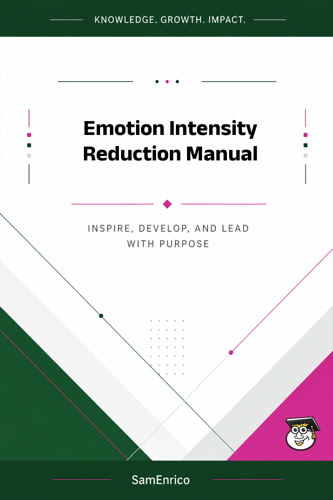
Non-FictionSelf-HelpDBTCrisis Survival
Emotion Intensity Reduction Manual
Use temperature change, intense exercise, and pace
Use temperature change, intense exercise, and paced breathing to rapidly reduce emotional intensity in crisis.
Formats
About this book
Free sample
Chapter 1: The Broken Lever--You are sitting across from a therapist, a trusted friend, or perhaps just your own reflection. Someone asks you, “Why are you so upset?” You know the answer. You can list the reasons, the triggers, the childhood wounds, the unfairness of the moment. You have the language. You have the insight.
You have spent years learning to name your emotions, to trace their origins, to understand the story behind the storm.And yet, none of that stops the storm.In fact, sometimes it makes it worse. Because while you are trying to explain yourself, your heart is still pounding at 130 beats per minute. Your hands are shaking. Your chest feels like it is wrapped in steel cables. Your thoughts are a loop of “I can’t do this” and “Why am I like this?” and “Make it stop.” The more you talk, the more you feel like a fraud—because you understand your emotions perfectly, and understanding has done absolutely nothing to turn down the volume.This is not a failure of will.
It is not a lack of therapy. It is not evidence that you are broken beyond repair.It is neurobiology.The Myth of the Talking Cure in Real-Time Crisis For over a century, Western psychology has operated on a seductive assumption: if you can name it, you can tame it. The “talking cure”—psychoanalysis, cognitive behavioral therapy, talk therapy in its many forms—rests on the belief that bringing unconscious material into conscious awareness, or replacing irrational thoughts with rational ones, will reduce emotional suffering. And for many problems, this is true. Chronic depression, long-standing anxiety patterns, relationship conflicts, and trauma processing all benefit from talk-based therapies over time.But there is a critical distinction that most self-help books fail to make: what works over weeks and months does not work in the next sixty seconds.When you are in the middle of a full-throttle emotional crisis—the kind where your vision tunnels, your breath shortens, and you feel an overwhelming urge to run, hit, scream, or hurt yourself—the parts of your brain required for talk therapy are literally offline.…
This is the end of the free sample. Get the eBook to keep going. Buy now
Contents
- Chapter 1
- Chapter 2
- Chapter 3
- Chapter 4
- Chapter 5
- Chapter 6
- Chapter 7
- Chapter 8
- Chapter 9
- Chapter 10
- Chapter 11
- Chapter 12
Details
- Author
- Wallace Elizabeth
- Publisher
- SamEnrico
- Language
- English
- Genre
- Non-Fiction, Self-Help, DBT, Crisis Survival
- Released
- 2026-06-10
- Pages (approx.)
- 142
- Available as
- eBook, Audiobook

Read better in the ZLOADR app
Your eBooks on your phone or tablet. Sign in with your SamEnrico account and start reading.
More by Wallace Elizabeth
 Large Audience Anxiety GuideWallace Elizabeth$11.99
 Kidnapped Journal FoundWallace Elizabeth$11.99
 Hearst World Building IconWallace Elizabeth$11.99
 Parental Anger and Screaming CessationWallace Elizabeth$11.99
 Rumbling Beneath the Sands: The Forgotten Seismologists of the Middle EastWallace Elizabeth$11.99
 The Moscow Paradox: The Spy Who Vanished in 1985Wallace Elizabeth$11.99
 Understanding Borrone–di Rocco–crovato SyndromeWallace Elizabeth$17.99
 How to Start a Hobby in Image editing (with Adobe Photoshop for example)Wallace Elizabeth$11.99
 Uber Virtual Internship BlueprintWallace Elizabeth$12.99
 Kenyan Public Holidays Remote GuideWallace Elizabeth$12.99
 Buckeye Chicken BreedingWallace Elizabeth$11.99
You may also like
 Hong Kong Handover 1997Dunn Johnnie$11.99
 Zumba For Postnatal Recovery CourseNeal Christian$11.99
 Zumba for BeginnersLadner Nikia$11.99
 YouTube Comment Mining GuideHumes Pandora$12.99
 Worry Box MeditationCarlin Rudy$11.99
 Workplace Stress MeditationNguyen Lynn$11.99
 Workplace Stress and Sleep RepairHawley Ivory$11.99
 Workplace Perfectionism CureDelaney Jeffry$11.99
 Workplace Injustice Anger GuideWallen Isabelle$11.99
 Work Addiction and Burnout LinkGreenwood Ester$11.99
 Women in Yoga and WellnessBeattie Galina$11.99
 Women in Stand Up ComedyChun Evangeline$11.99