
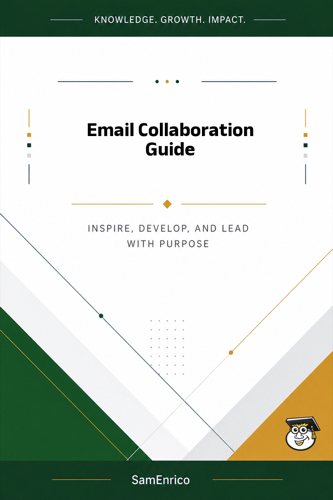
Non-FictionBusiness BriefEmailShared
Email Collaboration Guide eBook
Use shared inboxes for team handled messages to pr
Use shared inboxes for team handled messages to prevent duplication.
Formats
Free sample
Chapter 1: The $50,000 CC…--It was 10:47 AM on a Tuesday when Sarah, a senior account manager at a mid-sized marketing agency, made a decision that would cost her company $50,000. She didn’t know it at the time. She was just trying to be helpful.A client had emailed a simple question about timeline adjustments for an upcoming product launch. The email was addressed to Sarah directly, but she was heading into back-to-back meetings for the next four hours. Rather than let the client wait, she did what most well-intentioned professionals do: she forwarded the email to three colleagues with a cheerful “Can someone please handle this?
Thanks!”Within ninety minutes, something predictable and catastrophic happened.Her colleague James replied to the client with one set of dates. Her colleague Priya, who hadn’t seen James’s reply because she was working offline on a plane, replied two hours later with completely different dates. Her colleague Marcus, assuming the first two replies were both wrong, sent a third email “correcting” both of them with a third set of dates.The client, a senior vice president who had been with the agency for seven years, did not reply to any of the three emails. Instead, she forwarded the entire thread—all four emails, including Sarah’s original forward—to the agency’s CEO with a single sentence:“Does anyone at your company actually talk to each other?”The CEO called Sarah into his office at 4:30 PM that day. The client had demanded an explanation, a formal apology from the entire account team, and a fifteen percent discount on their next quarter’s contract.
The discount alone was $50,000.Sarah’s helpful forward had just cost her company fifty thousand dollars.The Invisible Tax of Traditional Email Here is the truth that no one tells you about email: It was never designed for teams.Email was invented in 1971 by Ray Tomlinson, who sent the first message between two computers sitting next to each other. The system he built was elegant for one person talking to one other person. It worked beautifully for “I’ll send you this file” and “What time is the meeting?” But Tomlinson was not thinking about what would happen when twenty, fifty, or five hundred people tried to collaborate through the same medium.Yet here we are, five decades later, running our teams on infrastructure built for individuals.The result is what I call the Invisible Tax of Email—the cumulative cost of every duplicated reply, every email that falls through the cracks, every “I thought YOU were handling that,” and every hour your team spends untangling confusion that should never have existed in the first place.Most teams don’t measure this tax. They feel it. They complain about it.
They joke about “reply-all apocalypses” and “CC hell.” But they never calculate the actual number. And because they never calculate it, they never fix it.Let’s fix that right now.The Real Cost: A Simple Calculation Before we go any further, I want you to do something uncomfortable. I want you to estimate how much money your team loses to email chaos every week.Here is the formula:(Average hourly salary of your team members) × (Number of team members using shared email addresses) × (Estimated hours per week lost to email duplication and confusion)Be honest. Don’t use the number you would tell your boss. Use the real number.I have run this calculation with over two hundred teams in the last four years.
The average result for a team of ten people is **$1,400 per week**. That is nearly $73,000 per year. For a team that thinks they are “managing just fine.”If your team is larger, the number gets frightening very quickly. A customer support team of fifty people, each making $30 per hour, losing just two hours per week to email chaos, is losing $156,000 per year. That is not a rounding error.
That is a salary for two full-time employees who could be doing actual work instead of untangling email knots.But here is what makes the Invisible Tax so insidious: you never see the waste in your profit and loss statement. It hides in plain sight. It shows up as “longer than expected response times,” “customer complaints about inconsistent answers,” “overtime hours that never get explained,” and the quiet burnout of your best employees who are tired of fighting the same fires every single week.The $50,000 CC was not an anomaly. It was a symptom.The Five Faces of Email Waste After analyzing thousands of team inboxes across every industry you can imagine—Saa S support teams, nonprofit donor relations, hospital administration, university admissions, real estate brokerages, and even a professional sports team—I have identified five distinct ways that traditional email fails teams.I call these the Five Faces of Email Waste. Every single problem you have ever experienced with team email fits into exactly one of these categories.
And once you can name the problem, you can solve it.Face One: Collision (Two Agents, One Customer, Same Time)Collision is what happened to Sarah’s team, but with a specific twist: two or more people replying to the same email at roughly the same time because neither knew the other was working on it.This is the most visible form of email waste. You see it immediately. The customer replies with “I just got two different answers from two of your people.” The team scrambles to apologize. The damage is done.Collision happens because traditional email has no visibility. In Gmail, Outlook, or any standard email client, you cannot see who else is looking at an email.
You cannot see who is typing a reply. You are flying blind, and so is everyone else on your team.The solution to Collision is what I call the Eyes on the Screen protocol—a combination of tool features and team disciplines that make collisions impossible. We will spend an entire chapter on this later. For now, just know that Collision is not a people problem. It is a visibility problem.Face Two: Fragmentation (One Customer, Many Threads)Fragmentation occurs when a single customer conversation gets scattered across multiple email threads because the customer replies to an old message, changes the subject line, or emails from a different address.Here is how Fragmentation feels from the customer’s side: You email a support team about a billing issue.
They reply with a tracking number. Two days later, you reply to that same thread with additional information. But because you accidentally changed the subject line from “Billing question - Ticket #4452” to just “Following up,” the support system creates a brand new ticket. A brand new agent picks it up. That agent has no idea about the first three emails.
You are now starting from zero.Fragmentation wastes everyone’s time. The customer feels unheard. The agent feels frustrated. The team looks incompetent.The solution to Fragmentation is conversation merging—the technical ability to link a new email to an existing thread even when the subject line changes. Most modern shared inbox tools can do this automatically.
Most teams never turn the feature on.Face Three: Repetition (Many Customers, Same Answer)Repetition is the quiet killer of team productivity.…
This is the end of the free sample. Get the eBook to keep going. Buy now
About this book
Details
- Author
- Crutcher Carie
- Publisher
- SamEnrico
- Language
- English
- Genre
- Non-Fiction, Business Brief, Email, Shared
- Released
- 2026-06-08
- Pages (approx.)
- 155
- Available as
- eBook, Audiobook

Read better in the ZLOADR app
Your eBooks on your phone or tablet. Sign in with your SamEnrico account and start reading.
More by Crutcher Carie
 Teen Military Enlistment EsteemCrutcher Carie$11.99
 Depression Leave ReturnCrutcher Carie$11.99
 Catherine Partition PolandCrutcher Carie$11.99
 The Gratitude for Difficult TimesCrutcher Carie$11.99
 The Great Zanzibar Palace of Wonders: Where African Rhythms Met the World (15th-16th Century)Crutcher Carie$11.99
 Understanding Yolk Sac TumorCrutcher Carie$17.99
 How to Start a Development of Building Projects for Residential Buildings Business (Beginners Guide)Crutcher Carie$11.99
 C Corp vs LLC for MarketplaceCrutcher Carie$12.99
 Freelance Bookkeeping for SalonsCrutcher Carie$12.99
 The Tinder ParadoxCrutcher Carie$11.99The Tinder ParadoxCrutcher Carie$11.99The Tinder ParadoxCrutcher Carie$11.99
You may also like
 Hong Kong Handover 1997Dunn Johnnie$11.99
 Zumba For Postnatal Recovery CourseNeal Christian$11.99
 Zumba for BeginnersLadner Nikia$11.99
 YouTube Comment Mining GuideHumes Pandora$12.99
 Worry Box MeditationCarlin Rudy$11.99
 Workplace Stress MeditationNguyen Lynn$11.99
 Workplace Stress and Sleep RepairHawley Ivory$11.99
 Workplace Perfectionism CureDelaney Jeffry$11.99
 Workplace Injustice Anger GuideWallen Isabelle$11.99
 Work Addiction and Burnout LinkGreenwood Ester$11.99
 Women in Yoga and WellnessBeattie Galina$11.99
 Women in Stand Up ComedyChun Evangeline$11.99