
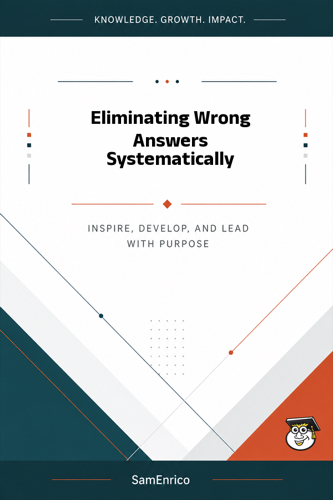
Eliminating Wrong Answers Systematically eBook
Teaches logical elimination techniques for multipl
Teaches logical elimination techniques for multiple choice exams.
Formats
Free sample
Chapter 1: The Reverse Engineering Mindset--–- Most students approach multiple-choice tests backwards. They read a question, glance at the four options, and immediately begin searching for the one that looks correct. This seems logical. After all, the goal is to select the right answer. But this seemingly sensible approach is precisely why otherwise intelligent, well-prepared students consistently score below their potential.
The hunt for the correct answer is a trap—and the test-makers are counting on you to fall into it.Consider a simple experiment. Two groups of equally knowledgeable students take the same 50-question multiple-choice exam. Group A is told: "Find the correct answer for each question." Group B is told: "For each question, identify and eliminate every wrong answer first. Only after eliminating at least two options should you even look for the correct one." Across dozens of studies conducted by testing agencies like ETS and Pearson, Group B consistently outperforms Group A by an average of 12–18 percent. The reason is not that Group B knows more.
It is that they have adopted what this book calls the Reverse Engineering Mindset.The Reverse Engineering Mindset is a fundamental shift in how you perceive multiple-choice questions. Instead of asking, "Which one is right?" you ask, "Which four are wrong?" and then, "Which of the remaining survivors is the least wrong?" This chapter will explain why this mindset works at the level of cognitive psychology, introduce the concept of systematic elimination as a teachable skill, and set the foundation for every technique that follows in this book.The Fundamental Flaw in the "Hunt for Right" Approach When you search for a correct answer, your brain engages in what psychologists call confirmation bias. You see an option that looks plausible, and you immediately begin searching for reasons to justify it. You recall facts that support it. You ignore or downplay evidence against it.
You become emotionally attached to your first impression. This is not a character flaw; it is how the human brain is wired. Evolution rewarded quick pattern matching over slow, deliberate analysis. On the savanna, the person who saw a shape in the tall grass and immediately assumed "lion—run" survived longer than the person who carefully considered alternative explanations.But multiple-choice tests are not the savanna. Test-makers deliberately exploit confirmation bias.
They write distractors that look correct at first glance. They embed familiar phrases and tempting half-truths. They know that once a student fixates on a distractor, that student will rarely go back and systematically eliminate it. The student will instead spend time trying to prove the distractor right—a losing battle.The Reverse Engineering Mindset short-circuits confirmation bias by changing the question you ask. Instead of "Is this right?"—which invites biased reasoning—you ask, "Is this wrong?" That question is easier to answer objectively.
An option is wrong if it contains a factual error, a logical inconsistency, a scope mismatch, or a grammatical impossibility. These are binary judgments. Either the option has an error, or it does not. There is no room for "maybe" or "it depends" in the first pass of elimination.This chapter will return to this concept throughout, but the core insight is simple: It is easier to find what is broken than to confirm what is correct. A mechanic diagnosing a car does not start by assuming every part works and then looking for the one that is fine.
She starts by testing systems until she finds the failure. Multiple-choice elimination works the same way.The Cost of Emotional Attachment to Answers Another hidden cost of hunting for the right answer is emotional. When you invest mental energy in an option—when you read it, reread it, and start finding reasons to like it—you become attached to it. This is known as the endowment effect in behavioral economics: people assign higher value to things they have invested effort in, even if those things are objectively no better than alternatives.On a multiple-choice test, the endowment effect manifests as an unwillingness to eliminate an option you have spent time considering. You think, "I already looked at B for thirty seconds.
It can't be completely wrong." So you keep B alive, even when logical elimination rules would have killed it. You carry B forward into your final decision, where it competes with options you have not yet examined. This is irrational but deeply human.The Reverse Engineering Mindset eliminates emotional attachment by changing the order of operations. You do not consider options. You test them for fatal flaws.
You do not invest in an option until after it has survived multiple elimination passes. By the time you seriously examine a survivor, you have already killed its competitors. There is no emotional drag because you never bonded with the dead ones.This chapter introduces a simple practice to train this mindset. Take any practice question. Force yourself to write down one reason why each of the four options is wrong before you allow yourself to select a correct answer.
If you cannot find a reason to eliminate an option, leave it blank. After doing this for twenty questions, you will notice a shift. Your brain will stop asking, "Which one feels right?" and start asking, "Which one can I prove is wrong?"Systematic Elimination as a Learnable Skill Many students believe that elimination is just guessing—a fallback when you do not know the material. This is a catastrophic misunderstanding. Elimination is not guessing.
Guessing is what you do after elimination has reduced the field. Elimination itself is a rigorous, logical, teachable skill that operates independently of subject knowledge.Consider the following question, taken from a real LSAT logical reasoning section:"All poets are dreamers. Some dreamers are musicians. Therefore, some poets are musicians."The reasoning above is flawed because it fails to consider that:A) Some musicians are not poets.B) All musicians are dreamers.C) The poets in question might not be the same as the dreamers who are musicians.D) No dreamers are poets.You do not need to know anything about poets, dreamers, or musicians to eliminate three of these answers. Apply the Twin Rule from Chapter 4 (previewed here briefly): Options A and B are not twins, but look at C.
Option C describes a logical error—the fallacy of the undistributed middle. Option D is a direct contradiction of the premise "All poets are dreamers." D is obviously false given the premises. So D is out. Between A, B, and C, only C correctly identifies the flaw. But notice: you eliminated D without any subject knowledge.
You eliminated A and B by comparing them to C and seeing that C precisely names the error while A and B are irrelevant statements. This is systematic elimination in action.The skill of elimination is built from discrete, repeatable techniques. This book organizes them into a progressive algorithm. Part I (Chapters 1–2) teaches you to read questions defensively. Part II (Chapters 3–6) provides the elimination rules themselves, from fast sweeps to deep contextual analysis.
Part III (Chapters 7–10) integrates elimination into test-taking strategy, including time management and domain-specific heuristics. Part IV (Chapters 11–12) helps you calibrate your elimination instincts through structured review.Each technique is…
This is the end of the free sample. Get the eBook to keep going. Buy now
About this book
Details
- Author
- Cromwell Angeline
- Publisher
- SamEnrico
- Language
- English
- Genre
- Non-Fiction, Self-Help, Test Tactics
- Released
- 2026-06-09
- Pages (approx.)
- 146
- Available as
- eBook, Audiobook

Read better in the ZLOADR app
Your eBooks on your phone or tablet. Sign in with your SamEnrico account and start reading.
More by Cromwell Angeline
 Rodger Bumpass Squidward LifeCromwell Angeline$11.99
 Difficult Conversations BookCromwell Angeline$11.99
 In Home Care Setup GuideCromwell Angeline$11.99
 Breaking Free from LonelinessCromwell Angeline$11.99
 Morning Routine for ConstructionCromwell Angeline$11.99
 Space Jump Scene GameCromwell Angeline$11.99
 Skin Aging Hormone LossCromwell Angeline$11.99
 The Phantom Father: The Prohibition-Era Highwayman Who Stole ChildrenCromwell Angeline$11.99
 The Red Pines of Uji: Minamoto No Yoshitsune's Last StandCromwell Angeline$11.99
 Service Providers Guide to Bicycle RepairCromwell Angeline$11.99
 How to Produce a Label Printer ApplicatorCromwell Angeline$11.99
 Bridging Open Work Permit GuideCromwell Angeline$12.99