
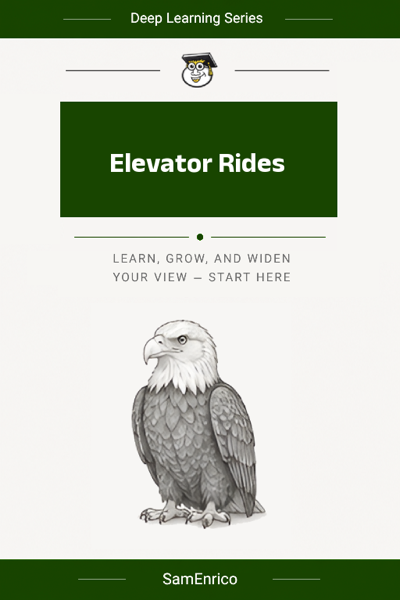
Non-FictionInformativeEducational
Elevator Rides eBook
A Coursebook on Elevator Rides
A Coursebook on Elevator Rides
Formats
Free sample
Chapter 1: The Rope That Held...--The axe blade caught the light of the New York afternoon, suspended for a single breath above the hemp rope. Below it, fifty feet down, a crowd of investors, journalists, and skeptical engineers tilted their faces upward. They had come to the Crystal Palace Exposition in 1853 expecting to see machines that spun thread and printed newspapers. Instead, they found a forty-two-year-old former wagon-maker standing on a wooden platform, holding an axe, about to commit what looked like professional suicide.Elisha Graves Otis was not a confident man by nature. He had failed at more businesses than most people attempt in a lifetime—a gristmill, a sawmill, a carriage company, a railroad brake factory.
His first wife had died young. His second marriage was strained by debt. At the moment he raised that axe, he was technically insolvent, having borrowed money from his own brothers just to rent exhibition space at the fair. The only thing he owned outright was a patent for a device no one had asked for: a safety brake for hoisting platforms.The problem he was trying to solve was as old as ropes themselves. Since the beginning of the Industrial Revolution, factories and warehouses had used steam-powered lifts to move heavy goods between floors.
But these "hoists" were death traps. A single frayed rope, a single slipped knot, a single over-lubricated pulley, and the platform would plummet, crushing anyone beneath it and throwing anyone on it against whatever stopped the fall first. No one rode these machines voluntarily. They were for freight only—coal, crates, iron ingots, animal carcasses. The human body was not trusted to the rope.Otis had spent two years quietly working on a solution in a rented loft in Yonkers, New York.
His idea was absurdly simple: a spring-loaded wagon spring mounted to the top of the platform, connected to a set of steel teeth that normally rested just above the guide rails. Under tension from the hoist rope, the spring stayed compressed, the teeth stayed retracted, and the platform moved freely. But if the rope broke—or was cut—the spring would instantly expand, driving the teeth into the rails with a force proportional to the speed of the fall. The faster the platform dropped, the harder the teeth bit. It was a device that used the energy of the fall to stop the fall.
It was, in the truest sense, a machine that saved itself.The problem was that no one believed him.In 1853, the word "elevator" did not exist in its modern sense. The Latin root elevare meant "to lift up," but the thing being lifted was almost never a person. Hotels and hospitals had begun experimenting with hydraulic lifts powered by city water pressure, but these were slow, leaky, and prone to catastrophic failure when cast-iron pipes burst. The prevailing wisdom among engineers was that vertical passenger transport would never be safe. The rope would always break eventually.
The human body would always lose that fight. The skyscraper, which existed only as a theoretical fantasy in the minds of architects like Louis Sullivan and Daniel Burnham, was impossible precisely because no one could figure out how to get people to the top floors without killing them on the way down.Otis understood something his contemporaries did not. He understood that the fear was not about the rope. The rope was just the visible symbol of a deeper terror: the loss of control. When you are on a ladder, you control your ascent.
When you are on stairs, you choose each step. But when you are suspended on a rope, you are passive. You surrender. You trust. And trust, in 1853, was not something Americans extended to machines.
The railroad had killed thousands. Steamboats exploded with horrifying regularity. Factory machinery crushed limbs and pulled workers into gears without warning. The industrial age had taught people one lesson above all others: machines want to kill you, and they are patient.Otis needed to reverse that lesson in a single demonstration.The Crystal Palace The New York Crystal Palace was a wonder of its age—a massive cast-iron and glass structure modeled after London's Crystal Palace, designed to showcase the best of American industry. It occupied the space that would later become Bryant Park, just behind the New York Public Library.
For six months in 1853, it hosted thousands of exhibitors displaying everything from Colt revolvers to Mc Cormick reapers to the first mechanical voting machine. Otis could not afford a prime exhibition space. He could not afford a full-sized elevator. He could not even afford a proper sign.What he could afford was a single open shaft, a small wooden platform, a hoist rope, and an axe borrowed from the building's maintenance shed.He set up his demonstration in a corner of the main hall, far from the crowded aisles where visitors flocked to see the latest sewing machines. His platform was deliberately small—barely six feet square—so that it could be hoisted only fifty feet, not the hundred or more that a real elevator might need.
His rope was deliberately ordinary, the same grade of hemp used in factories across the city. His brake was the only thing that was not ordinary. It sat on top of the platform, hidden beneath a hinged wooden cover that he lifted for the demonstration.The crowd that gathered on that autumn afternoon was not large. Maybe fifty people, mostly other exhibitors killing time between customers. But word had spread that the crazy wagon-maker was going to try something dangerous, and dangerous attracted attention in the same way a fire attracts onlookers.
By the time Otis climbed onto the platform and signaled for the hoist to begin, the crowd had grown to perhaps two hundred.He rose slowly. The steam engine that powered the hoist wheezed and groaned, filling the hall with the smell of hot oil and coal smoke. At ten feet, he looked down and saw faces staring up with expressions of mild curiosity. At twenty feet, a few men in the back began murmuring to each other. At thirty feet, someone shouted, "How high are you going?" Otis did not answer.
At forty feet, the platform began to wobble slightly—the inevitable result of imperfect guide rails and a rope that stretched under load. At fifty feet, he signaled stop.The platform swayed gently. The rope creaked. Otis stood perfectly still, a slight man in a black frock coat, his face expressionless. Then he reached down, picked up the axe, and held it so the crowd could see.The murmuring stopped.He raised the axe over his head, the blade glinting in the pale light filtering through the glass ceiling.
He looked down at the crowd. He looked at the rope. And then, with a single, deliberate motion, he brought the axe down and cut the rope clean through.The Fall That Wasn't The crowd screamed.It was not a theatrical scream or a staged gasp. It was the genuine, involuntary, animal cry of people watching another person die. Several women turned away.
One man dropped his hat. A child began to cry. Because in 1853, when a rope broke, the platform fell.…
This is the end of the free sample. Get the eBook to keep going. Buy now
About this book
Details
- Author
- Frazier Gerald
- Publisher
- SamEnrico
- Language
- English
- Genre
- Non-Fiction, Informative, Educational
- Released
- 2026-06-02
- Pages (approx.)
- 138
- Available as
- eBook, Audiobook

Read better in the ZLOADR app
Your eBooks on your phone or tablet. Sign in with your SamEnrico account and start reading.
More by Frazier Gerald
 Testosterone and Body Fat DistributionFrazier Gerald$11.99
 Cape Town Pitch Preparation CourseFrazier Gerald$11.99
 Pain Forgiveness PracticeFrazier Gerald$11.99
 The Mindfulness Based Stress ReductionFrazier Gerald$11.99
 High Pressure Deadline Coping SkillsFrazier Gerald$11.99
 The Last Telegram: How a Single Message Ignited a Cold War ConfrontationFrazier Gerald$11.99
 Eyes in the Sky: The Aerial Pioneers Who Redrew North AmericaFrazier Gerald$11.99
 Proposal for Research AssistantshipsFrazier Gerald$12.99
 Australian Superannuation GuideFrazier Gerald$12.99
 Understanding Charcot–Marie–tooth Disease Type 2b2Frazier Gerald$17.99
 How to Start a Hobby in KarateFrazier Gerald$11.99
You may also like
 Hong Kong Handover 1997Dunn Johnnie$11.99
 Zumba For Postnatal Recovery CourseNeal Christian$11.99
 Zumba for BeginnersLadner Nikia$11.99
 YouTube Comment Mining GuideHumes Pandora$12.99
 Worry Box MeditationCarlin Rudy$11.99
 Workplace Stress MeditationNguyen Lynn$11.99
 Workplace Stress and Sleep RepairHawley Ivory$11.99
 Workplace Perfectionism CureDelaney Jeffry$11.99
 Workplace Injustice Anger GuideWallen Isabelle$11.99
 Work Addiction and Burnout LinkGreenwood Ester$11.99
 Women in Yoga and WellnessBeattie Galina$11.99
 Women in Stand Up ComedyChun Evangeline$11.99