
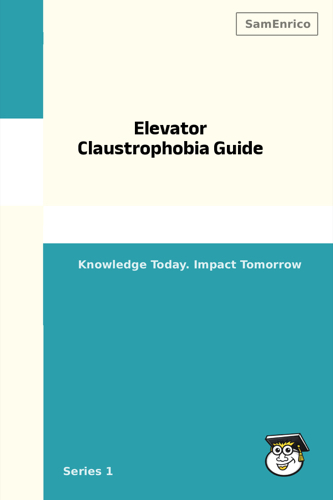
Elevator Claustrophobia Guide eBook
Ride in small spaces with controlled breathing and
by Draper Hai
Ride in small spaces with controlled breathing and visual distraction.
Formats
Free sample
Chapter 1: The Stairwell Lie--–- Every time you choose the stairs, you are not saving yourself. You are sentencing yourself to a longer sentence in the prison of your own mind. That sounds dramatic, I know. But let me explain why avoiding an elevator is one of the most destructive things you can do for your claustrophobia, and why the stairs you think are saving you are actually the very thing keeping you trapped.Let me start with a confession. Three years ago, I stood in front of a hotel elevator on the nineteenth floor.
I had just finished a two-hour meeting on the top floor of a high-rise in downtown Chicago. My colleagues pressed the call button. The doors opened. The elevator was empty, well-lit, and less than three days old. It smelled like new carpet and nothing else.
By every objective measure, it was one of the safest places I could have stood. And I could not get in.Instead, I told my colleagues I needed to take a call. I watched the doors close on their smiling, unbothered faces. And then I walked down nineteen flights of stairs. Nineteen.
By the time I reached the lobby, my knees were shaking, my shirt was soaked with sweat, and my lungs were burning. But that wasn't the worst part. The worst part was that I felt relieved. I had escaped. I had won.Except I hadn't won.
I had lost, and I didn't even know it.Because here is what happened inside my brain during those nineteen flights of stairs. Every step downward was a message sent directly to my amygdala – the ancient, reptilian part of my brain that exists solely to keep me alive. And the message was this: The elevator was dangerous. You avoided it. You survived.
Good job. Do that again next time. My brain did not know that I was avoiding a perfectly safe machine. My brain only knew that I had perceived a threat, taken action to escape that threat, and lived to tell the tale. That is the entire algorithm of fear learning.
Threat plus avoidance equals survival. Repeat.And repeat I did. For years.This chapter is called The Stairwell Lie because that is exactly what avoidance is. It is a lie you tell your brain every single time you choose the stairs, or wait for the next elevator when one arrives too crowded, or take the escalator, or simply stand in the hallway pretending to check your phone until the doors close and you can breathe again. The lie is this: I am keeping myself safe.But you are not keeping yourself safe.
You are making yourself less safe. Not from elevators – elevators are statistically safer than stairs, by the way, with far fewer injuries per million rides – but from your own fear. Every avoidance event is a deposit into what I call the Fear Savings Account. And the interest rate is punishing. Because the next time you face an elevator, your brain will remember every single time you ran away.
And it will demand that you run again, but faster, and sooner, and with more panic.The False Suffocation Alarm Let’s talk about what is actually happening inside your body when you stand in front of an elevator and feel your throat tighten, your chest compress, and your palms go slick with sweat.Your brain has a built-in suffocation alarm. It is an ancient piece of neurobiology that evolved hundreds of millions of years ago, long before humans existed, long before elevators existed, long before any of the modern world existed. This alarm was designed to detect one thing and one thing only: a drop in available oxygen that could lead to death by suffocation. In the wild, this alarm saved lives. It told our ancestors to get out of enclosed caves, to surface from underwater, to pull their faces out of mud or snow or whatever else was blocking their airways.The problem is that this alarm is not very sophisticated.
It does not measure actual oxygen levels in your blood. That would be too slow. Instead, it uses a series of proxy signals – the feeling of a tight space, the sensation of pressure on your chest, the sight of walls closing in, the sound of your own breathing becoming shallow, the memory of a previous panic attack. And elevators, unfortunately, trigger nearly every single one of these proxy signals at the same time.You step into a small metal box. The doors close behind you.
The walls are maybe three feet away on either side. The ceiling is low. The air feels still. Your brain, in less than a second, runs through its ancient checklist. Limited escape routes?
Check. Enclosed space? Check. Reduced airflow sensation? Check.
Previous fear response in similar environment? Check. And then it sounds the alarm. Not because you are actually suffocating – the oxygen level in an elevator is identical to the oxygen level in your living room – but because the proxy signals match the suffocation profile.This is what I call the False Suffocation Alarm. And once you understand that it is false, you are already halfway out of the trap.But here is where most people get stuck.
They feel the alarm go off, they feel the panic rising, and they do the most logical thing in the world. They try to escape. They push the door open button. They press the emergency call button. They pry the doors apart with their fingers.
Or, more commonly, they never get on the elevator in the first place. They take the stairs. They wait for the next one. They ask a friend to ride with them. They take the escalator.
They walk an extra eight blocks to avoid the one building with the glass elevator.And every single one of those behaviors, no matter how reasonable they seem, is a deposit into the Fear Savings Account.The Avoidance Trap I want you to imagine a dog. Not a real dog – a hypothetical dog. This dog is in a laboratory, and it is placed in a cage with a metal floor. The experimenters sound a tone, and then they deliver a mild electric shock to the dog's feet. This happens several times.
Soon, the dog learns that the tone predicts the shock. When the dog hears the tone, it shows signs of fear – whining, trembling, trying to escape.Now imagine that the experimenters stop delivering the shock. The tone sounds, but no shock follows. At first, the dog still shows fear. But after repeated tones without shocks, something remarkable happens.
The dog stops being afraid. The fear extinguishes. The dog learns that the tone no longer means danger.But here is the twist. If the experimenters give the dog a way to escape – if they open the cage door whenever the tone sounds – the dog will run out of the cage every single time. And here is the critical part: the dog will never stop being afraid.
Because the escape behavior prevents the dog from learning that the tone is safe. The dog only learns that escape works. And the fear stays forever.You are the…
This is the end of the free sample. Get the eBook to keep going. Buy now
About this book
Details
- Author
- Draper Hai
- Publisher
- SamEnrico
- Language
- English
- Genre
- Non-Fiction, Self-Help
- Released
- 2026-06-08
- Pages (approx.)
- 146
- Available as
- eBook, Audiobook

Read better in the ZLOADR app
Your eBooks on your phone or tablet. Sign in with your SamEnrico account and start reading.
More by Draper Hai
 Jimmy Hoffa Frank Fitzsimmons Succession PlotDraper Hai$11.99
 Soldier's Declaration of ConscienceDraper Hai$11.99
 SMART Measurable GoalsDraper Hai$11.99
 Self Esteem for First Generation ProfessionalsDraper Hai$11.99
 Money Talk With KidsDraper Hai$11.99
 Job Loss for Older WorkersDraper Hai$11.99
 The Hollow Crown's Last GuardianDraper Hai$11.99
 Euclid's Elements: The Secret Code of Shapes and NumbersDraper Hai$11.99
 A Collector's Handbook to the Rolls-royce WraithDraper Hai$11.99
 How to Produce Portable MediaDraper Hai$11.99
 Growing BothriochloaDraper Hai$11.99
 Managing Up Success Metrics GuideDraper Hai$12.99
You may also like
 Hong Kong Handover 1997Dunn Johnnie$11.99
 Zumba For Postnatal Recovery CourseNeal Christian$11.99
 Zumba for BeginnersLadner Nikia$11.99
 YouTube Comment Mining GuideHumes Pandora$12.99
 Worry Box MeditationCarlin Rudy$11.99
 Workplace Stress MeditationNguyen Lynn$11.99
 Workplace Stress and Sleep RepairHawley Ivory$11.99
 Workplace Perfectionism CureDelaney Jeffry$11.99
 Workplace Injustice Anger GuideWallen Isabelle$11.99
 Work Addiction and Burnout LinkGreenwood Ester$11.99
 Women in Yoga and WellnessBeattie Galina$11.99
 Women in Stand Up ComedyChun Evangeline$11.99