
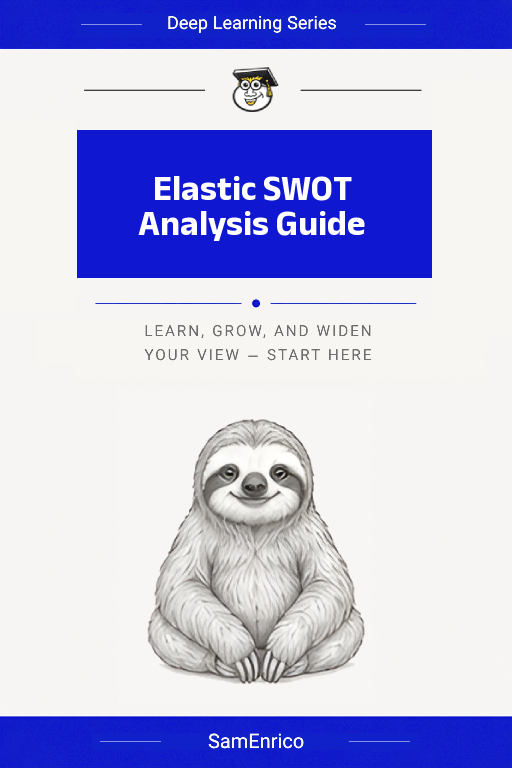
Non-FictionStrategic AtlasSearch
Elastic SWOT Analysis Guide eBook
Analyze search and observability platform, open-so
Analyze search and observability platform, open-source core, competition from Splunk and Datadog, and monetization.
Formats
Free sample
Chapter 1: The Recipe App...-- The most valuable technology companies of the past decade were not built in boardrooms. They were not architected by Mc Kinsey consultants or launched with Super Bowl commercials. They began as side projects, as scratching posts for frustrated developers, as solutions to problems so small that no venture capitalist would return a phone call about them. Elastic is one of those companies. Its origin story begins not with a billion-dollar market analysis, but with a young man named Shay Banon and his wife’s desire to become a chef.In 2004, Banon’s wife enrolled in a culinary school in London.
As she worked through recipes, she needed a way to search through the growing collection of dishes she was mastering. Banon, a software engineer by trade, decided to build her a simple search tool. He started with Apache Lucene, an open-source information retrieval library that was powerful but notoriously difficult to use. Banon built a lightweight wrapper around Lucene and called it Compass. It worked.
His wife could find her recipes. The problem was solved.But Banon noticed something. The act of making Lucene easier to use—of wrapping its raw power in a simple interface—had value far beyond his wife’s kitchen. Other developers started asking for Compass. They had their own data to search: product catalogs, log files, customer records.
Banon rebuilt Compass from the ground up, stripping away the complexity, making it distributed by design so it could run across many computers simultaneously. He called it Elasticsearch. He released it as open source in 2010.What happened next was not a marketing campaign. It was not a sales blitz. It was a quiet, relentless, and ultimately explosive wave of developer adoption.
Within a year, Elasticsearch had been downloaded over 1 million times. Within two years, it became the most popular search engine on Git Hub. Within three years, Banon had raised 100millionfromtop−tierventurecapitalfirms.Withineightyears,Elasticwentpublicatavaluationexceeding100 million from top-tier venture capital firms. Within eight years, Elastic went public at a valuation exceeding 100millionfromtop−tierventurecapitalfirms.Withineightyears,Elasticwentpublicatavaluationexceeding1.2 billion.This chapter tells the story of that improbable journey. It introduces the central framework of this book—the Accidental Business Model—and establishes the first pillar of Elastic’s strategic strength: the developer community as a sales force.
By the end of this chapter, you will understand how a bottom-up, product-led growth engine operates. You will see why building for the individual developer first, not the enterprise procurement officer, can create one of the most defensible moats in software. And you will learn how to measure the health of that moat before revenue ever appears on a balance sheet.The Accidental Business Model: How Side Projects Become Unicorns Most business books assume that successful companies are built according to a plan. The founder identifies a market opportunity, writes a business plan, raises capital, hires a sales team, and executes against a forecast. This is the top-down, enterprise-first model that defined software for decades.
Oracle sold to CIOs. SAP sold to COOs. Microsoft sold to IT directors. The buyer was always a professional procurement officer with a budget and a problem.Elastic did not follow this model. Neither did Mongo DB, Hashi Corp, or Docker.
Neither did Datadog, Splunk, or Crowd Strike. A new generation of infrastructure software companies emerged from a different playbook: bottom-up, product-led, developer-first. They did not sell to CIOs. They sold to individual engineers who were frustrated with the existing tools and willing to try something new on their own time, on their own laptops, with their own credit cards.The Three Phases of Accidental Growth The Accidental Business Model unfolds in three distinct phases. Understanding this progression is essential for any founder or strategist hoping to replicate Elastic’s success—or defend against a competitor using the same playbook.Phase One: The Individual Hobbyist.
In this phase, a developer discovers the product organically. They might hear about it on Hacker News, discover it while searching for a solution to a specific problem, or see a colleague using it. The barrier to entry is zero: the product is open source, free to download, and requires no approval from management. The developer installs it on a laptop or a small cloud instance. They use it for a side project, a weekend experiment, or a proof of concept.
At this stage, the developer is not a customer. They are a curious user. But they are also a future advocate.Phase Two: The Team Adoption. The developer brings the product to work. They start using it for a real project—maybe a logging pipeline, maybe a search feature on an internal dashboard.
Their teammates see it working. They start using it too. The product spreads virally within the organization, not because a salesperson sold it, but because engineers talk to each other. They share tips on Slack. They contribute to the open-source project.
They build internal tools around it. At this stage, the organization is not yet paying for the product. But it is becoming dependent on it.Phase Three: The Enterprise Purchase. The usage grows beyond what a free, self-managed deployment can handle. The team needs features that are only available in the commercial version: security controls, single sign-on, support SLAs, compliance certifications.
Or they simply want to stop managing the infrastructure themselves and move to a cloud-hosted version. The procurement conversation begins, but this time, it is not a cold call from a salesperson. It is an internal request from a team that is already using the product and does not want to switch. The vendor has leverage. The customer is not being sold to; they are asking to buy.This is the Accidental Business Model in its purest form.
Elastic did not acquire customers. Customers acquired Elastic.The Zero to One Secret: Owning a Commodity Peter Thiel’s famous question in Zero to One is: “What important truth do very few people agree with you on?” For Banon and the early Elastic team, the important truth was that search was not a feature. It was a platform. And it was woefully underserved.In 2010, enterprise search was a graveyard. Companies like Autonomy, FAST (acquired by Microsoft), and Endeca (acquired by Oracle) had built expensive, proprietary search appliances that required months of professional services to deploy.
They were slow, rigid, and outrageously expensive. The open-source alternatives—Lucene, Solr—were powerful but required deep expertise to operate. Search was a commodity in theory but a luxury in practice.Elastic saw that the commoditization of search was inevitable. Hardware costs were falling. Cloud computing was eliminating infrastructure barriers.
The only thing standing between every developer and world-class search was complexity. Elastic’s insight was to strip that complexity away. They built a search engine that was distributed by default, had a JSON-over-HTTP API that any web developer could use, and was ridiculously easy to install. The code was open source, so there was no risk in trying it.The Zero to One secret here is subtle: Elastic did not invent new technology. Lucene existed.
Distributed systems existed. JSON existed. HTTP existed. What Elastic invented was a product experience that made powerful search accessible to ordinary developers. They turned…
This is the end of the free sample. Get the eBook to keep going. Buy now
About this book
Details
- Author
- Flanders Lawrence
- Publisher
- SamEnrico
- Language
- English
- Genre
- Non-Fiction, Strategic Atlas, Search
- Released
- 2026-05-27
- Pages (approx.)
- 143
- Available as
- eBook, Audiobook

Read better in the ZLOADR app
Your eBooks on your phone or tablet. Sign in with your SamEnrico account and start reading.
More by Flanders Lawrence
 Assertive Communication for TeachersFlanders Lawrence$11.99
 Gratitude for ChangeFlanders Lawrence$11.99
 Senior Celebration GuideFlanders Lawrence$11.99
 Single Father ScrapingFlanders Lawrence$11.99
 The Beginner Meditation Timeline GuideFlanders Lawrence$11.99
 The Siege of Khartoum: Gordon's Last Stand Against the MahdiFlanders Lawrence$11.99
 Understanding Myopathy Mitochondrial CataractFlanders Lawrence$17.99
 Accounting Formulas for Construction ContractsFlanders Lawrence$12.99
 Category AnalystFlanders Lawrence$11.99
 How to Start a Music Teacher (own Account) Business (Beginners Guide)Flanders Lawrence$11.99
You may also like
 Hong Kong Handover 1997Dunn Johnnie$11.99
 Zumba For Postnatal Recovery CourseNeal Christian$11.99
 Zumba for BeginnersLadner Nikia$11.99
 YouTube Comment Mining GuideHumes Pandora$12.99
 Worry Box MeditationCarlin Rudy$11.99
 Workplace Stress MeditationNguyen Lynn$11.99
 Workplace Stress and Sleep RepairHawley Ivory$11.99
 Workplace Perfectionism CureDelaney Jeffry$11.99
 Workplace Injustice Anger GuideWallen Isabelle$11.99
 Work Addiction and Burnout LinkGreenwood Ester$11.99
 Women in Yoga and WellnessBeattie Galina$11.99
 Women in Stand Up ComedyChun Evangeline$11.99