
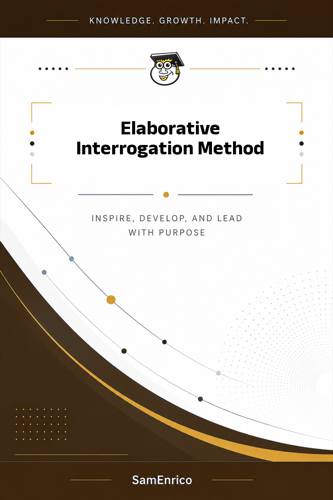
Elaborative Interrogation Method eBook
Ask how and why questions to deepen understanding
by Bruce Holley
Ask how and why questions to deepen understanding and create richer memory traces.
Formats
Free sample
Chapter 1: The Curiosity Engine--In the winter of 1984, a graduate student named Vera Woloshyn sat in a cramped laboratory at the University of Western Ontario, watching videotapes of children reading. She had asked them to do something simple: read a series of facts about animals, countries, and scientific phenomena. Some of the children read passively, moving their eyes across the page. Others whispered to themselves as they read. But a small group did something different.
They paused. They frowned. And then they asked themselves a question: Why?Woloshyn noticed something remarkable. The children who asked "why" remembered nearly twice as many facts as those who simply read. They didn't just remember the information—they understood it.
They could explain it to others, apply it to new situations, and recall it weeks later. The passive readers, by contrast, had forgotten most of what they had read within forty-eight hours.This discovery did not happen in isolation. Across the Atlantic, cognitive psychologist Michael Pressley had been running similar experiments with university students. He asked students to read sentences like "The hungry man got into the car" and then asked them to explain why the man got into the car. The students who generated explanations—the man was hungry, so he drove to a restaurant—remembered the sentences far better than those who simply read them.
Pressley called this strategy "elaborative interrogation," a term that would eventually spread from academic journals to classrooms, corporate training rooms, and medical schools around the world.The insight at the heart of these experiments is almost embarrassingly simple: asking "why" changes everything. Yet most of us never learn to do it deliberately. We read, we highlight, we reread, we nod along. And then we forget. The fluency illusion—that comfortable feeling of knowing that evaporates the moment we need to recall information—keeps us trapped in ineffective study habits.
We mistake recognition for recall, familiarity for understanding.This chapter is the foundation of everything that follows. It will give you the complete definition of elaborative interrogation, trace its history from obscure psychology labs to mainstream application, and distinguish it from strategies that look similar but work very differently. By the end of this chapter, you will understand not just what elaborative interrogation is, but why it works and how it differs from everything else you have tried. And you will never look at a simple fact the same way again.The Problem That Created the Solution Before we dive into the definition, we need to understand the problem that elaborative interrogation was designed to solve. That problem has a name: the fluency illusion.Here is how the fluency illusion works.
You read a chapter in a textbook. The sentences are clear, the concepts make sense, and you finish with a satisfying feeling of comprehension. You think to yourself, "I know this." Then comes the exam, or the presentation, or the conversation where you need to recall the information—and your mind goes blank. You recognized the material when you saw it, but you could not produce it from memory. Recognition and recall are not the same thing, but your brain tricks you into believing they are.Cognitive psychologists have known about the fluency illusion for decades.
Herman Ebbinghaus, the pioneer of memory research, documented the "forgetting curve" in 1885: without reinforcement, we forget half of what we learn within an hour and seventy percent within twenty-four hours. But Ebbinghaus studied rote memorization—nonsense syllables repeated until they stuck. What he did not anticipate was that understanding can also be an illusion. You can understand something perfectly in the moment and still fail to remember it later because understanding and memory are supported by different neural systems.This is where elaborative interrogation enters the story. The researchers who discovered EI were not looking for a memory trick.
They were trying to understand why some students naturally remembered more than others, even when their initial comprehension seemed identical. What they found was that the students who remembered more were the ones who spontaneously asked themselves explanatory questions. They did not simply accept facts as given. They wanted to know why those facts were true.In one landmark study, Pressley and his colleagues gave students a list of facts about familiar topics, such as "Golfers wear knit shirts because they are comfortable." Half the students were instructed to read each fact twice. The other half were instructed to read each fact and then answer the question "Why would that be true?" The results were stark: the elaborative interrogation group remembered seventy-two percent of the facts, compared to just forty-two percent in the repetition group.
That is a fifty percent improvement from a single question.The study was replicated across dozens of contexts, with children and adults, with simple facts and complex concepts, with immediate recall and delayed testing. The effect held. And it held because of a fundamental property of human memory: we remember what we process, not what we passively encounter.The Complete Definition of Elaborative Interrogation Now let us establish the definition that will guide the rest of this book. This definition appears in full only here; subsequent chapters will reference it rather than repeat it.Elaborative interrogation is a learning strategy in which the learner generates explanations for stated facts by asking "Why is this true?" or "Why would this make sense?" The goal is to integrate new information with existing mental models—what cognitive psychologists call schemas. When you successfully connect a new fact to something you already know, you create a richer memory trace, one with multiple pathways for retrieval.
The more connections, the stronger the memory.Let us break this definition into its components.First, it is a generative strategy. You are not passively receiving information. You are actively producing explanations, even if those explanations are imperfect or incomplete. The act of generation is what matters most. Research consistently shows that generating an answer—even a wrong one—strengthens memory more than reading a correct answer.
This is called the generation effect, and it is one of the most robust findings in cognitive psychology.Second, it is interrogative. The strategy takes the form of a question, not a statement. Asking "Why?" triggers a different cognitive process than telling yourself "This is important." Questions create what psychologists call a "knowledge gap"—a state of curiosity that motivates search. When you feel a gap, your brain releases dopamine, the same neurotransmitter involved in reward and motivation. That dopamine signal enhances memory formation.
In other words, curiosity is not just a feeling; it is a biological amplifier for learning.Third, it is elaborative. The word "elaboration" has a specific meaning in cognitive psychology: adding detail, making connections, building associations. Elaboration is the opposite of rote repetition. When you repeat a fact, you strengthen a single memory trace. When you elaborate on a fact, you create multiple traces connected to different aspects of your existing knowledge.
This is why elaboration produces more durable memories. A single rope is easy to break. A rope woven from many strands is almost unbreakable.Fourth, it integrates new information with existing knowledge. This is the most important part of the definition. Elaborative interrogation is not…
This is the end of the free sample. Get the eBook to keep going. Buy now
About this book
Details
- Author
- Bruce Holley
- Publisher
- SamEnrico
- Language
- English
- Genre
- Non-Fiction, Self-Help, Critical Thinking
- Released
- 2026-06-09
- Pages (approx.)
- 146
- Available as
- eBook, Audiobook

Read better in the ZLOADR app
Your eBooks on your phone or tablet. Sign in with your SamEnrico account and start reading.
More by Bruce Holley
 Success Without Hustle CultureBruce Holley$11.99
 Laci Peterson Cold Case LessonsBruce Holley$11.99
 Job Loss and Parenting GuideBruce Holley$11.99
 DoorDash Customer Rating GuideBruce Holley$11.99
 Ford Highland ParkBruce Holley$11.99
 Citation Rules for APA Only HandbookBruce Holley$11.99
 UK VAT Group Registration First Month HandbookBruce Holley$11.99
 Humor in Relationship StressBruce Holley$11.99
 The Last Broadcast: The 1937 Hindenburg Disaster and the Birth of Modern Disaster JournalismBruce Holley$11.99
 The Midnight Vote: How a 1973 Law Saved Millions from Forgotten CrisisBruce Holley$11.99
 How to Become a Caption WriterBruce Holley$11.99
 Understanding Anton SyndromeBruce Holley$17.99
You may also like
 Team Assumption BustingHook Ina$11.99
 Real vs Reel Social MediaKruger Norberto$11.99
 Chunking for Critical ThinkingMarino Darleen$11.99
 Mindfulness for Beginner NaysayersAlonso Palma$11.99
 Critical Listening for Debates and ArgumentsPrather Candy$11.99
 Collaborative Assumption Busting GuideStanfield Clemmie$11.99
 The Logical Fallacy Persuasion GuideLink Cordell$11.99
 Devil Advocate Role AssignmentCurran Kym$11.99
 Critical Thinking in Teams GuideRoark Elroy$11.99
 The Eisenhower Matrix Critical DistinctionCasas Sandee$11.99
 Red Teaming Creative IdeasWhitley Reta$11.99
 Elaboration Study GuideKuykendall Fay$11.99