
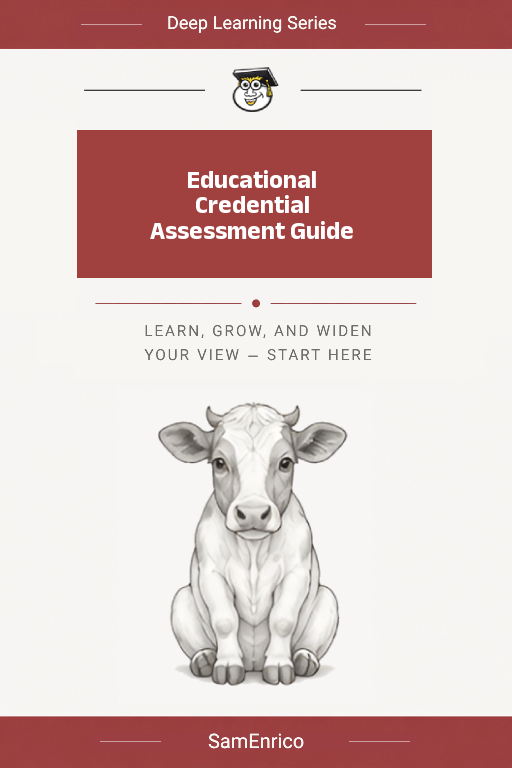
Educational Credential Assessment Guide eBook
Submit your Canadian degree or diploma for ECA, un
by Horn Lianne
Submit your Canadian degree or diploma for ECA, understanding which institutions are approved and how to order transcripts efficiently.
Formats
Free sample
Chapter 1: The Translation Trap--–- The first time I met Priya, she was crying into a cup of cold coffee at a Tim Hortons near Yonge and Bloor. She had landed in Toronto three weeks earlier with a suitcase, a dream, and a Master’s degree in Chemical Engineering from one of the top universities in India. Within seven days, she had applied to forty-seven jobs. Within fourteen days, she had received zero interview calls. Within twenty-one days, she had been told by a settlement worker that her degree “might not count for much here.” Priya did not understand.
She had the grades. She had the experience. She had the English fluency. What she did not have was a translation.Not a literal translation. Her degree was in English.
The problem was deeper. The problem was that the Canadian immigration system and Canadian employers speak a different language when it comes to education. They do not know what a “B.Tech from Anna University” means. They do not know if a “Bachelor of Commerce from the University of Mumbai” is equivalent to a three-year Canadian degree or a four-year one. They do not know if your “Master of Science from the University of Lagos” qualifies as a graduate degree or something less.
And because they do not know, their default answer is no.This chapter is about why that happens, what the Educational Credential Assessment (ECA) actually is, and—most critically—why a single misunderstanding about the five-year expiry rule has destroyed more Canadian immigration applications than any other mistake.The Pre-2013 Chaos: Why the ECA Was Invented Before 2013, Canada had a problem. Actually, Canada had a specific, painful, internationally embarrassing problem. Highly educated immigrants were driving taxis. Not because they wanted to—some did, as a transition—but because the immigration system had no standardized way to evaluate their credentials. A immigration officer in Sydney, Nova Scotia, looking at a degree from the University of Karachi, had the same level of expertise as a immigration officer in Vancouver looking at a degree from the University of Lagos.
Which is to say: none.The result was chaos. Two applicants with identical foreign degrees could receive completely different assessments depending on which officer reviewed their file. One officer might recognize the University of the Philippines as a legitimate institution. Another might have never heard of it and flag it as a diploma mill. There was no consistency.
There was no appeal process that made sense. There was only a patchwork of institutional knowledge that varied wildly from one case to another.In 2013, Immigration, Refugees and Citizenship Canada (IRCC) did something unusual for a government agency. They admitted the system was broken and created a solution. The solution was the Educational Credential Assessment. The idea was simple: outsource the evaluation of foreign degrees to specialized organizations who actually knew what they were doing.
IRCC would designate a small number of approved agencies. Those agencies would develop expertise in evaluating credentials from specific countries. They would create standardized equivalencies. And then immigration officers would simply look at the ECA report and see a single line: “This credential is equivalent to a Canadian four-year Bachelor’s degree.”No more guesswork. No more officer-dependent outcomes.
No more neurosurgeons driving taxis because someone in processing had never heard of the University of the Punjab.The system worked. It was not perfect, and this book will spend twelve chapters explaining exactly where it breaks down and how to fix it. But compared to the chaos before, the ECA was a revolution. The problem is that most applicants still do not understand what an ECA actually is—and that misunderstanding is the first step toward disaster.What an ECA Actually Is (And What It Is Not)Let me be extremely clear about what an Educational Credential Assessment does and does not do.What an ECA is: A formal, standardized opinion from an IRCC-designated organization about how your foreign educational credential compares to a Canadian one. It is a translation.
Specifically, it is a document that states something like: “The Bachelor of Commerce from the University of Mumbai is equivalent to a Canadian four-year Bachelor’s degree.” Or: “The Diploma in Business Administration from a private college in Nigeria is equivalent to a Canadian two-year college diploma.” Or: “The Master of Science from the University of the Philippines is equivalent to a Canadian Master’s degree.”That is it. That is the entire function of an ECA. It takes a credential from a foreign country and tells Canada what that credential would be if it had been earned at a Canadian institution.What an ECA is not: It is not an upgrade. It does not make your degree more valuable than it is. If your three-year foreign Bachelor’s degree is assessed as a two-year Canadian diploma, the ECA is not wronging you—it is telling you the truth about how Canada sees that credential.
It is not a guarantee of employment. An ECA does not say “this person can work as an engineer.” That is the job of professional regulatory bodies like Engineers Canada. An ECA only says “this person’s education is equivalent to a Canadian engineering degree.” Whether they can actually practice engineering is a separate question that requires separate assessments. It is not a credential that you can list on a resume as “Canadian degree equivalent.” It is an immigration document, not a job search document. (We will discuss how to use it for employment in Chapter 12, but that is a secondary use, not the primary purpose.)The single most important thing to understand: An ECA does not change your degree.
It translates it. If the translation is unfavorable, you cannot argue with the translator. You can only choose a different translator or accept the result.The Five-Year Time Bomb Now we arrive at the rule that has destroyed more applications than any other. The rule is simple to state and devastating to misunderstand.Your ECA report is valid for five years from the date it was issued. But here is the trap: the five years is measured from the date you submit your permanent residence application, not from the date you enter the Express Entry pool.Let me repeat that because it is that important.
Many applicants believe that if they receive their ECA report in January 2020 and enter the Express Entry pool in February 2020, the report is valid until January 2025. That is correct as far as it goes. But if you receive an Invitation to Apply in December 2024 and do not submit your full permanent residence application until February 2025—a delay that is common, as applicants gather police certificates, medical exams, and employment letters—your ECA report will be expired. You will have to start over.The exact language from IRCC is as follows: “The ECA report must be less than five years old on the date you submit your application for permanent residence.” Not the date you enter the pool. Not the date you receive your Invitation to Apply.
The date you click “submit” on your final application.I have personally spoken to applicants who lost six months and hundreds of dollars because…
This is the end of the free sample. Get the eBook to keep going. Buy now
About this book
Details
- Author
- Horn Lianne
- Publisher
- SamEnrico
- Language
- English
- Genre
- Non-Fiction, Student's Shortcut
- Released
- 2026-06-01
- Pages (approx.)
- 141
- Available as
- eBook, Audiobook

Read better in the ZLOADR app
Your eBooks on your phone or tablet. Sign in with your SamEnrico account and start reading.
More by Horn Lianne
 Body Scan For SleepHorn Lianne$11.99Body Scan For SleepHorn Lianne$11.99
 Lake County Prosecutor BiasHorn Lianne$11.99
 King Coretta Scott PartnershipHorn Lianne$11.99
 Studying With Background Music DebateHorn Lianne$11.99
 The Standardized Test GuideHorn Lianne$11.99
 Pet Loss and FosteringHorn Lianne$11.99
 Morning Routine for AnxietyHorn Lianne$11.99
 Master Goal System GuideHorn Lianne$11.99
 The Divine Chisel: Michelangelo’s Sistine RevelationHorn Lianne$11.99
 The Last Stand of Chittorgarh: Rajput Valor Against the Sultanate TideHorn Lianne$11.99
 How to Produce Knife GuidesHorn Lianne$11.99
You may also like
 Hong Kong Handover 1997Dunn Johnnie$11.99
 Zumba For Postnatal Recovery CourseNeal Christian$11.99
 Zumba for BeginnersLadner Nikia$11.99
 YouTube Comment Mining GuideHumes Pandora$12.99
 Worry Box MeditationCarlin Rudy$11.99
 Workplace Stress MeditationNguyen Lynn$11.99
 Workplace Stress and Sleep RepairHawley Ivory$11.99
 Workplace Perfectionism CureDelaney Jeffry$11.99
 Workplace Injustice Anger GuideWallen Isabelle$11.99
 Work Addiction and Burnout LinkGreenwood Ester$11.99
 Women in Yoga and WellnessBeattie Galina$11.99
 Women in Stand Up ComedyChun Evangeline$11.99