
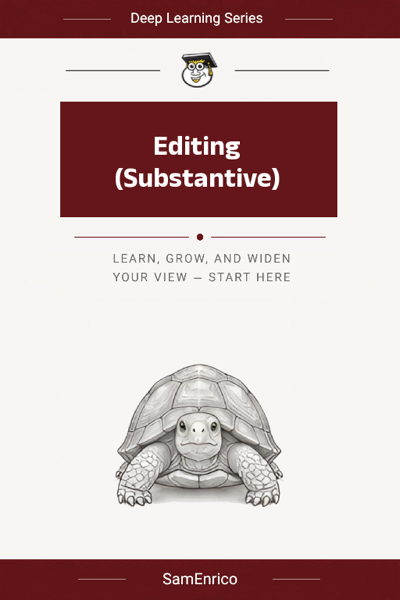
Non-FictionInformativeEducational
Editing (Substantive) eBook
A Coursebook on Editing (Substantive)
by Sayre Janita
A Coursebook on Editing (Substantive)
Formats
Free sample
Chapter 1: The Broken Manuscript…--–- Every great book begins as a terrible one. That is not pessimism; it is the first and most liberating truth any editor must accept. The manuscript that arrives in your inbox—whether from a first-time novelist trembling with hope or a seasoned academic defending a decade of research—will have problems. Not small problems, either. The prose will meander.
The argument will collapse in the middle. Characters will change eye color between chapters. Chapters will appear in no logical order. The author will have fallen in love with a paragraph that does nothing, a scene that goes nowhere, a sentence that actively harms the reader’s understanding. This is not failure.
This is the raw material of editing.Most people misunderstand what substantive editing actually is. They imagine a quiet person in a tweed jacket, pen in hand, gently correcting commas and suggesting better adjectives. That is copyediting, and it happens much later. Others imagine a ghostwriter in disguise, someone who will quietly rewrite the entire book while keeping the author’s name on the cover. That is not editing either; that is co-authorship without credit.
Substantive editing—the work this entire book teaches—occupies the territory between diagnosis and surgery. It asks the biggest questions first: Does this book need to exist in this form? Does it speak to the right reader? Does its structure support its purpose, or undermine it? Does the narrative arc rise and fall with intention, or stagger forward by accident?
These questions have nothing to do with commas. They have everything to do with meaning.This chapter is called “The Broken Manuscript” not to depress you but to free you. Once you accept that every draft is broken, you stop asking “Is this good?” and start asking “What kind of broken is this, and how do I fix it?” That shift—from judgment to diagnosis—is the foundation of substantive editing. A cardiologist does not shame a heart for having a blocked artery; she identifies the blockage and plans the intervention. An editor does not shame an author for having a plot hole; he identifies the hole and helps the author fill it.
This is the professional identity you will build across these twelve chapters. But first, you must understand what substantive editing actually is, where it sits in the editing hierarchy, and why most people—including many working editors—get it wrong.Defining the Substantive Editor The term “substantive editing” means different things in different publishing houses, different countries, and different genres. In Canada, the professional standards guide from Editors Canada defines substantive editing as editing that focuses on “the structure, content, and overall presentation” of a manuscript, often suggesting or making significant changes to “organization, pacing, tone, and voice.” In the United States, the term “developmental editing” is more common and often includes detailed plot and character work for fiction. In the United Kingdom, “structural editing” is the preferred term, and it typically excludes line-level work entirely, focusing only on architecture. This book uses “substantive editing” as an umbrella term that includes both developmental and structural work, while acknowledging that professional practice varies.What unites all these definitions is the level of intervention.
Substantive editing sits above copyediting and proofreading in the editorial hierarchy, but below authorial rewriting. You are not the author. You never become the author. Your job is to see what the author cannot see—because they are too close, too tired, too in love with their own sentences—and to show it to them with enough clarity and diplomacy that they can fix it themselves. The best substantive edit is one that makes the author say “Of course” rather than “Oh.” It reveals what was always latent in the manuscript, buried under repetition, misplaced emphasis, or structural confusion.This is harder than it sounds.
Most beginning editors fall into one of two traps. The first trap is under-editing: making a few small suggestions, praising everything, and sending the manuscript back essentially unchanged because you were afraid to hurt the author’s feelings. The second trap is over-editing: rewriting entire passages in your own voice, moving whole chapters without consultation, and effectively taking over the book. Both are professional failures. Under-editing cheats the author out of the help they paid for.
Over-editing steals their book. The substantive editor walks a narrow path between these traps, and this chapter—and this entire book—will teach you how to stay on that path.The Four-Pass Method Before you make a single change to a manuscript, before you write a single query to the author, you need a method. The method this book teaches is the Four-Pass Method, an expansion of traditional three-pass models that adds a critical final validation stage. Here is how it works:Pass One: Big-Picture Structure. You read the entire manuscript without stopping to edit sentences.
You take notes on index cards or in a document. You ask only structural questions: Does the opening hook land? Does each chapter belong where it is? Is there a missing chapter between what is now Chapter 4 and Chapter 5? Does the argument or plot progress logically, or does it circle back on itself?
You do not correct grammar. You do not rewrite awkward sentences. You do not fix spelling. You are looking at the skeleton of the book, not its skin.Pass Two: Narrative or Argumentative Flow. On your second read, you examine how the manuscript moves from one unit to the next.
For fiction: Does the tension rise and fall with intention? Are scene breaks placed where the reader needs to breathe? For nonfiction: Does each paragraph lead naturally to the next? Are transitions clear, or does the author assume connections the reader cannot see? This pass is about momentum.
You are looking at the muscles and ligaments that connect the skeleton.Pass Three: Consistency and Voice. On your third pass, you check for internal consistency. Do character descriptions match across chapters? Is the terminology the same every time (or deliberately changed for effect)? Does the voice hold steady, or does the author drift between formal and casual, first-person and third, past tense and present?
This pass also catches the first hints of line-level issues—but you still do not fix them yet. You note them in a style sheet (more on that in Chapter 2) and move on.Pass Four: The Validation Pass. This is the step that separates professionals from amateurs. After you have made your substantive suggestions and after the author has made their changes, and after the copyeditor has done their work, you read the manuscript again for macro issues. Why?
Because changes at the micro level can break the macro level. A scene cut in Chapter 3 might have been referenced in Chapter 11. A paragraph moved from page 40 to page 80 might now contradict a sentence that stayed behind. The Validation Pass catches these cascading errors. Many editors skip it.
They should not.These four passes are not rigid. In practice, you will move between them. You might be in Pass Two and notice a voice inconsistency that belongs in Pass Three; you make a note and continue. The method is a guide, not…
This is the end of the free sample. Get the eBook to keep going. Buy now
About this book
Details
- Author
- Sayre Janita
- Publisher
- SamEnrico
- Language
- English
- Genre
- Non-Fiction, Informative, Educational
- Released
- 2026-06-03
- Pages (approx.)
- 132
- Available as
- eBook, Audiobook

Read better in the ZLOADR app
Your eBooks on your phone or tablet. Sign in with your SamEnrico account and start reading.
More by Sayre Janita
 Hungarian American Return To Budapest HandbookSayre Janita$11.99
 The Flood Ventilation Drying GuideSayre Janita$11.99
 Observing Impermanence Through BreathSayre Janita$11.99
 Baby Sleep Instagram AccountsSayre Janita$11.99
 Free Shipping Minimum GuideSayre Janita$11.99
 The Silk Road Conspiracy: The Dark Web's First Crime EmpireSayre Janita$11.99
 How to Become a Nitroglycerin NeutralizerSayre Janita$11.99
 Green Methanol Capital GuideSayre Janita$12.99
 Legal Document Review ToolsSayre Janita$12.99
 Understanding Mixed Sclerosing Bone DystrophySayre Janita$17.99
You may also like
 Hong Kong Handover 1997Dunn Johnnie$11.99
 Zumba For Postnatal Recovery CourseNeal Christian$11.99
 Zumba for BeginnersLadner Nikia$11.99
 YouTube Comment Mining GuideHumes Pandora$12.99
 Worry Box MeditationCarlin Rudy$11.99
 Workplace Stress MeditationNguyen Lynn$11.99
 Workplace Stress and Sleep RepairHawley Ivory$11.99
 Workplace Perfectionism CureDelaney Jeffry$11.99
 Workplace Injustice Anger GuideWallen Isabelle$11.99
 Work Addiction and Burnout LinkGreenwood Ester$11.99
 Women in Yoga and WellnessBeattie Galina$11.99
 Women in Stand Up ComedyChun Evangeline$11.99