
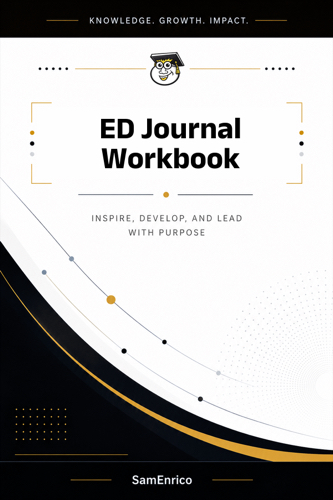
Non-FictionHealth & WellnessTracking
ED Journal Workbook eBook
Track symptoms, triggers, and treatment responses
Track symptoms, triggers, and treatment responses daily.
Formats
Free sample
Chapter 1: The Food Lie...--–- You have been told, probably for years, that your problem is about food. You have been told that if you could just eat “normally”—whatever that means—everything would be fine. You have been told that your struggle is with calories, portion sizes, meal timing, willpower, or self-control. And because you believe this lie, you have tried to solve the problem by focusing on the food. You have tried diets.
You have tried meal plans. You have tried tracking every single bite in apps that count numbers and calculate deficits and reward you for eating less. You have tried hating your body into a different shape. You have tried promising yourself that tomorrow will be different, that Monday will be the start of the new you, that after this next pound you will finally be free.None of it has worked. Not because you are weak.
Not because you lack discipline. Not because you are broken in some permanent, unfixable way. It has not worked because you have been aiming at the wrong target the entire time.Food is not the problem. Food is the red herring.A red herring, in storytelling, is a clue that leads the detective in the wrong direction. It looks important.
It smells like the solution. It demands attention. But it is a distraction from the real mystery. In your life, food has been the red herring. It has absorbed all your attention, all your anxiety, all your planning and regretting and obsessing.
And while you were staring at the plate, the real problem was happening somewhere else entirely.This chapter is going to show you where to look instead.The Iceberg Model: What You See vs. What Is Really There Imagine an iceberg floating in cold, dark water. The tip—the part above the surface—is visible to everyone. It is sharp, obvious, impossible to ignore. That tip is your eating behavior.
The number of meals you skipped or ate. The foods you labeled as “good” or “bad.” The binge that happened at 11 PM when you were alone. The purge that followed. The compulsive exercise. The weighing, measuring, calculating, compensating.
All of it—the behaviors that terrify you, shame you, exhaust you—that is the tip of the iceberg.Below the water, invisible from above, is the rest of the iceberg. It is massive. It is dark. It is the part that actually determines where the iceberg goes. And that underwater structure is made of everything you have not been looking at: emotions you cannot name, memories you have tried to forget, beliefs you did not choose but somehow believe anyway, relationships that wound you, loneliness that has no bottom, shame that has been there so long you forgot it was not part of you.The eating disorder is not the tip.
The eating disorder is the entire iceberg. But you have been trying to chip away at the tip while the underwater mass stays exactly where it is. No wonder nothing changes.This workbook is not about the tip. It is about diving down into the cold, dark water and looking at what is actually there. Not all at once—that would drown you.
But piece by piece, day by day, log entry by log entry. You are going to become a scientist of your own interior life. You are going to collect data not on calories, but on feelings. Not on weight, but on triggers. Not on meal times, but on the thoughts that arrive just before you reach for food or push it away.Why Food Became the Decoy Food is a brilliant decoy for a very specific reason: it is necessary.
You cannot stop eating entirely, the way you might stop drinking or gambling. You have to face food multiple times every single day for your entire life. This means the eating disorder has infinite opportunities to attach its anxiety to something real, something unavoidable, something that can be measured and tracked and fought over.If the real problem was, say, a deep terror of being unlovable, that would be harder to obsess over. Unlovability is abstract. It does not have a calorie count.
It does not show up on a scale. It cannot be controlled by skipping breakfast. But food? Food is concrete. Food is measurable.
Food gives the illusion of control when everything else feels completely out of control.So the eating disorder takes the vague, terrifying feeling of “something is wrong with me” and attaches it to something specific: “something is wrong with what I ate today.” This is a transformation you have performed thousands of times without realizing it. You felt anxious about a conversation that happened at work, and within an hour, you were standing in front of the refrigerator eating yogurt with a spoon directly from the container, and the original anxiety was gone, replaced by the familiar, almost comforting shame of having eaten “wrong.” Or you felt angry at a parent or a partner, and instead of feeling that anger—which might destroy the relationship or prove you are a bad person—you felt fat instead. Because fat is a feeling you know how to hate. Anger is not.This is what Anita Johnston, in her groundbreaking book Eating in the Light of the Moon, calls the “red herring” of food. She writes that women (and men, and nonbinary people—though her focus was primarily on women given the research at the time) have been taught to distrust their own appetites, not just for food but for life.
When you are hungry for meaning, for connection, for purpose, for rest, for pleasure, for love—and you cannot have those things, or you do not know how to ask for them, or you have been told you do not deserve them—you eat instead. Or you starve instead. Or you binge and purge instead. Because at least food is something you can control. At least food is something you can say no to when everything else in your life feels like a yes you never got to give.The Two Hungers You Have Never Been Taught to Separate There is a skill you were never taught in school, never learned from your parents (because they probably never learned it either), and certainly never saw modeled on social media.
That skill is distinguishing between stomach hunger and heart hunger.Stomach hunger is biological. It is your body asking for fuel. You know it by its sensations: a growling, empty feeling in the lower abdomen. Lightheadedness. Irritability that lifts when you eat.
Difficulty concentrating. A gnawing sensation that gets stronger over time. Stomach hunger is patient—it will wait—but it is also persistent. It does not go away until you eat. And crucially, stomach hunger is satisfied by approximately any food.
When you are truly physically hungry, an apple sounds good. So does toast. So does soup. So does a sandwich. You do not need something specific; you need energy.Heart hunger is emotional.
It is your psyche asking for something it is not getting. You know heart hunger by its urgency: it wants something specific, and it wants…
This is the end of the free sample. Get the eBook to keep going. Buy now
About this book
Details
- Author
- Merrick Ashlea
- Publisher
- SamEnrico
- Language
- English
- Genre
- Non-Fiction, Health & Wellness, Tracking
- Released
- 2026-06-09
- Pages (approx.)
- 123
- Available as
- eBook, Audiobook

Read better in the ZLOADR app
Your eBooks on your phone or tablet. Sign in with your SamEnrico account and start reading.
More by Merrick Ashlea
 The Parent Anger JournalMerrick Ashlea$11.99
 Validation For Housing InsecurityMerrick Ashlea$11.99
 Twelve Step Anniversary RecoveryMerrick Ashlea$11.99
 The Forensic Behavioral Analysis GuideMerrick Ashlea$11.99
 The Frozen Gambit: Charles XII’s Lost Victory at PoltavaMerrick Ashlea$11.99
 How to Become a Log InspectorMerrick Ashlea$11.99
 Register .us Domain HandbookMerrick Ashlea$12.99
 PR for Healthtech StartupsMerrick Ashlea$12.99
 The Breeder's Guide to Old English Game ChickensMerrick Ashlea$11.99
 Microsoft Teams CollaborationMerrick Ashlea$11.99
You may also like
 Hong Kong Handover 1997Dunn Johnnie$11.99
 Zumba For Postnatal Recovery CourseNeal Christian$11.99
 Zumba for BeginnersLadner Nikia$11.99
 YouTube Comment Mining GuideHumes Pandora$12.99
 Worry Box MeditationCarlin Rudy$11.99
 Workplace Stress MeditationNguyen Lynn$11.99
 Workplace Stress and Sleep RepairHawley Ivory$11.99
 Workplace Perfectionism CureDelaney Jeffry$11.99
 Workplace Injustice Anger GuideWallen Isabelle$11.99
 Work Addiction and Burnout LinkGreenwood Ester$11.99
 Women in Yoga and WellnessBeattie Galina$11.99
 Women in Stand Up ComedyChun Evangeline$11.99