
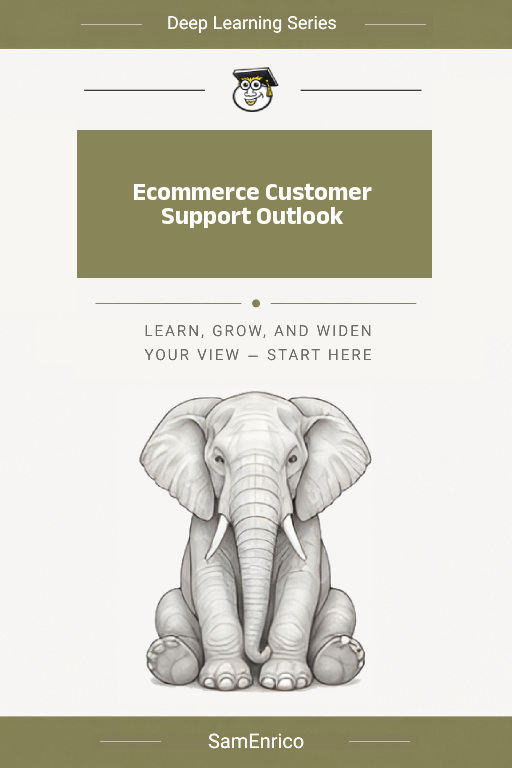
Non-FictionForecast & OutlookCX Automation
Ecommerce Customer Support Outlook eBook
Forecast AI chatbot resolution rates, human agent
by Regan Danita
Forecast AI chatbot resolution rates, human agent role evolution, and multilingual support requirements through 2030.
Formats
Free sample
Chapter 1: The Deflection Lie--–- In 2019, a major American footwear retailer ran an experiment that its leadership team hoped would prove the value of their new $2 million chatbot investment. They measured two things: how many customer inquiries the bot "handled" without human intervention, and how long customers waited before reaching a solution. The results, presented triumphantly at a quarterly board meeting, showed a 73% "containment rate"—industry jargon for the percentage of conversations that never touched a human agent. The board applauded. The CTO received a bonus.
The chatbot vendor issued a press release.What the board did not see—because the vendor's dashboard did not show it—was the after-action data. Customers who had "successfully" interacted with the bot were re-contacting support within twenty-four hours at a rate of 41%. That meant nearly half of the customers who thought they had resolved their issue had not, in fact, resolved anything. They had been deflected, not helped. They had been sent to an FAQ page that didn't answer their specific question, or guided through a return flow that failed at the final step, or told to "please visit our help center" when what they needed was a live human to authorize a refund on a defective product.The retailer's chatbot was a master of deflection.
It was a failure at resolution.This chapter dismantles the foundational lie of first-generation ecommerce customer support: that keeping customers away from humans is the same as helping them. We will trace the rise and fall of deflection as a KPI, define the paradigm shift to agentic AI, introduce the metric that actually matters—True Autonomous Resolution Rate (TARR)—and establish the 80% benchmark that separates market leaders from laggards by 2030. By the end of this chapter, you will understand why the old playbook is not just outdated but actively destructive, and why the next five years will belong to brands that retire "deflection" from their vocabulary.The Birth of a Bad Metric To understand how the ecommerce industry collectively embraced a metric as flawed as deflection rate, we need to go back to the early 2010s. At that time, customer support was universally viewed as a cost center. Every conversation with a human agent represented a negative line item on the P&L: agent salaries, benefits, training costs, software licenses, and facility overhead.
The less customers talked to humans, the logic went, the more money the company saved.This worldview was not malicious. It was simply incomplete. In a pre-AI world, where automation meant clunky IVR trees and rule-based email autoresponders, there was no viable alternative to humans for complex problem-solving. So support leaders did the only thing they could: they tried to reduce the volume of human interactions. They built knowledge bases.
They published FAQs. They implemented chatbots that could answer "Where is my order?" by scraping a tracking API. And they measured their success by how few customers reached a human.This was deflection. And for a brief period, it seemed to work. Early chatbots, primitive as they were, could indeed handle the most repetitive, low-value inquiries.
A customer asking for store hours received an instant answer. A customer checking order status got a tracking link. These were genuine resolutions, albeit for the simplest possible questions. The problem was that the industry became addicted to the metric, not the outcome.By 2018, chatbot vendors were competing on "containment rates," promising 70%, 80%, even 90% deflection. Ecommerce brands, under pressure to cut costs, bought in.
They deployed chatbots not as problem-solvers but as gatekeepers—digital bouncers standing between the customer and the human who could actually help. The result was a customer experience catastrophe that the industry is still cleaning up.The Anatomy of a Deflection Failure Let us be precise about what deflection does wrong. Deflection is not inherently evil. Directing a customer to a self-service article that perfectly answers their question is a good thing. The problem is that deflection optimizes for the wrong variable: the act of avoiding a human, rather than the outcome of solving a problem.A deflection-optimized system behaves as follows.
A customer initiates a chat. The bot scans for keywords. If it finds a match, it serves a pre-written answer or a link to a help article. The conversation ends—as far as the bot is concerned, the ticket is "contained." The customer, however, may have received an answer that is partially correct, completely wrong, or insufficiently detailed. They close the chat, try to follow the instructions, hit a wall, and reopen a new ticket hours or days later.
The system counts two interactions: one contained, one human. In reality, the customer has experienced frustration, wasted time, and a delayed resolution.Data from the Customer Contact Council, analyzed across more than two hundred ecommerce brands, reveals the true cost of deflection. The average chatbot engaged in deflection-only behavior resolves fewer than 30% of customer issues on the first attempt. Among customers who are deflected to a knowledge base article, 62% click away within ninety seconds without finding what they need. And among customers who ultimately reach a human after being deflected, their satisfaction scores are 40% lower than customers who reached a human directly—because they have already been primed for frustration.This is the deflection death spiral.
The bot fails. The customer tries again, more angry. The human inherits a problem that has now escalated in emotional intensity. The human spends extra time de-escalating before solving. The cost per resolution rises, not falls.
And the customer, exhausted, may never return.Consider a concrete example. A customer purchases a laptop bag from an online retailer. The bag arrives with a broken zipper. The customer opens a chat. The bot scans for keywords—"broken," "zipper," "defective"—and responds: "I'm sorry to hear that.
Please visit our returns portal to initiate a return." The bot provides a link and ends the conversation. The customer clicks the link, fills out a form, uploads a photo, and submits. Two days later, the customer receives an email: the return has been approved, but the customer must print a label, package the bag, and drop it at a shipping location. The customer does so. A week later, the customer receives a replacement.
Total time from first contact to resolution: nine days. Customer effort: high. Satisfaction: low.Now consider the same scenario with an agentic AI system that cares about resolution, not deflection. The customer types "the zipper on my new laptop bag is broken." The AI accesses the order history, confirms the purchase date is within the return window, and initiates a visual inspection flow. The customer uploads a photo.
The AI's computer vision model confirms the damage. The AI checks inventory, finds a replacement in stock, and authorizes an advanced exchange—the replacement ships immediately, with a prepaid label for the return of the damaged bag. The customer receives confirmation in under two minutes. Total time to resolution: two minutes. Customer effort: minimal.
Satisfaction: high.The difference between these two experiences is not technology. Both used a chatbot. The difference is philosophy. The first system optimized for deflection. The second optimized for resolution.
The first treated the customer as an interruption to be routed away. The second treated the customer as a human…
This is the end of the free sample. Get the eBook to keep going. Buy now
About this book
Details
- Author
- Regan Danita
- Publisher
- SamEnrico
- Language
- English
- Genre
- Non-Fiction, Forecast & Outlook, CX Automation
- Released
- 2026-05-29
- Pages (approx.)
- 127
- Available as
- eBook, Audiobook

Read better in the ZLOADR app
Your eBooks on your phone or tablet. Sign in with your SamEnrico account and start reading.
More by Regan Danita
 Internal Promotion Pitch AnxietyRegan Danita$11.99
 Growth Hormone Secretagogues GuideRegan Danita$11.99
 Work Break HypnosisRegan Danita$11.99
 Agoraphobia Waiting in Line CourseRegan Danita$11.99
 Grandparent Raising Grandkids AngerRegan Danita$11.99
 Silicon Samurai: The Untold Story of Masayoshi Son and SoftBank's RiseRegan Danita$11.99
 The Frozen Courtship: Magellan’s Arctic Gambit and the Love That Melted the IceRegan Danita$11.99
 Veteran Coding Education BenefitsRegan Danita$12.99
 Understanding Brain NeoplasmsRegan Danita$17.99
 10 Ways to Use Cod Roe (Recipe Book)Regan Danita$11.99
 Human Resources OfficerRegan Danita$11.99
You may also like
 Hong Kong Handover 1997Dunn Johnnie$11.99
 Zumba For Postnatal Recovery CourseNeal Christian$11.99
 Zumba for BeginnersLadner Nikia$11.99
 YouTube Comment Mining GuideHumes Pandora$12.99
 Worry Box MeditationCarlin Rudy$11.99
 Workplace Stress MeditationNguyen Lynn$11.99
 Workplace Stress and Sleep RepairHawley Ivory$11.99
 Workplace Perfectionism CureDelaney Jeffry$11.99
 Workplace Injustice Anger GuideWallen Isabelle$11.99
 Work Addiction and Burnout LinkGreenwood Ester$11.99
 Women in Yoga and WellnessBeattie Galina$11.99
 Women in Stand Up ComedyChun Evangeline$11.99