
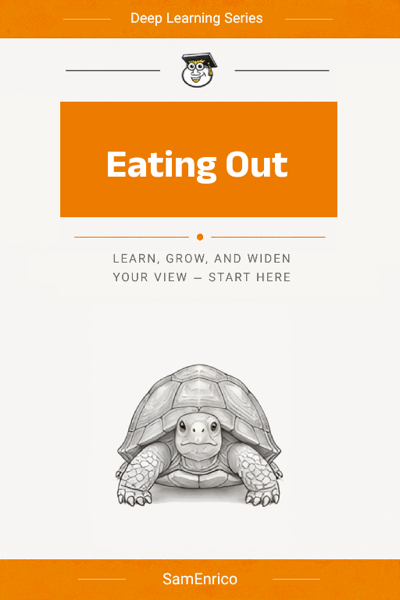
Eating Out
A Coursebook on Eating Out
A Coursebook on Eating Out
Formats
About this book
Free sample
Chapter 1: The Two-Thousand-Year Meal--The moment you walk through the door of any restaurant—from a Michelin-starred temple of gastronomy to a fluorescent-lit diner at three in the morning—you are stepping into a story that began long before you were born. The chair you pull out from the table, the menu you unfold, the very act of paying a stranger to cook for you while you sit and do nothing: none of this is natural. It is not inevitable. It is, in fact, a remarkable historical accident.We tend to think of restaurants as timeless. They feel as permanent and necessary as roofs and roads.
But for most of human history, the idea of walking into a building, sitting down, and asking a stranger to bring you food that you would then pay for before leaving—this was either impossible or deeply suspicious. The restaurant, as we understand it, is a surprisingly young invention. And understanding its strange, winding journey from ancient Rome to your phone screen is the first step toward becoming a truly great diner.Because here is the secret that the best diners already know: every plate carries ghosts. The Caesar salad on your table descends from a Prohibition-era speakeasy in Tijuana. The tasting menu in front of you traces its lineage to the opulent feasts of French kings.
The food truck where you grab lunch operates on the same economic principles as a Roman thermopolium. You cannot master the present without understanding the past.So let us begin where all restaurant stories begin: not in Paris, as most food writers would have you believe, but in the crowded, noisy, brilliantly organized streets of ancient Rome.The First Fast Food The year is 79 CE. Mount Vesuvius has not yet buried Pompeii, and the city is alive with commerce. Walk down any major thoroughfare, and you will see them: stone counters with circular cutouts sunk into the masonry, holding clay pots of prepared food. These are the thermopolia—from the Greek thermos (hot) and poleo (to sell).
Hot food to go.Pompeii alone had nearly ninety of these establishments. They served a population of roughly twelve thousand people.…
This is the end of the free sample. Get the eBook to keep going. Buy now
Contents
- Chapter 1
- Chapter 2
- Chapter 3
- Chapter 4
- Chapter 5
- Chapter 6
- Chapter 7
- Chapter 8
- Chapter 9
- Chapter 10
- Chapter 11
- Chapter 12
Details
- Author
- Williamson Doug
- Publisher
- SamEnrico
- Language
- English
- Genre
- Non-Fiction, Informative, Educational
- Released
- 2026-06-03
- Pages (approx.)
- 139
- Available as
- eBook, Audiobook

Read better in the ZLOADR app
Your eBooks on your phone or tablet. Sign in with your SamEnrico account and start reading.
More by Williamson Doug
 The Orphaned Adult WorkbookWilliamson Doug$11.99
 The Financial Handover CourseWilliamson Doug$11.99
 Hawking Simpsons CameosWilliamson Doug$11.99
 Remote Freelancer CommunicationWilliamson Doug$11.99
 Cannabis Craving ManagementWilliamson Doug$11.99
 Fiverr Video Introduction GuideWilliamson Doug$11.99
 The Delivery Driver OverdoseWilliamson Doug$11.99
 Posture Growth Hormone ConnectionWilliamson Doug$11.99
 Pre Presentation Calming ProtocolWilliamson Doug$11.99
 The Gates of Susa: Darius’ Shadow Over the LevantWilliamson Doug$11.99
 Rum & Rebellion: The Secret War of the Caribbean's Rum RunnersWilliamson Doug$11.99
 Love in the Depths: The Secret Romance Behind the First Underwater RobotsWilliamson Doug$11.99