
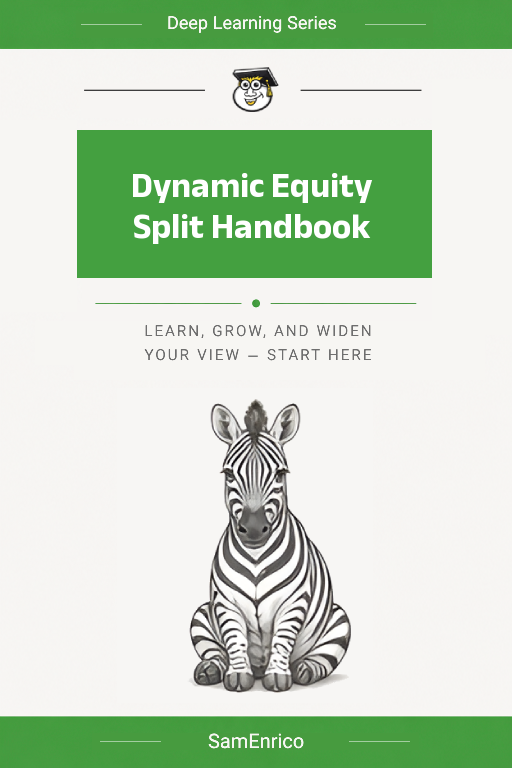
Dynamic Equity Split Handbook eBook
Adjust ownership quarterly based on actual contrib
Adjust ownership quarterly based on actual contributions using Slicing Pie method. Covers contribution tracking sheets, valuation updates, and buy-in rules for later co-founders.
Formats
Free sample
Chapter 1: The Prediction Paradox...--Most founders destroy their company before writing their first line of code. They don’t do it with bad strategy, poor marketing, or technical debt. They do it with a single conversation over tacos and a napkin that says “50/50.”That napkin is a suicide pact.I have watched this happen more than one hundred times. Two smart, ambitious people meet at a coffee shop or a shared workspace. They have complementary skills—one codes, one sells.
They share a vision for a product that could change an industry. They decide to become co-founders. Someone says, “Let’s split equity fifty-fifty. We’re partners.” Everyone nods. They shake hands.
They start building.Eighteen months later, one of them is working eighty hours a week, sleeping under their desk, and missing their child’s birthday. The other is working ten hours a week, taking “strategy calls” from a vacation rental in Costa Rica, and still owns exactly half the company. The overworked founder cannot fire the underworking founder. Cannot dilute them. Cannot even have an honest conversation without risking a lawsuit or a friendship.The company either limps along with dead equity weighing it down, or it dies in arbitration.
The napkin was wrong. And no one ever told them there was another way.This book is that other way.The Napkin That Launched a Thousand Lawsuits Let me tell you about Sarah. Her real name is different, but her story is painfully common.Sarah co-founded a healthtech startup with her best friend Mark. They had known each other since college. Mark had the initial idea—a wearable device that tracked glucose levels without needles.
Sarah had the engineering background to build it. Over tacos and tequila, they agreed: fifty-fifty. Equal partners. No paperwork beyond a one-page operating agreement they found online.For the first six months, it worked. Sarah built the prototype.
Mark raised $50,000 from his uncle and handled “business development,” which mostly meant networking events and pitch decks. They split the cash contribution equally because the uncle’s money came with Mark’s name attached.By month twelve, the dynamic had shifted. Sarah had quit her job to work full-time. She was logging sixty to seventy hours a week, managing contract developers, filing patents, and dealing with manufacturing vendors. Mark had kept his day job as a sales director at a medical device company.
He worked on the startup ten hours a week, mostly on weekends. He still owned 50 percent.By month eighteen, the company had a working prototype, two pilot customers, and a term sheet from a seed fund for $500,000. The lead investor asked for a cap table. Sarah sent over the operating agreement. The investor’s lawyer called her the next day.“You know Mark owns half the company, right?” the lawyer said.“Yes,” Sarah said.
“He’s my co-founder.”“How many hours does he work?”Sarah paused. “Maybe ten a week.”“How many hours do you work?”“Seventy.”“And he contributed the same cash?”“He raised fifty thousand from his uncle. I matched it with savings.”The lawyer was quiet for a moment. “Sarah, your co-founder is about to get two million dollars for working ten hours a week while you get two million dollars for working seventy. That’s not fair.
But it’s legal. And there is nothing you can do about it.”Sarah tried to negotiate. She asked Mark if he would voluntarily reduce his equity to 25 percent, given the disparity in effort. Mark said no. He pointed to the napkin.
“We agreed fifty-fifty. Partners.” He also pointed out that without his uncle’s money, there would be no prototype. That was true. What he did not mention was that Sarah had matched the cash and done all the engineering. The conversation ended with both of them angry and silent.The seed fund walked away.
The investor cited “cap table toxicity.” Sarah spent the next six months trying to restructure the company, but Mark would not sign any dilution agreement without a $200,000 buyout the company could not afford. The startup died. Sarah went back to a corporate engineering job. Mark went back to his day job. They no longer speak.The napkin killed the company.The Blackjack Bet: Why Predictions Always Fail Sarah and Mark made the same mistake that 90 percent of founding teams make: they predicted the future.
They assumed that because they were equal partners in intention, they would be equal partners in contribution. They were wrong. And the math proves why.Consider a simple analogy. You and a friend walk into a casino. You each have different amounts of money.
You bring 10,000.Yourfriendbrings10,000. Your friend brings 10,000.Yourfriendbrings200. You agree to play blackjack together and split your winnings fifty-fifty because you are “partners.” You sit at the table. Over the course of the night, you lose your entire 10,000.Yourfriend,onahotstreak,turnstheir10,000. Your friend, on a hot streak, turns their 10,000.Yourfriend,onahotstreak,turnstheir200 into $50,000.At the end of the night, your friend says, “Time to split the winnings.
I won 50,000.Youtake50,000. You take 50,000.Youtake25,000, I take $25,000.”Would that feel fair to you? Probably not. You lost your entire 10,000.Yourfriendriskedonly10,000. Your friend risked only 10,000.Yourfriendriskedonly200.
But you agreed to split fifty-fifty. Are you bound by that agreement? Or is the agreement obviously unfair because it ignored the reality of who actually contributed what?In a casino, most people would say the fifty-fifty split is absurd. Your share of winnings should equal your share of bets. You bet 10,200total(10,200 total (10,200total(10,000 from you, 200fromyourfriend).Yourshareofthebetswas98percent.Yourshareofthewinningsshouldbe98percentof200 from your friend).
Your share of the bets was 98 percent. Your share of the winnings should be 98 percent of 200fromyourfriend).Yourshareofthebetswas98percent.Yourshareofthewinningsshouldbe98percentof50,000, or 49,000.Yourfriend’sshareshouldbe49,000. Your friend’s share should be 49,000.Yourfriend’sshareshouldbe1,000. That is fair.A startup is identical. The “winnings” are the eventual exit value—an acquisition, an IPO, or a profitable business.
The “bets” are the contributions: hours of work at market rates, cash invested, intellectual property created, equipment purchased. If you do not track contributions, you cannot know who bet what. And if you cannot know who bet what, you cannot divide the winnings fairly.The napkin fails because it assumes that contributions will remain exactly as predicted. But contributions never remain as predicted. People get sick.
People lose motivation. People have family emergencies. People discover that they do not actually like building a startup. People get divorced. People have children.
People burn out. People get hired away by Google.Every single one of these events changes the actual contributions. But the napkin does not change. It is frozen in time, reflecting a prediction made before anyone did any work. That is the Prediction Paradox: the more confidently you predict the future split, the more likely you are to be wrong and cause a breakup.Dead Equity: The Zombie in Your Cap Table When a founder stops contributing but keeps their equity, that equity becomes dead equity.
It is called dead because it does nothing. It does not work. It does not sell. It does not recruit. It does not build product.
It simply sits on the cap table, diluting everyone else and blocking decisions.Dead equity is more common than most founders…
This is the end of the free sample. Get the eBook to keep going. Buy now
About this book
Details
- Author
- Najera Sherlyn
- Publisher
- SamEnrico
- Language
- English
- Genre
- Non-Fiction, Startup Guide, Vesting Schedules, Action Guide
- Released
- 2026-06-01
- Pages (approx.)
- 153
- Available as
- eBook, Audiobook

Read better in the ZLOADR app
Your eBooks on your phone or tablet. Sign in with your SamEnrico account and start reading.
More by Najera Sherlyn
 IBS Eating Out Social Situations CourseNajera Sherlyn$11.99
 The Sasquatch Witness DisappearancesNajera Sherlyn$11.99
 Data Driven Growth Experiments GuideNajera Sherlyn$11.99
 Anansi Weaves the Sky: The Spider’s Great DeceptionNajera Sherlyn$11.99
 The Ghosts of Mumbai Central: The 1993 Bombings That Shook IndiaNajera Sherlyn$11.99
 Understanding Hutchinson IncisorsNajera Sherlyn$17.99
 Ultimate Handbook Guide to Tampa : (United States) Travel GuideNajera Sherlyn$11.99
 Safety WatchNajera Sherlyn$11.99
 China Digital Payments OutlookNajera Sherlyn$12.99