
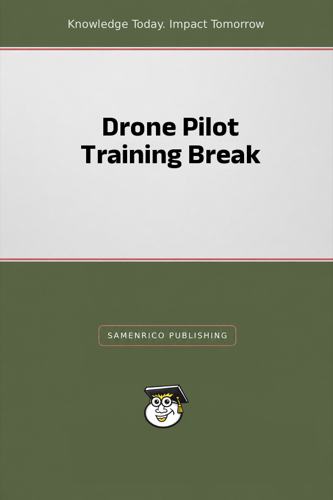
Non-FictionNon-Obvious CareerDroneAviation
Drone Pilot Training Break
Present UAV certification as technical skill, regu
by Shank Eilene
Present UAV certification as technical skill, regulation knowledge, and visual observation.
Formats
About this book
Free sample
Chapter 1: The Four Killers...–- Most drone pilots learn to fly backward. That is not a metaphor. When a $15,000 inspection drone suddenly wobbles, descends without command, or flies sideways into a tree, the pilot’s first reaction is almost always to pull back on the stick and climb. Climbing feels safe. Climbing feels like escape.
Climbing is almost always the wrong answer.The author learned this lesson in a cattle field outside Boulder, Colorado, at 7,500 feet of density altitude on a ninety-four-degree July afternoon. The drone was a Matrice 210, borrowed, insured, and thoroughly pre-flighted according to the manufacturer’s checklist. The mission was simple: fly a grid pattern over a solar array, capture thermal images of failing panels, return. Nothing about the flight was remarkable until the drone reached two hundred feet. The aircraft began to oscillate gently in pitch, then more aggressively, then without pattern.
The controller showed full throttle input. The drone continued to descend. By the time the author initiated a climb, the drone was already in a vortex ring state, falling through its own rotor wash at eleven feet per second. It struck the ground hard enough to shatter all six propellers and crack the main chassis.The manufacturer’s telemetry report used the word “aerodynamics” fourteen times. The pilot’s report used the word “density altitude” twenty-two times.
Neither report mentioned pilot error directly. Both reports were wrong. The error was not in the flying. The error was in the understanding. The pilot knew what density altitude was.
The pilot did not know what density altitude did.This chapter exists to close that gap. Aerodynamics is not abstract physics for engineers. Aerodynamics is the diagnostic language of why drones crash. The Part 107 exam tests your ability to define the four forces of flight. This chapter teaches you to recognize those forces failing in real time, to correct them before they become unrecoverable, and to walk away from flights that other pilots would lose.The Four Forces Are Not Equal on a Drone Every manned aviation textbook begins with the four forces: lift, weight, thrust, drag.
In a fixed-wing aircraft, these forces exist in a stable equilibrium. Reduce thrust, and the plane descends gradually, trading altitude…
This is the end of the free sample. Get the eBook to keep going. Buy now
Contents
- Chapter 1
- Chapter 2
- Chapter 3
- Chapter 4
- Chapter 5
- Chapter 6
- Chapter 7
- Chapter 8
- Chapter 9
- Chapter 10
- Chapter 11
- Chapter 12
Details
- Author
- Shank Eilene
- Publisher
- SamEnrico
- Language
- English
- Genre
- Non-Fiction, Non-Obvious Career, Drone, Aviation
- Released
- 2026-06-08
- Pages (approx.)
- 136
- Available as
- eBook, Audiobook

Read better in the ZLOADR app
Your eBooks on your phone or tablet. Sign in with your SamEnrico account and start reading.
More by Shank Eilene
 Gambling Cue Exposure TherapyShank Eilene$11.99
 Disappointment in Publish BookShank Eilene$11.99
 Emotional Inheritance Healing WorkbookShank Eilene$11.99
 Work Addiction Among Teachers GuideShank Eilene$11.99
 The Last Words of Hypatia: A Scholar’s Final Stand Against the DarkShank Eilene$11.99
 Clerk Meat PTShank Eilene$11.99
 Zero Subscriber Newsletter Launch GuideShank Eilene$12.99
 Parcel Carrier Rate NegotiationShank Eilene$12.99
 Understanding Left Ventricular HypertrophyShank Eilene$17.99
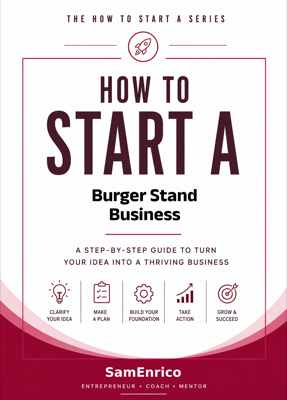 How to Start a Burger Stand Business (Beginners Guide)Shank Eilene$11.99
You may also like
 Hong Kong Handover 1997Dunn Johnnie$11.99
 Zumba For Postnatal Recovery CourseNeal Christian$11.99
 Zumba for BeginnersLadner Nikia$11.99
 YouTube Comment Mining GuideHumes Pandora$12.99
 Worry Box MeditationCarlin Rudy$11.99
 Workplace Stress MeditationNguyen Lynn$11.99
 Workplace Stress and Sleep RepairHawley Ivory$11.99
 Workplace Perfectionism CureDelaney Jeffry$11.99
 Workplace Injustice Anger GuideWallen Isabelle$11.99
 Work Addiction and Burnout LinkGreenwood Ester$11.99
 Women in Yoga and WellnessBeattie Galina$11.99
 Women in Stand Up ComedyChun Evangeline$11.99