
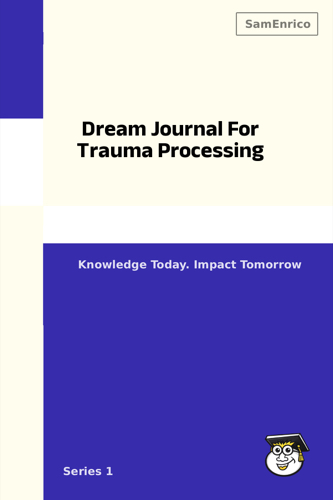
Dream Journal For Trauma Processing eBook
Works with distressing dreams under guidance.
Works with distressing dreams under guidance.
Formats
Free sample
Chapter 1: The Memory Trap--–- Every morning, millions of people wake up gasping, sweating, or frozen in silence. They reach for a journal—because someone told them that writing down their dreams will help. They pick up a pen, and then the trouble begins. They write every detail of the nightmare, from the first terrifying image to the last. They describe the monster, the chase, the fall, the locked door that won't open.
They pour their fear onto the page, believing that naming the terror will somehow tame it. And then, days or weeks later, they notice something horrifying: the nightmares are getting worse. More frequent. More vivid. More real.
What went wrong?The answer lies not in the act of writing itself, but in the type of writing. Standard dream journals—the ones sold in every bookstore, recommended by every wellness blog, and praised by every creativity coach—were never designed for traumatized brains. They were designed for curious minds, for artists seeking inspiration, for spiritually inclined individuals hoping to decode symbolic messages from their unconscious. These are worthy pursuits. But they operate on a completely different neurological platform than the one trauma survivors inhabit during sleep.This chapter draws a hard, evidence-based line between recreational dream journaling and trauma-informed work.
It explains, in plain language, why the standard approach can inadvertently strengthen the very nightmares you are trying to dissolve. You will learn the difference between a neutral dream and a traumatic nightmare—a difference that is not merely one of intensity but of kind. You will discover the concept of "reconsolidation risk" and why writing a linear narrative of a nightmare can sometimes act like rehearsing a phobia instead of healing it. And finally, you will be introduced to the MIRROR method, the proprietary protocol that underpins every exercise in this book. By the time you finish this chapter, you will understand why your previous attempts may have backfired—and why this book offers a fundamentally different, safer, and more effective path forward.Before we go any further, a critical note about the word "trauma." In these pages, trauma refers to any experience that overwhelms your nervous system's ability to cope, leaving behind a lasting imprint of fear, helplessness, or horror.
This includes single-incident events (car accidents, assaults, natural disasters) and complex, repeated exposures (childhood abuse, domestic violence, military combat). It also includes events that others might dismiss as "not that bad" but that your nervous system registered as life-threatening. Your brain does not lie about what scared it. If you wake up from nightmares that leave you breathless, sweaty, or unable to return to sleep, this book is for you—regardless of whether anyone else would call your experiences "traumatic enough."The Standard Dream Journal: A Tool for the Wrong Job Let us begin by examining the typical dream journal. If you walk into any bookstore or search online for "dream journal," you will find pages designed to capture the following: a title for the dream, a list of characters, a description of the setting, the sequence of events, the emotions felt, and—most problematically—a section for "interpretation" or "what the dream means." Some journals include dream dictionaries that equate specific symbols with fixed meanings: a snake means temptation, a house means the self, water means emotions, and so on.
Others encourage free-associative writing, asking the dreamer to "let the story flow" without editing or censoring.For a person without a trauma history, these prompts can be genuinely helpful. They encourage self-reflection, creativity, and emotional intelligence. They treat the dreaming mind as a wise guide, a source of insight, or at least an interesting conversation partner. The implicit message is: Your dreams have something to teach you. Listen to them.But for a trauma survivor, this framework is not just unhelpful—it can be actively dangerous.
Here is why.The traumatized brain does not store memories like a healthy brain does. Under normal conditions, a memory is encoded by the hippocampus—a seahorse-shaped structure deep in the brain that acts like a librarian, tagging each memory with a time, a place, and a narrative sequence. When you remember a normal event, you experience it as something that happened in the past. You know it is over. You can tell the story from beginning to end without feeling like you are back there.Trauma fractures this system.
During a traumatic event, the amygdala—the brain's alarm system—overrides the hippocampus. Threat detection takes priority over memory cataloging. As a result, traumatic memories are not stored as coherent stories with beginnings, middles, and ends. They are stored as sensory fragments: sounds, smells, physical sensations, flashes of images, and raw emotional states. These fragments have no timestamp.
Your brain does not know they are past. That is why a loud noise, a certain smell, or a particular tone of voice can suddenly make you feel like the trauma is happening right now.Now consider what happens when a trauma survivor writes down a nightmare in a standard dream journal. They are asked to take a fragmented, sensory, fear-based experience and turn it into a linear narrative. They must decide what happened first, what happened next, and what happened last. They must describe the setting, the characters, the sequence.
They must name the emotions. They must, in many journals, interpret what the dream "means."This act of forced linearization does something unexpected and dangerous: it teaches the amygdala to treat the nightmare as a coherent threat script rather than a jumble of fragments. Each time you write the nightmare as a story, you rehearse the fear pathway from beginning to end. Your brain begins to expect the sequence. It learns the order of operations.
And because traumatic memories are stored without timestamps, the act of rehearsing the narrative can trigger the same physiological response as the original event. Your heart races. Your palms sweat. Your breathing quickens. You are not remembering the nightmare—you are reliving it, on paper, in slow motion.This is the hidden trap of the standard dream journal.
It promises catharsis but delivers conditioning. It asks you to "face your fears" without first teaching you how to do so safely. It mistakes narrative coherence for healing, when in fact, for a traumatized brain, coherence can become a cage.Neutral Dreams vs. Traumatic Nightmares: A Crucial Distinction To understand why the MIRROR method works where standard journals fail, we must first understand what nightmares actually are—and what they are not.Neutral dreams occur during REM (rapid eye movement) sleep, which cycles throughout the night. During REM, the brain is highly active, nearly as active as when you are awake.
But certain regions are selectively deactivated. The dorsolateral prefrontal cortex—the part of the brain responsible for logic, planning, and self-awareness—is turned down. This is why dreams feel real even when they are bizarre. Your brain's reality-testing system is offline. Meanwhile, the amygdala and other emotion-processing regions remain active, which is why dreams have emotional texture.In a neutral dream, the content may be strange, unsettling, or even mildly frightening, but the emotional response stays within the brain's "window of tolerance." You might dream of being chased, but…
This is the end of the free sample. Get the eBook to keep going. Buy now
About this book
Details
- Author
- Lefebvre Rosamaria
- Publisher
- SamEnrico
- Language
- English
- Genre
- Non-Fiction, Self-Help, Trauma
- Released
- 2026-06-10
- Pages (approx.)
- 151
- Available as
- eBook, Audiobook

Read better in the ZLOADR app
Your eBooks on your phone or tablet. Sign in with your SamEnrico account and start reading.
More by Lefebvre Rosamaria
 The Kanpur Massacre HistoryLefebvre Rosamaria$11.99
 Tall Body Esteem GuideLefebvre Rosamaria$11.99
 Engineering Design Thinking GuideLefebvre Rosamaria$11.99
 AI Deck Accessibility GuideLefebvre Rosamaria$11.99
 Recall Software Evaluation GuideLefebvre Rosamaria$11.99
 High Blood Pressure MetabolicLefebvre Rosamaria$11.99
 Croatian Green Hydrogen PotentialLefebvre Rosamaria$11.99
 The Last Shot: How a Vaccine Stopped a PandemicLefebvre Rosamaria$11.99
 Moving House DreamsLefebvre Rosamaria$11.99
 The Last Dive of the *Ming*Lefebvre Rosamaria$11.99
 Blood and Ink: The Last Stand of the Kelmendi WarriorsLefebvre Rosamaria$11.99
 Leveraged Introductions and Warm AccessLefebvre Rosamaria$11.99
You may also like
 Hong Kong Handover 1997Dunn Johnnie$11.99
 Zumba For Postnatal Recovery CourseNeal Christian$11.99
 Zumba for BeginnersLadner Nikia$11.99
 YouTube Comment Mining GuideHumes Pandora$12.99
 Worry Box MeditationCarlin Rudy$11.99
 Workplace Stress MeditationNguyen Lynn$11.99
 Workplace Stress and Sleep RepairHawley Ivory$11.99
 Workplace Perfectionism CureDelaney Jeffry$11.99
 Workplace Injustice Anger GuideWallen Isabelle$11.99
 Work Addiction and Burnout LinkGreenwood Ester$11.99
 Women in Yoga and WellnessBeattie Galina$11.99
 Women in Stand Up ComedyChun Evangeline$11.99