
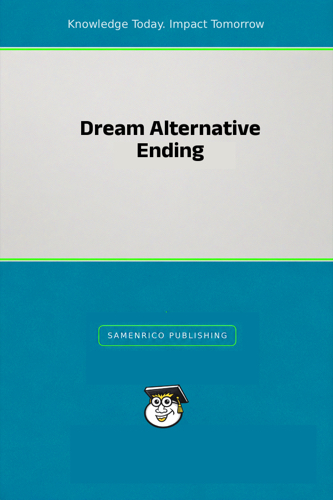
Dream Alternative Ending
Rewrites nightmare conclusions for resolution.
Rewrites nightmare conclusions for resolution.
Formats
About this book
Free sample
Chapter 1: The Uninvited Scriptwriter...--–- You wake up with your heart hammering against your ribs, the ghost of a scream still caught in your throat. The sheets are tangled around your legs like a trap. For a few precious seconds, you don't remember where you are. Then the bedroom materializes—the familiar crack in the ceiling, the glow of the digital clock, the weight of the blanket—and relief washes over you. It was just a dream.
Just a nightmare. Again. You glance at the clock: 3:47 AM. The same hour as last Tuesday. And the Tuesday before that.
You roll over, close your eyes, and try to convince yourself that it doesn't matter. But somewhere in the back of your mind, a small voice whispers: It's going to happen again tomorrow night, isn't it?If this scene feels familiar, you are not alone. Nightmares are not a niche problem reserved for trauma survivors or patients in therapy. They are a universal human experience, as common as bad days at work or arguments with loved ones. Clinical research suggests that over 85 percent of adults report at least one nightmare per year, and approximately 8 to 10 percent of the population suffers from frequent, distressing nightmares on a weekly or even nightly basis.
That translates to hundreds of millions of people across the globe who are, right now, losing sleep, waking up exhausted, and dreading the moment their head hits the pillow. Yet for all their prevalence, nightmares remain one of the most misunderstood and mismanaged aspects of human psychology. We are told to "not let them bother us," to "remember they aren't real," or to simply "think happy thoughts before bed." These platitudes fail because they misunderstand the fundamental nature of the nightmare. The nightmare is not random noise. It is not a punishment.
It is not a prophecy. And it is certainly not a sign that you are broken.The nightmare, as you will learn in this chapter, is something far more specific and far more treatable. It is the brain's failed attempt at protection. It is a script written by an…
This is the end of the free sample. Get the eBook to keep going. Buy now
Contents
- Chapter 1
- Chapter 2
- Chapter 3
- Chapter 4
- Chapter 5
- Chapter 6
- Chapter 7
- Chapter 8
- Chapter 9
- Chapter 10
- Chapter 11
- Chapter 12
Details
- Author
- Hammond Melody
- Publisher
- SamEnrico
- Language
- English
- Genre
- Non-Fiction, Self-Help
- Released
- 2026-06-06
- Pages (approx.)
- 140
- Available as
- eBook, Audiobook

Read better in the ZLOADR app
Your eBooks on your phone or tablet. Sign in with your SamEnrico account and start reading.
More by Hammond Melody
 Alcohol Recovery for CouplesHammond Melody$11.99
 Post Hypnotic Suggestion for ExerciseHammond Melody$11.99
 Comparing Yourself AngerHammond Melody$11.99
 The Maestro of Mechanical Wonders: Johann Sebastian Bach and the Clockwork UniverseHammond Melody$11.99
 How to Produce Clay CraftsHammond Melody$11.99
 Account Approval Timeline GuideHammond Melody$12.99
 Social Media Management Business SetupHammond Melody$11.99
 Ultimate Handbook Guide to Ziyang : (China) Travel GuideHammond Melody$11.99
You may also like
 Hong Kong Handover 1997Dunn Johnnie$11.99
 Zumba For Postnatal Recovery CourseNeal Christian$11.99
 Zumba for BeginnersLadner Nikia$11.99
 YouTube Comment Mining GuideHumes Pandora$12.99
 Worry Box MeditationCarlin Rudy$11.99
 Workplace Stress MeditationNguyen Lynn$11.99
 Workplace Stress and Sleep RepairHawley Ivory$11.99
 Workplace Perfectionism CureDelaney Jeffry$11.99
 Workplace Injustice Anger GuideWallen Isabelle$11.99
 Work Addiction and Burnout LinkGreenwood Ester$11.99
 Women in Yoga and WellnessBeattie Galina$11.99
 Women in Stand Up ComedyChun Evangeline$11.99