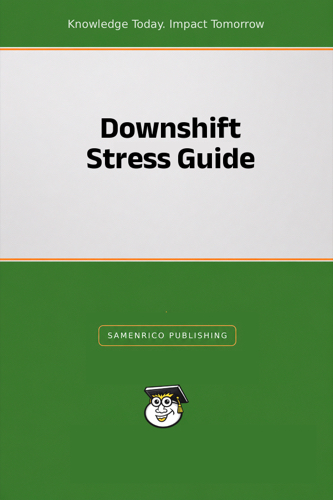
Downshift Stress Guide eBook
Nap, pray, and pause to lower stress hormones.
Nap, pray, and pause to lower stress hormones.
Formats
Free sample
Chapter 1: The Hormonal Highway--–- You wake up at 6:15 a.m. to the sound of your phone. Before your feet touch the floor, you check email. Three urgent requests. A Slack message from a colleague in London.
A news alert that spikes your heart rate. You haven't even brushed your teeth, and already your body is awash in stress hormones. By 10 a.m., you've had two coffees, snapped at a coworker, and can't remember what you ate for breakfast. By 3 p.m., you're crashing. By 9 p.m., you're too wired to sleep.
And tomorrow, you'll do it all again.This is not a personal failing. This is a physiological pattern—one that you can measure, understand, and change.Most people believe stress is a feeling. An emotion. Something you should "think positive" about or "manage better." But stress is not primarily psychological. It is hormonal.
It is a chemical cascade that evolved over hundreds of millions of years to save your life from predators, not to help you respond to emails. When you understand stress as hormones—cortisol, adrenaline, and their counterbalancing partners—you stop blaming yourself and start working with your biology.This chapter will transform how you see your daily experience. You will learn what the top ten stress-resilience books agree upon: acute stress is adaptive, but chronic stress is toxic. You will map the 24-hour rhythm of cortisol and identify exactly where your habits disrupt it. And you will learn three simple, science-backed methods to measure your personal stress load—without expensive lab tests or wearables (though those help).
By the end of this chapter, you will have turned the vague sense of "being stressed" into quantifiable data. And data, unlike feelings, can be acted upon.The Two Faces of Stress: Acute vs. Chronic Let us begin with a thought experiment. Imagine you are walking through a forest. A bear appears twenty feet away, rising onto its hind legs.
What happens inside your body? Your amygdala—the brain's smoke detector—signals the hypothalamus. The hypothalamus activates the sympathetic nervous system. Your adrenal glands release adrenaline and cortisol. Your heart rate jumps from 70 to 150 beats per minute.
Blood vessels in your arms and legs dilate, preparing for fight or flight. Your pupils widen. Your digestion stops. Your immune system mobilizes. You are now a perfect survival machine.That bear encounter is acute stress.
It lasts seconds or minutes. It is adaptive, even life-saving. It sharpens your senses, focuses your attention, and mobilizes energy. After the bear leaves—or after you outrun it—your parasympathetic nervous system (the "rest and digest" branch) activates. Your heart rate slows.
Cortisol levels drop. Your body returns to baseline. This is how stress was designed to work: spike, respond, recover.Now imagine a different scenario. You are not being chased by a bear. You are sitting at a desk.
But your email inbox has 247 unread messages. Your boss just assigned a project due Friday—today is Tuesday. Your child's school called about a fever. Your credit card bill is higher than expected. And you haven't had more than six hours of sleep in three weeks.
There is no bear. But your body does not know the difference.Your amygdala fires anyway. Your sympathetic nervous system activates. Your adrenals release cortisol and adrenaline. The difference is that the bear eventually leaves.
The inbox does not. The deadlines keep coming. The bills keep arriving. The sleep debt compounds. Your body stays in high gear—not at 100 percent activation, but at 40 or 50 percent, all day, every day.
This is chronic stress. And it is toxic.The distinction between acute and chronic stress is the single most important concept in this book. Every top stress bestseller—from Why We Sleep to Burnout to The Relaxation Response—agrees on this foundation. Acute stress makes you stronger, like exercise makes muscles stronger. Chronic stress breaks you down, like never letting a muscle relax.
The goal of this book is not to eliminate stress. The goal is to restore the natural rhythm: acute spikes followed by genuine recovery.Your Hormonal Highway: Meet Cortisol and Adrenaline To understand why chronic stress damages your body, you need to meet your primary stress hormones. Think of them as vehicles on a hormonal highway. When everything works correctly, they speed up during danger and slow down during rest. When the highway is always congested, everything breaks.Adrenaline (Epinephrine): The Sprinter Adrenaline is the sprinter.
It acts within seconds. It increases heart rate, elevates blood pressure, expands air passages in the lungs, and redirects blood to major muscle groups. It also triggers the release of glucose and fats from storage sites, giving you immediate energy. Adrenaline is why your hands shake before a presentation and why your vision narrows during an argument.Adrenaline's half-life in the bloodstream is approximately two to three minutes. That means after a stressor ends, your body can clear adrenaline relatively quickly—if you let it.
But if you keep feeding the stressor (checking email, ruminating, anticipating the next threat), adrenaline stays elevated. Chronically high adrenaline contributes to hypertension, heart palpitations, anxiety disorders, and insomnia.Cortisol: The Marathon Runner Cortisol is the marathon runner. It takes several minutes to peak, but it stays elevated for hours. Cortisol's job is to keep your body fueled during prolonged stress. It raises blood sugar by triggering gluconeogenesis (creating new glucose from non-carbohydrate sources).
It suppresses non-essential functions: digestion, reproduction, growth, and parts of the immune system. It also affects memory formation—which is why traumatic events are seared into your brain and why chronic stress makes it hard to recall where you put your keys.Cortisol follows a circadian rhythm. In a healthy person, cortisol peaks around 8:00 a.m., about 30 to 45 minutes after waking (this is called the cortisol awakening response). It then declines gradually throughout the day, reaching its lowest point around midnight. This rhythm is hardwired into your suprachiasmatic nucleus—your body's master clock.
When you sleep well, eat regularly, and experience normal acute stressors, this rhythm ticks along like a metronome.But chronic stress flattens the curve. Instead of a sharp morning peak and a low midnight trough, cortisol becomes a dull, elevated line—like a fever that never breaks. This flattened rhythm is associated with fatigue, depression, metabolic syndrome, impaired immune function, and accelerated cellular aging (shortened telomeres). In fact, one of the most reliable biomarkers of burnout is a blunted cortisol awakening response.The Dance Between Cortisol and Melatonin Cortisol does not act alone. It dances with melatonin, the hormone of darkness and sleep.
When cortisol is high, melatonin is low. When melatonin rises (in response to darkness and cooling body temperature), cortisol falls. This inverse relationship is why you cannot sleep when you are stressed and why poor sleep raises your cortisol the next day. It is a vicious cycle that this entire book is designed to break.The Disruptors: How Modern Life Hijacks Your Hormones You now understand the ideal pattern: sharp morning cortisol, gradual decline, low cortisol at night, rising melatonin, deep sleep, repeat. But modern life is exquisitely designed to disrupt this pattern.
Here are the most common disruptors—the ones you will learn to identify and change.Blue Light and Late-Night Screens Your retina…
This is the end of the free sample. Get the eBook to keep going. Buy now
About this book
Details
- Author
- Sheridan Roselia
- Publisher
- SamEnrico
- Language
- English
- Genre
- Non-Fiction, Health & Wellness, Stress Reduction
- Released
- 2026-06-08
- Pages (approx.)
- 152
- Available as
- eBook, Audiobook

Read better in the ZLOADR app
Your eBooks on your phone or tablet. Sign in with your SamEnrico account and start reading.
More by Sheridan Roselia
 Probiotic Anxiety TrialSheridan Roselia$11.99
 Functional Fixedness BreakthroughSheridan Roselia$11.99
 Pain Noting TechniqueSheridan Roselia$11.99
 Automatic Anger ThoughtsSheridan Roselia$11.99
 The Taika Waititi BiographySheridan Roselia$11.99
 Power of AttorneySheridan Roselia$11.99
 Pomodoro for ProcrastinationSheridan Roselia$11.99
 Mutiny at Sea: The 2015 Pacific Princess Prisoner RiotSheridan Roselia$11.99
 The Poets of the Jazz Age: A Harlem Renaissance RevivalSheridan Roselia$11.99
 How to Start a Mineral Water Exporter (wholesale) Business (Beginners Guide)Sheridan Roselia$11.99
 The Essential Guide to Original ScoreSheridan Roselia$11.99
 How to Produce Eye MasksSheridan Roselia$11.99