
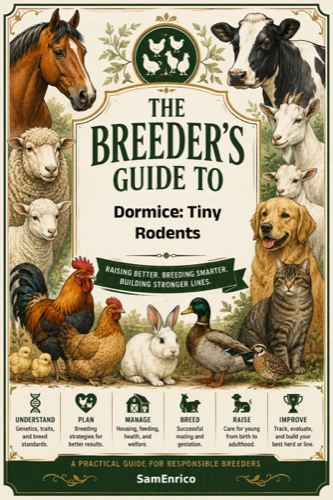
Dormice: Tiny Rodents eBook
This wildlife publication, published by SamEnrico,
This wildlife publication, published by SamEnrico, covers Dormice: Tiny Rodents
Formats
Free sample
Chapter 1: The Sleep-Climbing Paradox...–- On a damp autumn evening in a古老的 English woodland, a creature no heavier than a handful of feathers emerges from a woven ball of honeysuckle bark. It pauses at the fork of a hazel branch, whiskers twitching, eyes wide and dark as polished jet. In one fluid motion, it hangs upside-down from a twig no thicker than a drinking straw, rotates its hind feet a full 180 degrees, and reaches out to nip a ripe nut still in its green husk. This is a dormouse. It is neither a mouse, nor a squirrel, nor a rat.
And for seven months of the year, it will quite literally cease to be a warm-blooded mammal, dropping its body temperature to within a degree of the cold soil around it. To understand the dormouse is to enter a world where the boundaries between waking and sleeping, climbing and falling, life and death blur into a single, continuous strategy for survival.The first problem any naturalist encounters when studying dormice is not biological but linguistic. The very name "dormouse" carries centuries of misconception. It derives from the Old French dormir (to sleep), with the Anglo-Saxon mus (mouse) grafted onto it, creating a hybrid word that means, roughly, "sleeping mouse." But dormice are not mice. They belong to the family Gliridae (sometimes called Myoxidae in older texts), a lineage so ancient and so distinct that it split from the ancestors of true mice and rats before the Himalayas began their slow collision with the Asian continent.
While the great rodent radiation of the Eocene produced rats, squirrels, beavers, porcupines, and guinea pigs, the dormice held to an older plan: a compact body, a remarkably flexible spine, a tail that doubles as a fifth limb, and a metabolic system that treats energy as a currency to be hoarded, not spent.Dispelling the "big squirrel" myth requires an even closer look. Squirrels are diurnal, aggressive, and built for powered climbing—muscular hind legs that launch them up tree trunks. Dormice are nocturnal, secretive, and built for stealthy, energy-efficient movement through the fine branches of the shrub layer. A squirrel encountering a gap will leap; a dormouse will test the gap, retreat, find a longer route, or simply wait until a tendril of honeysuckle grows across it. This behavioral caution is not timidity.
It is thermodynamics in action. Every unnecessary movement costs calories, and for an animal that must pack on 30 to 50 percent of its body weight as fat just to survive the winter, waste is fatal.The Fossil Record: A 50-Million-Year Overnight Stay To appreciate the dormouse's evolutionary isolation, we must travel back to the early Eocene, approximately 50 million years ago. The climate was hot and wet. Primitive horses the size of dogs roamed the forests of what is now Europe and North America, and the first true primates were just appearing. Among the undergrowth scurried a small rodent with a short snout, a long tail, and teeth that would prove remarkably stable over deep time.
Fossils belonging to the family Gliridae have been found in the Messel Pit in Germany, a UNESCO World Heritage site that preserves an entire Eocene ecosystem in astonishing detail. Those early dormice already possessed the key dental feature that defines the family: a distinctive pattern of cheek teeth (premolars and molars) with multiple ridges arranged in a way that is neither mouse-like nor squirrel-like but uniquely glirid.For the next 30 million years, as other rodent families exploded into hundreds of species and colonized every continent except Antarctica, the dormice remained conservative. They did not evolve into giant forms or aquatic forms or burrowing specialists. They stayed in the trees, stayed small, and stayed omnivorous with a strong preference for plant matter. When the great ice ages of the Pleistocene began 2.6 million years ago, dormice responded not by evolving thicker fur or larger body size but by perfecting what they had already begun: hibernation.
Where other rodents retreated to warmer latitudes, dormice retreated into torpor. They became, in effect, time travelers, skipping the inhospitable months by shutting down almost every physiological system.This evolutionary strategy has proven both a success and a vulnerability. Success, because dormice have survived every mass extinction event since the Eocene, including the asteroid impact that wiped out the non-avian dinosaurs 66 million years ago (which occurred before dormice appeared, but the point stands: their lineage is resilient). Vulnerability, because the very traits that allow them to survive long winters—low reproductive rate, extreme habitat specialization, and a slow, cautious lifestyle—make them exquisitely sensitive to rapid environmental change caused by humans.The 29 Living Species: A Family Portrait Today, the family Gliridae comprises 29 recognized species, grouped into three subfamilies: Graphiurinae (African dormice), Leithiinae (which includes the hazel, garden, and forest dormice), and Glirinae (the edible dormouse and its close Asian relatives). Their distribution tells a story of ancient climate shifts and continental drift.
The majority of species live in Europe and Asia Minor, with a secondary radiation in sub-Saharan Africa. Remarkably, no dormice are native to the Americas, Australia, or Madagascar—a distribution pattern that suggests the family arose in the Old World after the breakup of the supercontinent Gondwana but before the land bridges that could have carried them to the New World.European and Asian dormice share several characteristics: deep hibernation (5 to 11 months depending on latitude and species), strict arboreal habits, and seasonal breeding. But within this group, diversity abounds. The edible dormouse (Glis glis) is the giant of the family, reaching up to 250 grams—ten times the weight of the smallest species. The hazel dormouse (Muscardinus avellanarius) is the gymnast, with a prehensile tail so flexible it can curl into a perfect spiral.
The garden dormouse (Eliomys quercinus) is the carnivore, adding birds' eggs and nestlings to its diet. And the Asian species, such as the Chinese dormouse (Chaetocauda sichuanensis), are the enigmas, so rarely seen that some are known only from a handful of museum specimens.African dormice (genus Graphiurus, with approximately 14 species) diverge from their European cousins in fascinating ways. Because they live in warmer climates with less pronounced winters, they experience a different suite of selective pressures. Most African dormice do not hibernate deeply; instead, they may enter short periods of torpor during cool nights or during the dry season when food is scarce. This behavior, called aestivation, is a form of summer sleep that allows them to survive drought without migrating.
African dormice are also more social than their European relatives, sometimes sharing nests in small groups, and they are more likely to be found in rocky outcrops and termite mounds rather than exclusively in trees. These differences are not trivial variations but evolutionary adaptations to fundamentally different environments. A dormouse from Tanzania would not survive a winter in Poland, and a dormouse from Poland would perish from heat stress in an African dry season.Why Dormice Are Not "Living Fossils" (But Close Enough)The term "living fossil" is controversial among paleontologists. True living fossils—like the coelacanth or the ginkgo tree—are species that appear nearly identical to their ancient ancestors over hundreds of millions of years. Dormice do not meet this strict definition.
Their teeth have evolved, their body size has shifted, and their behavior has adapted to changing environments. However, the dormouse…
This is the end of the free sample. Get the eBook to keep going. Buy now
About this book
Details
- Author
- Hawthorne Taunya
- Publisher
- SamEnrico
- Language
- English
- Genre
- Non-Fiction, Informative, Educational
- Released
- 2026-06-02
- Pages (approx.)
- 114
- Available as
- eBook, Audiobook

Read better in the ZLOADR app
Your eBooks on your phone or tablet. Sign in with your SamEnrico account and start reading.
More by Hawthorne Taunya
 Influence Techniques for Product ManagersHawthorne Taunya$11.99
 Legal Marijuana Road RageHawthorne Taunya$11.99
 Comparison Trap PostpartumHawthorne Taunya$11.99
 Breast Health For Non Binary PeopleHawthorne Taunya$11.99
 People Pleasing Fawn ResponseHawthorne Taunya$11.99
 Tech Layoff RecoveryHawthorne Taunya$11.99
 Cloud Floating RelaxationHawthorne Taunya$11.99
 Group Creativity for Social WorkersHawthorne Taunya$11.99
 Bloodhounds of the Penitentiary: The K9 War Against 19th-Century Prison GangsHawthorne Taunya$11.99
 When the World Was a Dream: The Navajo EmergenceHawthorne Taunya$11.99
 How to Start a Agricultural Machinery and Equipment Rental With Operator Business (Beginners Guide)Hawthorne Taunya$11.99
 EU Export Eco Certification HandbookHawthorne Taunya$12.99