
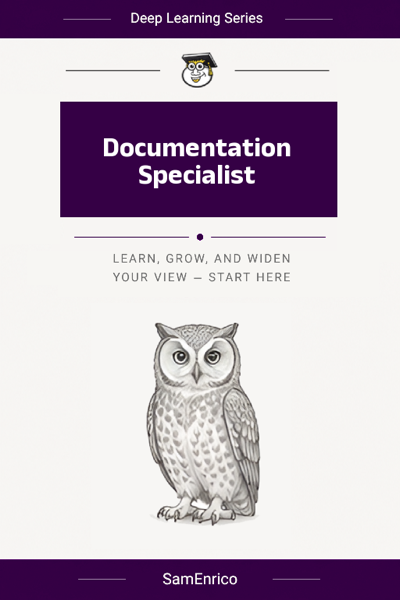
Non-FictionInformativeEducational
Documentation Specialist eBook
A Coursebook on Documentation Specialist
by Fusco Masako
A Coursebook on Documentation Specialist
Formats
Free sample
Chapter 1: The Invisible Backbone--–- Every company has a secret weapon. It is not the CEO’s vision, the engineering team’s brilliance, or the sales team’s charm. It is something far quieter, far more mundane, and yet utterly indispensable: the documentation. From the safety manual that prevents a factory accident to the API reference that enables a billion-dollar integration, documentation is the invisible backbone upon which every successful product rests. And at the heart of that backbone stands the Documentation Specialist.For decades, this role has been misunderstood, underestimated, and often relegated to the status of a “word processor”—someone who cleans up commas after the real work is done.
But that stereotype is not only wrong; it is dangerously outdated. The modern Documentation Specialist is a strategist, a user advocate, a system architect, and a diplomat rolled into one. They do not simply describe products; they shape user experiences, reduce support costs, mitigate legal risks, and accelerate product adoption. In short, they make complex things usable.This chapter dismantles the myth of the passive technical writer and rebuilds the role from the ground up. You will learn how the profession has evolved from standalone manuals to agile, code-integrated documentation.
You will discover the three pillars of success—Process, People, and Tools—that define the modern practice. You will understand how to calculate the return on investment (ROI) of documentation in concrete business terms: fewer support tickets, faster onboarding, and higher customer retention. And you will confront the ethical dimensions of the role, including accessibility standards (WCAG) and inclusive language. By the end of this chapter, you will see yourself not as a scribe but as a strategic partner in product development.The Historical Evolution: From Technical Writer to Documentation Specialist To understand where the role is going, you must first understand where it came from. The traditional “technical writer” emerged in the mid-20th century alongside complex military and aerospace systems.
Think of the thick, spiral-bound manuals that accompanied fighter jets or mainframe computers. These writers worked in isolation, receiving finished products from engineers and then “writing them up” in a linear, waterfall process. They were last in line, often given days to document what took months to build. Their tools were word processors, their outputs were PDFs, and their audience was assumed to read from cover to cover.That world has evaporated. In its place is a continuous, agile environment where software updates ship weekly, products change based on user feedback, and documentation must keep pace in real time.
The shift began in the early 2000s with the rise of the internet and wikis, accelerated with the Dev Ops movement (which treated docs as code), and has now matured into a discipline called “documentation as a product.” In this new paradigm, the Documentation Specialist participates in sprint planning, writes in the same repository as developers, and deploys content via the same continuous integration pipelines. They are no longer the last link; they are a first-class member of the product team.The title “Documentation Specialist” reflects this broader scope. Where “technical writer” emphasized the act of writing, “specialist” implies a command of systems, standards, and strategy. The modern specialist knows how to structure information for reusability (single sourcing), how to version content alongside code (Git), and how to measure success via analytics (user search behavior, task completion rates). In short, writing is only 50 percent of the job.
The other half is advocacy, process design, and tool mastery.The Three Pillars of Success: Process, People, Tools Throughout this book, you will encounter three recurring themes that form the foundation of effective documentation. I call them the Three Pillars of Success. Every successful Documentation Specialist must balance and master all three.Pillar One: Process Without a repeatable, documented process, documentation quickly becomes chaos. Process answers questions like: How does a document move from idea to publication? Who reviews it?
How often is it updated? How do we handle version conflicts? The chapters ahead will introduce you to specific processes, including the document lifecycle (Chapter 6), single sourcing workflows (Chapter 8), and agile project management for docs (Chapter 9). A strong process is not bureaucratic red tape; it is the guardrail that keeps content consistent, accurate, and usable.Pillar Two: People No document is written in a vacuum. Documentation Specialists work constantly with Subject Matter Experts (SMEs), product managers, developers, quality assurance testers, support agents, and even end users.
Each group has its own incentives, vocabulary, and availability. Learning to extract information from reluctant engineers, to mediate conflicting feedback, and to advocate for the user without alienating stakeholders is an art form. Chapter 7 is entirely dedicated to collaboration and review cycles, but the principle appears in every chapter: Documentation is a team sport.Pillar Three: Tools The tools of the trade have evolved far beyond Microsoft Word. Today’s specialist chooses from a dizzying array of options: version control systems (Git), markup languages (Markdown, re Structured Text), static site generators (Hugo, Docusaurus), component content management systems (CCMS), API documentation tools (Swagger), and automated linters (Vale). The right toolchain can automate repetitive tasks, enforce style rules, and enable single sourcing.
The wrong toolchain can create friction that makes teams abandon documentation altogether. Chapter 10 provides a detailed survey and decision matrix. But for now, know that you cannot be a modern specialist without being comfortable with at least one lightweight markup language and a version control system.The ROI of Documentation: Why Investing in Docs Pays One of the most common frustrations expressed by Documentation Specialists is the perception that leadership sees documentation as a cost center—an unavoidable expense rather than a value driver. To counter this, you must learn to speak the language of business: return on investment (ROI). In this section, we will explore how to quantify the value of documentation in terms that resonate with executives, product managers, and finance teams.
(For operational metrics like search analytics and user satisfaction, see Chapter 9.)Reduced Support Costs Every time a user opens a support ticket for a question that could have been answered by clear documentation, the company incurs a cost. The average cost of a tier-one support interaction (email or chat) ranges from 5to5 to 5to15 per ticket. A phone call can cost 30ormore.Nowimagineaproductwith100,000users.Ifeachuseropensjustoneavoidableticketperyear,theannualcostis30 or more. Now imagine a product with 100,000 users. If each user opens just one avoidable ticket per year, the annual cost is 30ormore.Nowimagineaproductwith100,000users.Ifeachuseropensjustoneavoidableticketperyear,theannualcostis500,000 to $1.5 million.
Good documentation can reduce that by 25 to 40 percent. That is not a cost saving; that is a direct contribution to the bottom line.Documentation Specialists can calculate this metric by measuring “support ticket deflection rate.” Implement a feedback mechanism on each documentation page: “Did this article solve your problem?” When users answer “yes,” you can attribute a savings. Most modern help desk platforms (Zendesk, Intercom) integrate with documentation tools to track this automatically. Armed with this data, you can make a compelling business case: “Investing 100,000indocumentationthisyearwillreducesupportcostsby100,000 in documentation this year will reduce support costs by 100,000indocumentationthisyearwillreducesupportcostsby300,000.”Faster Onboarding and Time-to-Value The sooner a user achieves their first “aha” moment—the first time they successfully use the product—the more likely they are to become a paying, retained…
This is the end of the free sample. Get the eBook to keep going. Buy now
About this book
Details
- Author
- Fusco Masako
- Publisher
- SamEnrico
- Language
- English
- Genre
- Non-Fiction, Informative, Educational
- Released
- 2026-05-25
- Pages (approx.)
- 158
- Available as
- eBook, Audiobook

Read better in the ZLOADR app
Your eBooks on your phone or tablet. Sign in with your SamEnrico account and start reading.
More by Fusco Masako
 Pinterest VA For Pet BrandsFusco Masako$11.99
 Meditation for Chronic Knee PainFusco Masako$11.99
 Breast Asymmetry New OnsetFusco Masako$11.99
 Values And Mission Alignment Performance ReviewFusco Masako$11.99
 Binge Eating After Trauma RecoveryFusco Masako$11.99
 The Lost Caravans of the Sahara: Ancient African Explorers and the Secrets of the North PoleFusco Masako$11.99
 The Blood of the Colosseum: Gladiators Who Defied RomeFusco Masako$11.99
 Blocking Software GuideFusco Masako$12.99
 Pre Seed Accelerator GuideFusco Masako$12.99
 Understanding Colobomatous Microphthalmia Heart Disease HearingFusco Masako$17.99
 A Beginners Guide to Australian Handball (Volume 1)Fusco Masako$11.99
You may also like
 Hong Kong Handover 1997Dunn Johnnie$11.99
 Zumba For Postnatal Recovery CourseNeal Christian$11.99
 Zumba for BeginnersLadner Nikia$11.99
 YouTube Comment Mining GuideHumes Pandora$12.99
 Worry Box MeditationCarlin Rudy$11.99
 Workplace Stress MeditationNguyen Lynn$11.99
 Workplace Stress and Sleep RepairHawley Ivory$11.99
 Workplace Perfectionism CureDelaney Jeffry$11.99
 Workplace Injustice Anger GuideWallen Isabelle$11.99
 Work Addiction and Burnout LinkGreenwood Ester$11.99
 Women in Yoga and WellnessBeattie Galina$11.99
 Women in Stand Up ComedyChun Evangeline$11.99