
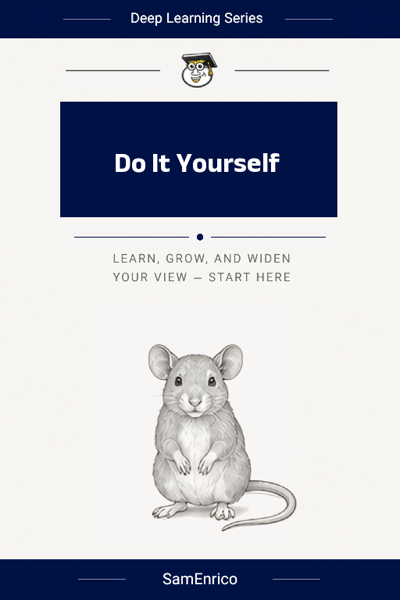
Non-FictionInformativeEducational
Do It Yourself eBook
A Coursebook on Do It Yourself
by Fair Annetta
A Coursebook on Do It Yourself
Formats
Free sample
Chapter 1: The Wobbly Chair...--–- I threw away a perfectly good toaster once because I didn't know a $0.50 spring could save it. That mistake cost me forty dollars and three years of believing I was “not handy.” The truth is worse than the money: I wasn't incapable. I was scared.The toaster stopped latching. You know the kind—you push the lever down, it clicks, the toast lowers. Mine wouldn't click.
I jiggled it. I slammed it. I swore at it. Then I walked it to the trash chute in my apartment building and heard it clang against the metal sides all the way down. A week later, I bought a new toaster for forty dollars.Three years after that, I mentioned this story to a friend who repairs small appliances.
He laughed. “That's a ninety-second fix,” he said. “There's a little spring that engages the latch. They pop out sometimes. You just hook it back in.”I felt sick.
Not because I had lost forty dollars. Because I had lost three years of believing I could fix things. That spring was a tiny metal lie detector, and it had revealed something I didn't want to admit: I had never tried to fix the toaster. I had jiggled it and slammed it, but I had never taken it apart. I had never looked inside.
I had never even googled “toaster not latching.”I assumed I couldn't fix it because I had never fixed anything. That circular logic kept me trapped for years. Every broken thing became more evidence for the case I had built against myself: “See? You can't fix things. You're not handy.
Just buy a new one.”This book is the spring that hooks back into the latch. It is the permission slip you have been waiting for. But before you learn a single skill—before you thread a needle or saw a board or wire a plug—you need to understand why you haven't already started. The problem is not your hands. The problem is your head.The Fear of Wasting (And Why It's a Lie)The number one reason people don't try DIY is not lack of time, money, or talent.
It is the fear of wasting materials. “What if I ruin this piece of wood?” “What if I cut this fabric wrong?” “What if I pour this epoxy and it cures lumpy?”Here is what you need to understand: materials are tuition. A ruined two-by-four costs four dollars. That is the price of a latte. A botched sewing project costs a two-dollar thrift store shirt.
A failed epoxy pour costs fifteen dollars. Compared to a community college course (five hundred dollars) or a trade school (ten thousand dollars), your tuition is laughably cheap.The alternative—hiring someone or buying new—costs ten to a hundred times more. I paid forty dollars for a new toaster when the spring cost fifty cents. You have probably done the same thing dozens of times. A new zipper for a jacket costs eight dollars installed by a tailor, but you bought a new jacket for eighty.
A loose drawer slide costs three dollars for a replacement, but you bought a new dresser for two hundred.The math is brutal and clear: not trying is more expensive than failing.But the fear isn't really about money, is it? It's about identity. You're afraid that if you try and fail, you will have proof that you are “not a fixer.” Right now, in the safety of not trying, you can maintain the possibility that you might be handy. The moment you try and fail, that possibility dies.Except it doesn't. Failure is not evidence of inability.
Failure is evidence of trying. Every expert maker has a pile of failures. My woodshop has a shelf of shame—the first birdhouse (roof collapsed), the first dovetail joint (looks like a beaver chewed it), the first epoxy table (full of bubbles). I keep them as trophies. They remind me that I was once a beginner who didn't quit.The Economics of DIY: A Worksheet That Will Save You Thousands Before you fix anything, you need to know whether you should.
Not everything is worth your time. Not every repair makes financial sense. Sometimes the most powerful DIY skill is knowing when to let something go.Here is the Fix/Replace Matrix. Use it before every project. It takes ninety seconds and will save you more money than any other page in this book.Column One: Repair Cost Add up everything you will spend to fix the item.
Be honest. Include:Materials (glue, wood, thread, paint, replacement parts)Tools you don't own but will need to buy (but only if you can't borrow or rent them)Your time, valued at fifteen dollars per hour (minimum wage for your own labor)Here is the trick about your time: only count it if you would otherwise be earning money. If you are fixing something on a Sunday afternoon while watching football, your time is worth zero dollars. If you are skipping work to fix it, your time is worth your hourly wage. Be honest but not punitive.Column Two: Replacement Cost What does it cost to buy a new (or comparable used) version of this item?
Include:Purchase price (new or used)Shipping or gas to go get it Disposal cost for the old one (some cities charge for bulk pickup)Column Three: Emotional Value This is the column that spreadsheets hate. On a scale of one to ten, how much do you love this thing? A one is “I found it on the curb.” A ten is “my grandmother built this with her hands.”Here is the rule: if emotional value is seven or higher, fix it regardless of the math. You are not an accountant. You are a human being who loves objects that have meaning.The Decision Tree If replacement cost is under twenty dollars AND emotional value is under three: let it go.
Donate it or trash it. You are not saving money; you are hoarding chores.If repair cost is less than half of replacement cost: fix it. This is a financial win.If repair cost is more than replacement cost but emotional value is over seven: fix it anyway. You are paying for sentiment, not economics.If you are unsure: set the item aside for one week. If you haven't thought about it, let it go.I used this worksheet on a broken coffee maker.
Replacement cost: eighty dollars. Repair cost: fifty-cent spring plus fifteen minutes of my time. Emotional value: two (it was a basic coffee maker). I fixed it. That fifty-cent spring saved me seventy-nine dollars and fifty cents.
The worksheet took sixty seconds.The Three Types of DIY People (A Self-Diagnostic)Not everyone starts in the same place. The single biggest mistake new DIYers make is trying a project that is two levels above their current skill. They fail. They feel stupid. They quit.You will not make that mistake because you are about to take a ninety-second diagnostic quiz.
Answer honestly. No one is watching.Question One: Have you ever held a hammer?A) No, and I'm not sure which end…
This is the end of the free sample. Get the eBook to keep going. Buy now
About this book
Details
- Author
- Fair Annetta
- Publisher
- SamEnrico
- Language
- English
- Genre
- Non-Fiction, Informative, Educational
- Released
- 2026-06-02
- Pages (approx.)
- 132
- Available as
- eBook, Audiobook

Read better in the ZLOADR app
Your eBooks on your phone or tablet. Sign in with your SamEnrico account and start reading.
More by Fair Annetta
 Telomere Pain ConnectionFair Annetta$11.99
 Talent Migration Patterns for Gaming IndustryFair Annetta$11.99
 The Nickelodeon Child Star ExperienceFair Annetta$11.99
 Jeff Bezos Shareholder LettersFair Annetta$11.99
 The Amanda Knox Case Summary BriefFair Annetta$11.99
 The Lion of the North: Gustavus Adolphus and the Art of WarFair Annetta$11.99
 How to Start a Opencast Coal Disposal Point Business (Beginners Guide)Fair Annetta$11.99
 SEA Waste Management GuideFair Annetta$12.99
 Letter Of Credit For Exporters HandbookFair Annetta$12.99
 Understanding Limb Transversal Defect Cardiac AnomalyFair Annetta$17.99
You may also like
 Hong Kong Handover 1997Dunn Johnnie$11.99
 Zumba For Postnatal Recovery CourseNeal Christian$11.99
 Zumba for BeginnersLadner Nikia$11.99
 YouTube Comment Mining GuideHumes Pandora$12.99
 Worry Box MeditationCarlin Rudy$11.99
 Workplace Stress MeditationNguyen Lynn$11.99
 Workplace Stress and Sleep RepairHawley Ivory$11.99
 Workplace Perfectionism CureDelaney Jeffry$11.99
 Workplace Injustice Anger GuideWallen Isabelle$11.99
 Work Addiction and Burnout LinkGreenwood Ester$11.99
 Women in Yoga and WellnessBeattie Galina$11.99
 Women in Stand Up ComedyChun Evangeline$11.99