
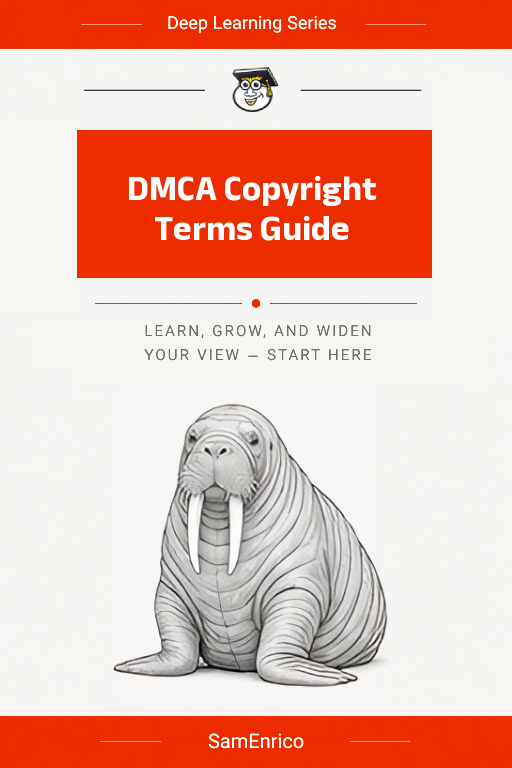
Non-FictionFirst 30 DaysCopyright Law
DMCA Copyright Terms Guide eBook
Add copyright infringement procedures to your term
by Sauer Pa
Add copyright infringement procedures to your terms page. This brief covers safe harbor requirements and takedown notice provisions for user generated content.
Formats
Free sample
Chapter 1: The Hidden Truth...-- The email arrived on a Tuesday afternoon. Maria, founder of a handmade jewelry blog with 12,000 monthly visitors, opened it while eating lunch at her desk. The subject line read: "Copyright Infringement Notice – Immediate Action Required." She almost deleted it as spam. By Friday, her merchant account was frozen. By the following Tuesday, a law firm had filed a federal lawsuit demanding $150,000 for a single photograph—one image she had never seen, uploaded by a stranger in a comment three months earlier, buried on page fourteen of her blog.Maria is not a pirate.
She is not a criminal. She is a small business owner who did one thing wrong: she assumed that because she didn't upload the infringing content herself, she couldn't be sued for it. That assumption cost her everything.This book exists because that assumption is the single most expensive mistake you can make as an online business owner. And if you run any website, app, or platform that allows users to post comments, photos, videos, or code—whether you are a solo blogger, a community manager, a Saa S startup founder, or an in-house legal counsel—you are currently at risk.The Dangerous Gap Between Intention and Liability Let us be absolutely clear about what is at stake. The Copyright Act of 1976, as amended by the Digital Millennium Copyright Act of 1998, imposes strict liability for copyright infringement.
Strict liability means exactly what it sounds like: your intent does not matter. Your lack of knowledge does not matter. Whether you made a single penny from the infringing content does not matter. If a copyrighted work appears on your servers without authorization, and you have not followed the specific legal procedures outlined in this book, you can be held financially responsible.The numbers are not abstract. Under 17 U.S.C.
§ 504, statutory damages range from 750to750 to 750to30,000 per infringed work. If a court finds that the infringement was willful—and courts have found willfulness simply because the defendant did not have a repeat infringer policy in place—that number jumps to $150,000 per work.Consider what that means for an ordinary website. A single user uploads ten copyrighted photographs to your forum. That is ten "works." At the minimum statutory damage of 750perwork,youowe750 per work, you owe 750perwork,youowe7,500. At the average award of 15,000perwork,youowe15,000 per work, you owe 15,000perwork,youowe150,000.
If the copyright owner persuades a jury that you were willfully blind—that you should have known the photos were infringing—you could owe $1.5 million. For ten photos. Uploaded by a stranger.This is not theoretical. In 2019, a federal jury awarded 8.3millionagainsttheoperatorofasmallstreamingsitethathadembeddedcopyrightedvideosuploadedbyusers.In2021,aphotographersuedalifestyleblogfor8.3 million against the operator of a small streaming site that had embedded copyrighted videos uploaded by users. In 2021, a photographer sued a lifestyle blog for 8.3millionagainsttheoperatorofasmallstreamingsitethathadembeddedcopyrightedvideosuploadedbyusers.In2021,aphotographersuedalifestyleblogfor120,000 after a single user comment included an unlicensed image.
The blog settled for 45,000—roughlythreeyearsofitsnetprofit.In2023,afitnessinfluencerwona45,000—roughly three years of its net profit. In 2023, a fitness influencer won a 45,000—roughlythreeyearsofitsnetprofit.In2023,afitnessinfluencerwona600,000 default judgment against a fan forum that refused to remove her workout videos after repeated notices.These are not cases about piracy empires or illegal streaming rings. These are cases about ordinary websites that failed to understand the rules of the road.The DMCA as a Shield, Not a Sword The Digital Millennium Copyright Act of 1998 was designed to solve a specific problem. In the early days of the commercial internet, copyright owners sued online platforms for user-generated content, and they often won. In one landmark case, Playboy Enterprises v.
Frena (1993), a court held that a bulletin board service was liable for infringing images uploaded by its subscribers, even though the service had no knowledge of the images and removed them immediately upon request. The legal theory was straightforward: the platform hosted the content, so the platform was an infringer.Congress recognized that this created an impossible situation. If platforms could be sued for every user upload, the internet as we know it would not exist. No social media, no You Tube, no Wikipedia, no comment sections, no user reviews. So Congress created a compromise: the DMCA safe harbors.Under Section 512 of the DMCA, an Online Service Provider (OSP) can avoid monetary liability for copyright infringement if it meets four specific requirements.
These are not suggestions. They are not best practices. They are statutory prerequisites. Miss any one of them, and you lose the safe harbor entirely. The four requirements are:You must have no actual or "red flag" knowledge that the material is infringing.You must not receive a direct financial benefit from the infringing activity that you have the right and ability to control.Upon receiving a valid takedown notice, you must remove the material expeditiously.You must have a designated agent registered with the U.S.
Copyright Office and a repeat infringer policy in place.These four requirements are the skeleton of this book. Chapters 2 through 12 will put meat on those bones. But before we dive into the technical details, we need to understand why so many website owners fail to qualify for the safe harbor—and why you almost certainly have gaps in your current approach.The Three Most Dangerous Misconceptions Over the past decade of advising online businesses, I have heard three misconceptions repeated so often that they deserve their own section. Each one has cost real business owners real money. Each one is completely wrong.Misconception Number One: "I didn't upload it, so I'm not responsible."This is the most common and most dangerous error.
Under traditional copyright law, the person who copies and distributes a work is the infringer. But the DMCA's safe harbor is an affirmative defense—that means you are presumed liable unless you prove you qualify for protection. Without the safe harbor, you are liable for user-uploaded content exactly as if you had uploaded it yourself. The only question is damages.Think of it this way: if a stranger parks a stolen car in your driveway, you are not automatically guilty of theft. But if you ignore the car for three months, never call the police, and let your friends drive it around, you have created a fact pattern that looks a lot like possession of stolen property.
The DMCA requires you to take affirmative steps—registering an agent, publishing a policy, responding to notices—to avoid that implied liability.Misconception Number Two: "I have a terms of service page, so I'm covered."A terms of service page is a contract between you and your users. The DMCA safe harbor is a federal statute. They are not the same thing, and one does not substitute for the other. I have reviewed hundreds of websites that proudly display a "Copyright Policy" page that does absolutely nothing to satisfy the DMCA's requirements. A typical mistake: "If you believe your copyright has been infringed, please email us." That is not a valid takedown procedure.
It lacks the six mandatory elements required by statute, and a copyright owner who uses your informal email form has not actually given you a valid legal notice. You cannot rely on your To S to save you when you have failed to register your designated agent…
This is the end of the free sample. Get the eBook to keep going. Buy now
About this book
Details
- Author
- Sauer Pa
- Publisher
- SamEnrico
- Language
- English
- Genre
- Non-Fiction, First 30 Days, Copyright Law
- Released
- 2026-06-01
- Pages (approx.)
- 149
- Available as
- eBook, Audiobook

Read better in the ZLOADR app
Your eBooks on your phone or tablet. Sign in with your SamEnrico account and start reading.
More by Sauer Pa
 Bodyweight Strength ProgressionSauer Pa$11.99
 Financial Account Leak ScriptsSauer Pa$11.99
 The Nun Who Healed TraumaSauer Pa$11.99
 Financial Infidelity AngerSauer Pa$11.99
 The TM Checking SessionSauer Pa$11.99
 Acupuncture For EczemaSauer Pa$11.99
 Nightmare QuizSauer Pa$11.99
 Jeane KirkpatrickSauer Pa$11.99
 Design Team Sprint FatigueSauer Pa$11.99
 The Quantum Leap: How a 12-Year-Old Girl Discovered a New PlanetSauer Pa$11.99
 The Last Stand of the Spartan 300: A Draft of DestinySauer Pa$11.99
 Constantinople Unbroken: The Byzantine Empire That Never FellSauer Pa$11.99
You may also like
 Hong Kong Handover 1997Dunn Johnnie$11.99
 Zumba For Postnatal Recovery CourseNeal Christian$11.99
 Zumba for BeginnersLadner Nikia$11.99
 YouTube Comment Mining GuideHumes Pandora$12.99
 Worry Box MeditationCarlin Rudy$11.99
 Workplace Stress MeditationNguyen Lynn$11.99
 Workplace Stress and Sleep RepairHawley Ivory$11.99
 Workplace Perfectionism CureDelaney Jeffry$11.99
 Workplace Injustice Anger GuideWallen Isabelle$11.99
 Work Addiction and Burnout LinkGreenwood Ester$11.99
 Women in Yoga and WellnessBeattie Galina$11.99
 Women in Stand Up ComedyChun Evangeline$11.99