
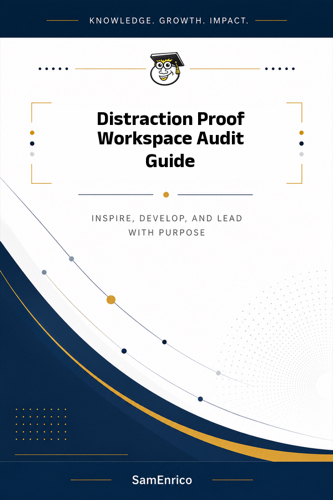
Non-FictionSelf-HelpEnvironmental Audit
Distraction Proof Workspace Audit Guide eBook
Score your current workspace on 20 distraction met
by Marino Angla
Score your current workspace on 20 distraction metrics and implement targeted fixes.
Formats
Free sample
Chapter 1: The 47-Second Heist--You don’t have an attention deficit. You have a workspace deficit.Let that land for a moment. For years, you’ve probably blamed yourself for every lost minute—the rabbit hole of social media, the “quick check” of email that turned into thirty minutes, the Slack ping that derailed your best writing hour. You’ve called yourself undisciplined, lazy, or simply “bad at focusing.” You’ve downloaded productivity apps, tried pomodoro timers, and made ambitious to-do lists that crumbled by 10 a.m.None of it stuck.Not because you’re broken. Because you’ve been fighting the wrong enemy.The real thief isn’t your willpower.
It’s your environment.This book exists to prove one thing: distraction is not a moral failing. It is a design flaw. And design flaws can be measured, diagnosed, and fixed without a single ounce of additional discipline.In the next twelve chapters, you will conduct a full-scale audit of your workspace—your desk, your screens, your notifications, your lighting, your social norms, and even your own internal triggers. You will score yourself on twenty specific metrics, each one tied to a proven fix. And by the end, you will transform any workspace—home office, corporate cubicle, coffee shop, or hybrid hell—into a distraction-proof fortress.But first, you need to understand the scope of the problem.
Because until you know how much attention you’re actually losing, you cannot possibly fix it. And the numbers are far worse than you imagine.The Vanishing Attention Span Let’s start with a staggering fact.In 2004, before the smartphone revolution, before Slack, before always-on email, the average knowledge worker focused on a single task for roughly two and a half minutes before switching to something else. That wasn’t great, but it was functional. People still wrote books, built software, and ran companies.By 2012, that number had dropped to seventy-five seconds.By 2016, it had fallen to forty-seven seconds.That is the most recent data from Gloria Mark, a professor of informatics at the University of California, Irvine, who has spent two decades studying attention in the workplace. Her research is the bedrock of this chapter, and it reveals a terrifying trajectory: every year, our ability to sustain focus shrinks further, eaten away not by laziness but by the relentless architecture of the attention economy.Forty-seven seconds.Think about what you can do in forty-seven seconds.
You can read two text messages. You can glance at a headline. You can type a single sentence if you’re fast. You can barely heat a cup of coffee. And yet, that is now the average duration of uninterrupted work in a modern office.But here is where the story gets truly alarming.The Recovery Cost Switching tasks every forty-seven seconds is catastrophic enough on its own.
But the damage doesn’t end when you switch. The real cost comes when you try to switch back.According to Mark’s research, after any interruption—a ping, a person, a self-directed glance at your phone—it takes an average of twenty-three minutes to fully return to your original task. Not just to look at the same screen, but to regain the same depth of focus, the same working memory, the same cognitive flow.Twenty-three minutes.Let’s do the math. If you are interrupted just four times in an hour—which is actually fewer interruptions than the average knowledge worker experiences—you lose nearly ninety minutes of cognitive restoration time. Not working time.
Restoration time. The time your brain spends rebuilding the context it lost.Over an eight-hour day, that adds up to hours of lost productivity. Over a year, that’s hundreds of hours. Over a career, it’s years of your life, stolen not by any single dramatic event but by the death of a thousand pings.And here is the cruelest irony: most interruptions are not emergencies. Most are not even important.
Most are trivial, habitual, or entirely self-inflicted. But trivial or not, each one carries the same twenty-three-minute price tag.This is the core insight that reframes everything you think you know about productivity. You have been told that distraction is about willpower. It is not. Distraction is about physics.
Every interruption has a measurable cost. Every ping has a price. And your workspace has been designed by people who profit when you pay that price over and over again.External vs. Internal Triggers: The Two Thieves Before we go further, we need to name the two kinds of thieves that steal your attention. This distinction will appear throughout the book, so it’s worth understanding deeply.External triggers are the obvious ones.
They come from your environment, not from you. A Slack notification. A colleague tapping your shoulder. A phone buzzing on your desk. A calendar reminder popping up.
A car alarm outside your window. These are the pings, dings, and human collisions that pull your eyes away from your work.External triggers are the low-hanging fruit of distraction-proofing. They are relatively easy to measure, relatively easy to fix, and they account for roughly half of all interruptions in a typical workplace.Internal triggers are sneakier. They come from inside your own head. The sudden urge to check Instagram while writing a difficult email.
The impulse to open a news tab when you hit a confusing paragraph. The feeling of boredom that drives you to stand up and get water even though you aren’t thirsty. The anxiety that makes you check your inbox for the fifteenth time in an hour.Internal triggers are harder to fix because they feel like “you.” You might tell yourself that you’re just curious, or restless, or that you deserve a break. But what’s really happening is that your brain is seeking escape from discomfort—a hard problem, a boring task, or a scary deadline. The workspace can either amplify or reduce these internal triggers.
A clean, well-lit, tool-rich environment lowers the friction to start hard tasks. A chaotic, noisy, notification-soaked environment makes every internal trigger feel unbearable.The book addresses both types of triggers, but in a specific order. Part Two focuses almost exclusively on external triggers because they are the fastest to fix and yield the most immediate return. Once you have silenced the external noise, you will be able to see your internal triggers more clearly. And that is when Part Four’s tools for cognitive load and internal chaos will become essential.But for now, know this: you cannot fix what you do not measure.
And before you measure anything else, you need to measure how often you switch tasks.Audit Metric #1: Context Switching Frequency Every chapter in this book introduces one or more audit metrics. These are the twenty specific measurements that form the spine of the Distraction-Proof Workspace Audit. By the time you finish the book, you will have scored your workspace on all twenty metrics and implemented targeted fixes for your weakest areas.Metric #1 is the foundation of everything else.Definition: Context Switching Frequency measures how many times per hour you voluntarily or involuntarily switch between different tasks, applications, windows, or mental modes. Each time you move from…
This is the end of the free sample. Get the eBook to keep going. Buy now
About this book
Details
- Author
- Marino Angla
- Publisher
- SamEnrico
- Language
- English
- Genre
- Non-Fiction, Self-Help, Environmental Audit
- Released
- 2026-06-06
- Pages (approx.)
- 143
- Available as
- eBook, Audiobook

Read better in the ZLOADR app
Your eBooks on your phone or tablet. Sign in with your SamEnrico account and start reading.
More by Marino Angla
 Female Supreme Court JusticesMarino Angla$11.99
 Anki for College StudentsMarino Angla$11.99
 Step Ten Daily InventoryMarino Angla$11.99
 Denmark Green Tax GuideMarino Angla$11.99
 Habit for Anxiety GuideMarino Angla$11.99
 Oregon Attorney General InvestigationMarino Angla$11.99Oregon Attorney General InvestigationMarino Angla$11.99
 Fixed Mindset Traps GuideMarino Angla$11.99
 The Silent Witness: How a Lock of Hair Solved a Victorian MurderMarino Angla$11.99
 The Obsidian Spy: A Mayan God’s GambitMarino Angla$11.99
 10 Ways to Use Rumex Scutatus (Recipe Book)Marino Angla$11.99
 Understanding Leigh's DiseaseMarino Angla$11.99
You may also like
 Hong Kong Handover 1997Dunn Johnnie$11.99
 Zumba For Postnatal Recovery CourseNeal Christian$11.99
 Zumba for BeginnersLadner Nikia$11.99
 YouTube Comment Mining GuideHumes Pandora$12.99
 Worry Box MeditationCarlin Rudy$11.99
 Workplace Stress MeditationNguyen Lynn$11.99
 Workplace Stress and Sleep RepairHawley Ivory$11.99
 Workplace Perfectionism CureDelaney Jeffry$11.99
 Workplace Injustice Anger GuideWallen Isabelle$11.99
 Work Addiction and Burnout LinkGreenwood Ester$11.99
 Women in Yoga and WellnessBeattie Galina$11.99
 Women in Stand Up ComedyChun Evangeline$11.99