
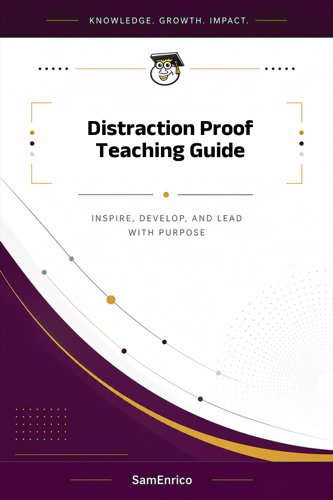
Non-FictionSelf-HelpEducationClassroom Management
Distraction Proof Teaching Guide Audiobook
Manage classroom interruptions, keep lesson flow,
Manage classroom interruptions, keep lesson flow, and regain attention after disruptions.
Formats
Free sample
Chapter 1: Beyond the Gavel--–- Picture the scene. You have spent two hours prepping this lesson. You have printed the handouts, queued the slides, rehearsed the transitions. The bell rings. You launch in.
Fifteen minutes later, a phone buzzes in a backpack. A student in the third row rolls her eyes. Two boys in the back are passing a note. Someone asks when lunch is. Someone else asks to go to the bathroom.
Your voice tightens. Your pulse quickens. And a familiar voice inside your head whispers: If I were stricter, this wouldn't happen.That voice is lying to you. And chasing that lie is the reason you are exhausted.This chapter dismantles the first and most costly assumption about classroom management: the belief that authority is the antidote to distraction. We will examine why stricter rules, louder reprimands, and heavier consequences fail to produce lasting attention.
We will explore the neurobiology of why punitive systems backfire. And we will lay the foundation for a radically different approach—one that replaces the gavel with the metronome.The Punishment Trap Every teacher knows the arc. A student acts out. You respond with a consequence. The behavior stops—temporarily.
Then it returns, often worse than before. You escalate the consequence. The behavior stops again, then returns again. You escalate further. The cycle continues until the only remaining consequences are suspension, expulsion, or your own burnout.This is the punishment trap.
And it is not your fault. The trap is built into the structure of punitive systems themselves, reinforced by every classroom management program that prioritizes "consequences" over "design."Here is why the trap works the way it does. Punishment triggers the brain's threat response. When a student perceives a consequence as threatening, their amygdala (the brain's smoke detector) activates. Blood flows away from the prefrontal cortex (the thinking brain) and toward the survival circuits.
The student becomes less capable of reflection, less capable of impulse control, and more likely to react defensively. You have not increased their capacity for attention. You have reduced it.The research is unequivocal. A meta-analysis published in the Journal of Educational Psychology examined forty years of classroom management studies. The findings: punitive approaches (detentions, referrals, public reprimands) produce short-term compliance but do not improve long-term attention or engagement.
In fact, students in high-punishment classrooms showed higher rates of distraction over time than students in low-punishment classrooms. The punishment…
This is the end of the free sample. Get the Audiobook to keep going. Buy now
About this book
Details
- Author
- Boykin Rosalind
- Publisher
- SamEnrico
- Language
- English
- Genre
- Non-Fiction, Self-Help, Education, Classroom Management
- Released
- 2026-06-09
- Pages (approx.)
- 146
- Available as
- eBook, Audiobook

Listen in the VoxFlicks app
Audiobooks and audio dramas wherever you go. Sign in with your SamEnrico account and press play.
More by Boykin Rosalind
 Committee Of Public Safety GuideBoykin Rosalind$11.99
 Postpartum Depression Support Group GuideBoykin Rosalind$11.99
 Czech Republic Remote Work GuideBoykin Rosalind$11.99
 Anger in Polyamorous SystemsBoykin Rosalind$11.99
 Pelvic Floor ChecklistBoykin Rosalind$11.99
 The Crucial Conversations GuideBoykin Rosalind$11.99
 The Adopted Child in DysfunctionBoykin Rosalind$11.99
 Body Image For AlopeciaBoykin Rosalind$11.99
 The Stanford Prison Experiment: When Good Men Go BadBoykin Rosalind$11.99
 The Stanford Prison Experiment: Behind the Bars of MadnessBoykin Rosalind$11.99
 The Unseen Empire: How a Forgotten Broadcast War Shaped the Modern Media LandscapeBoykin Rosalind$11.99
 How to Start a Recreational Sports Center BusinessBoykin Rosalind$11.99
You may also like
 Hong Kong Handover 1997Dunn Johnnie$11.99
 Zumba For Postnatal Recovery CourseNeal Christian$11.99
 Zumba for BeginnersLadner Nikia$11.99
 YouTube Comment Mining GuideHumes Pandora$12.99
 Worry Box MeditationCarlin Rudy$11.99
 Workplace Stress MeditationNguyen Lynn$11.99
 Workplace Stress and Sleep RepairHawley Ivory$11.99
 Workplace Perfectionism CureDelaney Jeffry$11.99
 Workplace Injustice Anger GuideWallen Isabelle$11.99
 Work Addiction and Burnout LinkGreenwood Ester$11.99
 Women in Yoga and WellnessBeattie Galina$11.99
 Women in Stand Up ComedyChun Evangeline$11.99