
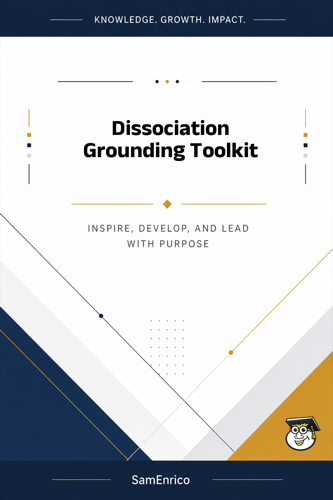
Non-FictionSelf-HelpDissociation
Dissociation Grounding Toolkit eBook
Pull yourself back from depersonalization with sen
Pull yourself back from depersonalization with sensory anchors.
Formats
Free sample
Chapter 1: The Ghost in the Machine--–- You are reading this sentence, but you are not sure you believe it.The words are on the page. You can see the shapes of the letters, the white space between the lines, the way the light catches the paper or the screen. You know, intellectually, that you are looking at a book. You know, intellectually, that you are holding it in your hands—or that your eyes are moving across a screen, or that someone is reading this aloud to you. But somewhere between your eyes and your awareness, something has broken.
The words feel distant. The page feels flat. Your own hands, the ones holding the book, might as well belong to a stranger. You look down at your fingers and think: Those are not my fingers. Those are props.
Those are someone else's hands, and I am watching them from very far away.If this feels familiar, you are not alone. And you are not broken.This book is not for people who have everything figured out. It is not for people who wake up feeling solid, present, and real every morning. It is for the people who wake up and have to check. It is for the people who look in the mirror and feel a jolt of wrongness—not because they dislike what they see, but because they do not recognize the person looking back.
It is for the people who have spent hours, days, even years wondering if they are losing their minds, if they have brain damage, if they are secretly psychotic, if they will ever feel like themselves again.You are not losing your mind. You are not psychotic. You do not have brain damage. You have a nervous system that learned, somewhere along the way, that the safest thing to do was to turn down the volume on reality.This chapter is called "The Ghost in the Machine" because that is what depersonalization feels like: you are the ghost, and your own body is the machine. You are floating somewhere behind your eyes, operating levers and pulleys that no longer feel attached to you.
Your voice comes out of your mouth and you hear it as if someone else is speaking. You walk across a room and you feel like you are watching a character in a video game move across a screen. The world is still there. You are still there. But the connection between the two has been severed by an invisible knife.The good news—and there is good news, even if you cannot feel it right now—is that the knife is not permanent.
The connection can be repaired. And the first step to repairing it is to understand, once and for all, what is actually happening inside your brain.The Circuit Breaker You Never Knew You Had Let us start with a story. Imagine you are walking through your home at night. It is dark. You cannot see the floor.
Suddenly, your bare foot steps on a piece of broken glass. What happens? You do not think, Oh, I appear to have encountered a sharp object; I should probably lift my foot now. No. Your foot lifts before the signal even reaches your conscious brain.
Your spinal cord processes the danger, sends a motor command back to your leg, and only after your foot is already in the air does your brain say, By the way, that was glass, and it hurt.That is your nervous system doing its job. It is fast, efficient, and largely automatic. It does not ask for your permission. It does not wait for your opinion. It simply acts.Now imagine a different scenario.
You are walking through that same dark house, but this time, you step on something that is not glass. It is a stick. Or a toy. Or nothing at all—just a shadow on the floor. Your foot still lifts.
Your heart still races. You still feel a jolt of alarm. And then, a moment later, your brain catches up and says, False alarm. There is no danger. You can put your foot down.Your nervous system just tripped a circuit breaker.
It overreacted to a potential threat, mobilized your body for action, and then—when it realized the threat was not real—it began to calm down.Dissociation works the same way, except the circuit breaker gets stuck in the "off" position.Here is what actually happens inside your brain during depersonalization or derealization. Your amygdala—a small, almond-shaped structure deep in your brain—detects a threat. That threat might be real (a car crash, an assault, a panic attack) or it might be perceived (a stressful conversation, a crowded room, a memory, a substance like marijuana that temporarily disrupts your brain's normal signaling). Your amygdala does not know the difference between a real threat and a perceived one. It only knows that something is wrong.In response, your brain activates your body's most ancient survival system: the freeze response.
You have heard of fight or flight. Freeze is the third option, the one your nervous system reaches for when fighting is impossible and fleeing is useless. A mouse frozen in the paws of a cat is not "spacing out." It is dissociating. Its brain has released a flood of endogenous opioids—natural painkillers—so that if the cat bites, the mouse will not suffer as much. Its awareness narrows.
Its sense of self dims. It becomes, in a very real sense, a ghost in the machine of its own body.That mouse, if it escapes, will eventually come back online. Its nervous system will reset. It will run away, hide in a hole, and after some time, it will go back to being a mouse—eating, grooming, sleeping, being present in its small mouse life.But your nervous system is more complicated than a mouse's. You have a prefrontal cortex, the part of your brain that thinks about thinking, that worries about worrying, that monitors your own internal state with a relentless, obsessive precision.
And that prefrontal cortex is precisely what keeps your circuit breaker stuck in the off position.Why Your Brain Chose Numbness (And Why It Keeps Choosing It)Let me tell you about Sarah. Sarah is not a real person—she is a composite of dozens of people I have spoken to, researched, and read about while writing this book. But her story is real in the way that all of our stories are real.Sarah had her first depersonalization episode when she was nineteen years old. She was a college sophomore, stressed about exams, drinking too much coffee, sleeping too little. One night, she smoked marijuana with friends—something she had done before without issue.
But this time, something went wrong. Her heart began to race. The room started to spin. She felt like she was watching herself from the ceiling, a tiny figure on a couch, her mouth moving, her hands gesturing, her voice saying words she did not remember choosing.She thought she was dying. She thought she was having a stroke.
She thought she had finally, truly, lost her mind.The panic attack passed after about twenty minutes. But the dissociation did…
This is the end of the free sample. Get the eBook to keep going. Buy now
About this book
Details
- Author
- Mackenzie Carolina
- Publisher
- SamEnrico
- Language
- English
- Genre
- Non-Fiction, Self-Help, Dissociation
- Released
- 2026-06-08
- Pages (approx.)
- 133
- Available as
- eBook, Audiobook

Read better in the ZLOADR app
Your eBooks on your phone or tablet. Sign in with your SamEnrico account and start reading.
More by Mackenzie Carolina
 Stillbirth Postpartum RecoveryMackenzie Carolina$11.99
 Navigation App Anger ManagementMackenzie Carolina$11.99
 Loving Kindness Sleep MeditationMackenzie Carolina$11.99
 Targeted Therapy For Breast CancerMackenzie Carolina$11.99
 Anticipatory Grief In PrisonMackenzie Carolina$11.99
 Influence Techniques for LawyersMackenzie Carolina$11.99
 Creative Collaboration JournalMackenzie Carolina$11.99
 The Last Flight of the Condor: Peru's Death Row Meal That Shocked a NationMackenzie Carolina$11.99
 Bladensburg’s Phantom Drums: The Haunting of the War of Spanish SuccessionMackenzie Carolina$11.99
 Dachshunds: The Sausage DogMackenzie Carolina$11.99
 How to Produce Cooking StarchMackenzie Carolina$11.99
 Brazilian Law Free University GuideMackenzie Carolina$12.99
You may also like
 Hong Kong Handover 1997Dunn Johnnie$11.99
 Zumba For Postnatal Recovery CourseNeal Christian$11.99
 Zumba for BeginnersLadner Nikia$11.99
 YouTube Comment Mining GuideHumes Pandora$12.99
 Worry Box MeditationCarlin Rudy$11.99
 Workplace Stress MeditationNguyen Lynn$11.99
 Workplace Stress and Sleep RepairHawley Ivory$11.99
 Workplace Perfectionism CureDelaney Jeffry$11.99
 Workplace Injustice Anger GuideWallen Isabelle$11.99
 Work Addiction and Burnout LinkGreenwood Ester$11.99
 Women in Yoga and WellnessBeattie Galina$11.99
 Women in Stand Up ComedyChun Evangeline$11.99