
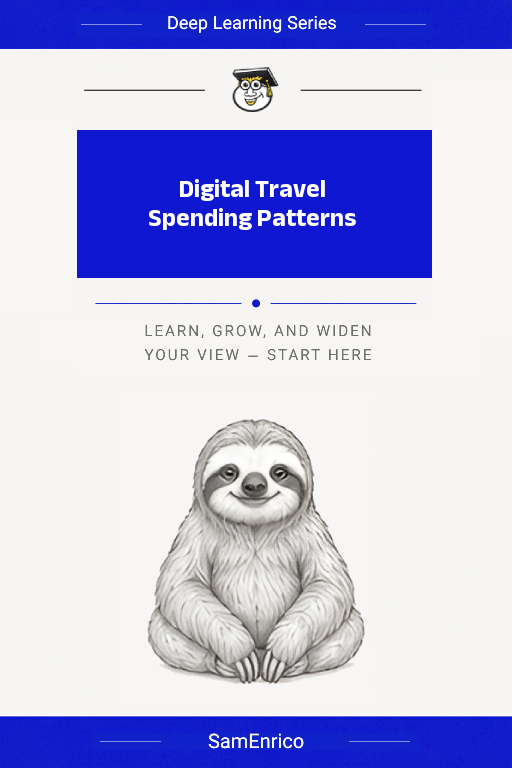
Digital Travel Spending Patterns
Tracks online travel agency (OTA) usage, direct bo
by Muniz Monte
Tracks online travel agency (OTA) usage, direct booking preferences, and spending on travel apps and digital concierge services.
Formats
About this book
Free sample
Chapter 1: The Trust Paradox--–- The 7:32 AM flight from Chicago to Denver was overbooked, as usual. Maria, a 34-year-old marketing director, had done what she always does when planning a trip: she opened three browser tabs. One for Expedia. One for Booking.com. One for the hotel's own website.
She compared prices, read reviews, and then, despite finding a marginally better rate on the hotel's site, she booked through Expedia. Why? She couldn't quite articulate it. Habit, perhaps. Or the faint sense that the OTA would protect her if something went wrong.
Twenty minutes later, she received a confirmation email with a "processing fee" she hadn't noticed until after clicking "purchase." She sighed, made a mental note to check more carefully next time, and then promptly forgot. A week later, when a snowstorm canceled her connection, she spent forty-seven minutes on hold with Expedia's customer service, only to be told her ticket was non-refundable. "I'll book direct next time," she told herself. But she wouldn't. Statistically speaking, she'd be back on Expedia within six months.This is the Trust Paradox.
And it is the single most important psychological bottleneck in the digital travel economy.The 50/24 Problem: Defining the Paradox Let us begin with a number that should keep every OTA executive awake at night: 24 percent. According to aggregated consumer trust data from 2024–2025, only 24 percent of travelers trust online travel agencies to act in their best interest. Yet here is the number that keeps them sleeping soundly: 50 percent. Half of all travelers still book through OTAs. The gap between these two figures—twenty-six percentage points of distrust that does not translate into defection—is the Trust Paradox.
It is a cognitive dissonance so deeply embedded in traveler behavior that it has become structural.To understand why, we must abandon the rational actor model of consumer behavior. Travelers do not book through OTAs because they trust them. They book through OTAs because OTAs solve a different problem: the problem of overwhelming choice. A traveler searching for a hotel in Paris faces approximately 1,800 options. An airline route from New York to London has…
This is the end of the free sample. Get the eBook to keep going. Buy now
Contents
- Chapter 1
- Chapter 2
- Chapter 3
- Chapter 4
- Chapter 5
- Chapter 6
- Chapter 7
- Chapter 8
- Chapter 9
- Chapter 10
- Chapter 11
- Chapter 12
Details
- Author
- Muniz Monte
- Publisher
- SamEnrico
- Language
- English
- Genre
- Non-Fiction, Consumer Mind Report, Digital Travel
- Released
- 2026-05-29
- Pages (approx.)
- 141
- Available as
- eBook, Audiobook

Read better in the ZLOADR app
Your eBooks on your phone or tablet. Sign in with your SamEnrico account and start reading.
More by Muniz Monte
 Divorce and DepressionMuniz Monte$11.99
 Fentanyl Test Strip GuideMuniz Monte$11.99
 Caffeine and Presentation AnxietyMuniz Monte$11.99
 Anger Management for Union RepsMuniz Monte$11.99
 The Vitamin C Immunity GuideMuniz Monte$11.99
 Pillars of Dust: The Forgotten Opium Wars of the Silk RoadMuniz Monte$11.99
 Understanding Polydactyly Syndrome Middle Ray DuplicationMuniz Monte$17.99
 YouTube Trend Jacking GuideMuniz Monte$12.99
 Business Systems SpecialistMuniz Monte$11.99
 How to Become a Nut-sorter OperatorMuniz Monte$11.99