
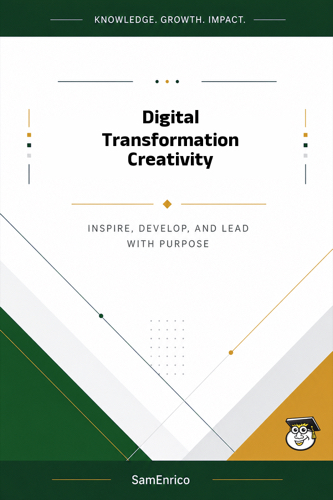
Non-FictionSelf-HelpDigital Transformation
Digital Transformation Creativity eBook
Generate novel technology adoption and digitizatio
by Batie Keena
Generate novel technology adoption and digitization strategies for legacy processes.
Formats
Free sample
Chapter 1: The Pain Audit--Every digital transformation begins with a lie. The lie is this: “We need to find what’s working and do more of it.” Consultants say it. Executives repeat it. Books praise it. And then, predictably, the transformation fails.
Not because the technology was bad. Not because the budget was too small. But because the question was wrong from the very first day.What if you asked the opposite question? What if, instead of searching for what works, you went looking for what hurts? What if the most creative digitization strategy begins not with a map of efficiency, but with a map of pain?This is the core argument of Chapter 1.
Most organizations approach legacy processes with a standard process mapping mentality. They gather stakeholders. They draw swimlanes. They identify bottlenecks and redundancies. Then they go shopping for software that promises to automate those steps.
The result is a digital version of the same broken process—only now it runs faster. That is not transformation. That is digital cosplay.To truly transform, you must start with creative friction points. You must seek out the people who suffer most under the current system. You must study rejection, not approval.
You must follow anger, not gratitude. This chapter introduces two foundational tools for doing exactly that: Negative Personas and the Friction Spectrum. Together, they form the Legacy Audit—a method for turning organizational pain into creative fuel.The chapter begins with a cautionary tale of what happens when you skip the pain audit. Then it walks you through the Negative Persona technique with a detailed banking case study. Next, it introduces the Friction Spectrum as a prioritization tool.
Finally, it provides a step-by-step workshop guide for conducting your own Legacy Audit. By the end of this chapter, you will never look at a legacy process the same way again.Why Pain Is Smarter Than Praise Let us start with a simple observation. When you ask people what is working well in a legacy process, they will protect it. They will defend it. They will tell you stories about why each seemingly useless step exists, usually involving a compliance requirement from 2007 or a manager who once got angry about a missing signature.
Praise breeds preservation. Compliments calcify.Pain, on the other hand, is honest. Pain does not care about office politics. Pain does not protect anyone’s turf. When someone tells you “this part of the process makes me want to quit every Tuesday afternoon,” you have just received a gift.
That person has handed you a map. Follow that map, and you will find not just inefficiency, but creative opportunity.Consider the difference between two approaches to digitizing an expense reimbursement process. The standard approach interviews the finance director, who praises the system for its audit trail and compliance. The creative approach interviews the junior associate who has to re-enter paper receipts every Friday night because the scanner is broken. That associate will not praise anything.
That associate will tell you exactly which steps are worthless, which rules are stupid, and which technology would actually help. That is your creative partner, not your complainer.The concept of creative friction dates back to research on constraint-based innovation. When systems are too smooth, too efficient, too perfect, human beings stop thinking. They go on autopilot. A certain amount of friction—of annoyance, of resistance, of mild daily suffering—keeps the brain engaged.
The trick is to identify friction that is generative (annoying enough to spark invention) versus friction that is merely destructive (so painful that people quit or bypass the system entirely). The Legacy Audit exists to make that distinction visible.Negative Personas: The Anti-User Manual Most design processes begin with a persona. You have seen them before. “Meet Sarah, a busy marketing manager who needs quick access to customer data.” Sarah is friendly. Sarah is competent.
Sarah represents the ideal user, and the entire digitization effort revolves around making Sarah happy. This is a trap.Negative Personas flip the script. Instead of modeling the person who succeeds with the legacy process, you model the person who suffers most. You give them names like “Frustrated Frank” or “Bypassing Brenda” or “Rejected Richard.” You map their daily struggles in vivid detail. You ask not “what would delight this person” but “what would stop this person from wanting to throw their keyboard.”The logic is counterintuitive but proven.
When you solve for the person at the edge of the system—the one who is failing, quitting, or bypassing controls—you often discover solutions that work for everyone else as a side effect. The ideal user was never the problem. The ideal user could have made any system work. The failing user reveals the system’s true structural flaws.A Negative Persona typically includes five components:First, demographic and role context. Who is this person in the organization?
Not their job title, but their actual power and position. Are they junior or senior? Do they have authority to change the process, or are they simply subjected to it?Second, specific pain points. List every moment in the legacy process where this person feels confusion, frustration, anger, or resignation. Be precise.
“The system is slow” is not a pain point. “Every Tuesday at 3 PM, the server times out and I lose 20 minutes of work” is a pain point.Third, workarounds. What does this person do to survive? Do they keep a shadow spreadsheet? Do they call someone directly instead of using the official channel?
Do they simply give up and let tasks pile up? Workarounds are gold. Every workaround is a clue about what the official system fails to provide.Fourth, emotional trajectory. How does this person feel at the beginning, middle, and end of the process? Does the process start okay and then degrade?
Does it begin badly and never recover? Mapping emotions reveals where the system is most fragile.Fifth, a creative prompt. Based on everything above, what would need to be true for this person to go from suffering to succeeding? The prompt should be specific and provocative. Not “make the system faster” but “what if approvals happened automatically unless someone objected within one hour?”The Bank That Studied Rejection The most powerful case study for Negative Personas comes from a regional bank that was struggling to digitize its small business loan approval process.
The legacy process was entirely paper-based. Applications arrived by mail or fax. Loan officers manually entered data into a decades-old system. Approval decisions took an average of 14 days. The bank had already tried to digitize once, spending two million dollars on a workflow automation platform.
Adoption was near zero. Loan officers hated the new system and quickly reverted to paper.The bank’s transformation team did what most teams do. They interviewed the most successful loan officers. They asked what worked well. They heard praise for the paper system’s flexibility, for the ability to write notes in margins, for the personal relationships with applicants.
The team concluded that the problem was culture, not process. They were wrong.A junior analyst named Maria proposed a different approach. She asked to interview only loan officers who had the highest rejection rates.…
This is the end of the free sample. Get the eBook to keep going. Buy now
About this book
Details
- Author
- Batie Keena
- Publisher
- SamEnrico
- Language
- English
- Genre
- Non-Fiction, Self-Help, Digital Transformation
- Released
- 2026-06-09
- Pages (approx.)
- 140
- Available as
- eBook, Audiobook

Read better in the ZLOADR app
Your eBooks on your phone or tablet. Sign in with your SamEnrico account and start reading.
More by Batie Keena
 Overcoming the Shame SpiralBatie Keena$11.99
 Religious Bias At Work GuideBatie Keena$11.99
 Black Persuasion InfluenceBatie Keena$11.99
 The Kent School MemoirBatie Keena$11.99
 The Dromon Admiral: Leo the Wise and the Byzantine Naval RenaissanceBatie Keena$11.99
 Understanding Turner–morgani–albrightBatie Keena$17.99
 VAT and Intragroup TransactionsBatie Keena$12.99
 Singapore Pre Seed Fundraising GuideBatie Keena$12.99
 Ultimate Handbook Guide to Amravati : (India) Travel GuideBatie Keena$11.99
 Director Software DevelopmentBatie Keena$11.99
You may also like
 Hong Kong Handover 1997Dunn Johnnie$11.99
 Zumba For Postnatal Recovery CourseNeal Christian$11.99
 Zumba for BeginnersLadner Nikia$11.99
 YouTube Comment Mining GuideHumes Pandora$12.99
 Worry Box MeditationCarlin Rudy$11.99
 Workplace Stress MeditationNguyen Lynn$11.99
 Workplace Stress and Sleep RepairHawley Ivory$11.99
 Workplace Perfectionism CureDelaney Jeffry$11.99
 Workplace Injustice Anger GuideWallen Isabelle$11.99
 Work Addiction and Burnout LinkGreenwood Ester$11.99
 Women in Yoga and WellnessBeattie Galina$11.99
 Women in Stand Up ComedyChun Evangeline$11.99