
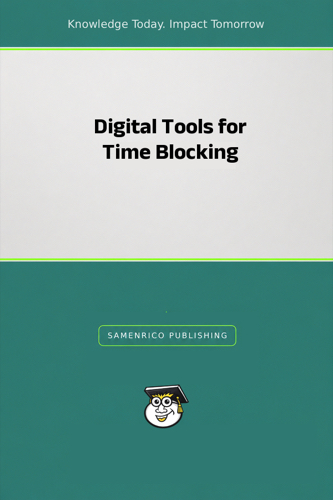
Digital Tools for Time Blocking eBook
Use Google Calendar, Notion, or Todoist for effect
by Lytle Perry
Use Google Calendar, Notion, or Todoist for effective time blocking.
Formats
Free sample
Chapter 1: The Brittle Promise--–- Sarah had spent thirty minutes the night before. She drew careful boxes on her paper planner: 9:00 AM to 10:30 AM for the budget report. 10:30 AM to 11:00 AM for team check-ins. 11:00 AM to 12:00 PM for deep work on the proposal. She used four different colored pens.
She felt proud. She felt in control.By 9:17 AM, her CEO had moved the staff meeting to 10:00 AM. By 9:45 AM, a client emergency required an immediate call. By 10:30 AM, Sarah had erased and rewritten her schedule three times. By 11:00 AM, she gave up entirely and spent the rest of the day answering emails, feeling like a failure.Sarah told herself she lacked discipline.
She told herself she needed to try harder. She told herself that time blocking just didn't work for people like her.She was wrong about everything except the last part.Time blocking, as most people practice it, does not work. Not because time blocking is a bad idea, but because the version of time blocking most people learn was designed for a world that no longer exists. It was designed for monks in monasteries. For factory workers on assembly lines.
For a time when interruptions arrived by postal mail and took three days to reach you.You are not a monk. You are not on an assembly line. And your interruptions arrive every ninety seconds, not every ninety hours.This chapter will show you why traditional time blocking fails, how digital tools fundamentally change the game, and how to build a flexible, resilient time blocking system that bends instead of breaks. By the end of this chapter, you will stop blaming yourself for life's interruptions and start using a system designed for the world you actually live in.The Invention of Guilt Let us begin with a confession. I have tried paper time blocking at least a dozen times.
Each time, I bought a beautiful planner. Each time, I carefully mapped out my ideal week. Each time, I felt a surge of optimism that this time, finally, I would become the organized person I always wanted to be.And each time, by Tuesday afternoon, the planner was a graveyard of crossed-out boxes and frustrated scribbles.Here is what I learned after years of failure and hundreds of conversations with frustrated professionals: traditional time blocking does not fail because you lack willpower. It fails because it is structurally brittle.Brittleness is a material property. A brittle material, like glass or dried clay, holds its shape perfectly under ideal conditions.
It looks strong. It feels solid. But the moment you apply unexpected stress—a twist, a drop, a sudden temperature change—it does not bend. It shatters.Paper time blocking is brittle. It assumes a perfect world where meetings start and end exactly on time, where emergencies do not arise, where your energy levels remain constant, and where no one interrupts you.
In that perfect world, paper time blocking is beautiful. In the world you actually inhabit, it is a source of shame.Consider what happens when a meeting runs fifteen minutes over. In a paper system, your next three blocks are now misaligned. Do you erase everything? Do you squeeze a ninety-minute task into sixty minutes?
Do you simply give up? Most people choose the fourth option: they feel guilty, blame themselves for poor planning, and abandon time blocking altogether.The guilt is the worst part. You internalize the failure. You tell yourself that organized people somehow never face interruptions, that productivity experts live in a frictionless universe where every block flows perfectly into the next. This is a lie.
The most productive people in the world face just as many interruptions as you do. They have simply stopped using brittle tools.The Four Thousand Week Reality Check Before we dive into digital solutions, we need to confront a deeper truth. Oliver Burkeman, in his brilliant book Four Thousand Weeks, points out that the average human lifespan is about four thousand weeks. That is not a lot. And yet, most productivity systems are built on the fantasy that if you just optimize enough, you will eventually get everything done.You will not.
You cannot. There is no amount of time blocking, no combination of colored pens, no perfect morning routine that will allow you to accomplish every task, answer every email, attend every meeting, and pursue every aspiration. The finite nature of your life is not a problem to be solved. It is a condition to be accepted.This is where traditional time blocking does its greatest damage. By encouraging you to schedule every minute of every day, it creates the illusion that total control is possible.
When reality violates that illusion—as it always does—you experience not just frustration but a kind of existential whiplash. You were promised mastery. You received chaos.The solution is not to abandon time blocking. The solution is to abandon the fantasy of total control. You cannot dominate time.
You can only negotiate with it.Jake Knapp and John Zeratsky, authors of Make Time, understand this intuitively. Their "Highlight" method suggests that instead of scheduling every minute, you identify just one or two critical activities per day. Everything else is secondary. This is not laziness. It is strategic surrender.
By admitting that you cannot do everything, you free yourself to actually do the things that matter.Digital time blocking, as we will build it in this book, is built on this foundation of acceptance. You will not schedule every minute. You will schedule the minutes that matter. The rest will remain flexible, ready to absorb the inevitable interruptions of a real life.Why Digital Changes Everything If paper planners are brittle, digital calendars are elastic. They bend.
They stretch. They recover.Let us return to Sarah from the opening of this chapter. In a paper system, her CEO's meeting change was a disaster. In a digital system, using Google Calendar, it was a three-second adjustment. She selected the budget report block, dragged it from 9:00 AM to 2:00 PM, and continued with her day.
No erasing. No rewriting. No guilt.This simple act of drag-and-drop rescheduling is the most underrated productivity innovation of the past decade. It seems trivial. It is not.
It changes the psychological relationship between you and your schedule.In a paper system, a schedule change feels like a failure. You have to physically destroy your previous plan. The act of erasing or crossing out is an act of admission: I was wrong. My plan was bad. I am bad at planning.In a digital system, a schedule change feels like a routine adjustment.
You drag. You drop. You move on. The plan was not wrong. The situation changed.
Your tools adapted. This is not a failure of discipline. It is a feature of reality.But drag-and-drop is just the beginning. Digital calendars offer three capabilities that paper cannot match:1. Infinite Rescheduling Without Penalty You can move a block from Tuesday to Thursday to next week without ever losing clarity.
Your calendar remains legible. Your tasks remain visible. Paper, by contrast, becomes a mess of arrows and cross-outs that no one—including you—can decipher by Thursday afternoon.2. Recurring Templates Once you design…
This is the end of the free sample. Get the eBook to keep going. Buy now
About this book
Details
- Author
- Lytle Perry
- Publisher
- SamEnrico
- Language
- English
- Genre
- Non-Fiction, Self-Help, Software Guides
- Released
- 2026-06-10
- Pages (approx.)
- 134
- Available as
- eBook, Audiobook

Read better in the ZLOADR app
Your eBooks on your phone or tablet. Sign in with your SamEnrico account and start reading.
More by Lytle Perry
 Mind Reading Anger DistortionLytle Perry$11.99
 Body Scan Mindfulness for TeensLytle Perry$11.99
 Belgian Border CrossingLytle Perry$11.99
 Jamaican Nurse In London TrustLytle Perry$11.99
 Lisdexamfetamine GuideLytle Perry$11.99
 Atomic Habits For Habit GroupLytle Perry$11.99
 Unidentified Remains Fingerprint Cold HitsLytle Perry$11.99
 The Last Whisper of the Great Green WallLytle Perry$11.99
 The Gridiron Gladiators: How African Designers Styled NFL Legends (1960s-1970s)Lytle Perry$11.99
 How to Start a Passenger Transport By Inter-urban Railways (other Than Inter-city Service) BusinessLytle Perry$11.99
 Growing CalochortusLytle Perry$11.99
 A Collector's Handbook to the Simca SpecialLytle Perry$11.99