
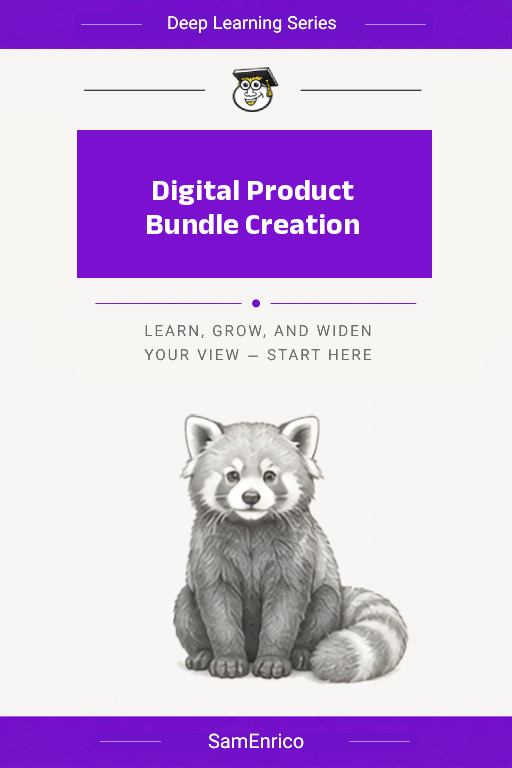
Digital Product Bundle Creation eBook
Combine multiple digital products into a higher-va
by Marble Hoa
Combine multiple digital products into a higher-value bundle in two days.
Formats
Free sample
Chapter 1: The Inventory Myth--–- You do not have a product problem. You have a packaging problem. Let me repeat that, because every creator I have ever worked with—from first-time Etsy sellers to six-figure course entrepreneurs—believes the exact opposite. They believe that if they could just create one more e Book, record one more training, or design one more template, the floodgates would open. They believe that more products equal more sales.
They believe that their hard drive is full of potential, but somehow that potential never translates into a full bank account. After auditing over two hundred digital product businesses, I have discovered a pattern that will either infuriate you or liberate you: The creators with the largest libraries of products are almost never the highest earners. In fact, the opposite is consistently true. The highest earners in the digital space—the people making reliable, predictable, often surprising amounts of money—have small catalogs. Sometimes as few as three to five products.
Sometimes only one bundle that does all the heavy lifting.This chapter exists to shatter the most expensive myth in the digital creator economy: the myth that you need more inventory. You have been sold a story that creation is the path to income. Platforms like Gumroad, Etsy, and Shopify have every incentive to encourage you to list more products. More listings mean more chances for them to take a cut. But for you, more products often mean more confusion, more maintenance, and most dangerously, more decision fatigue for your customers.
The goal of this book is not to teach you how to create faster. The goal is to teach you how to stop creating and start bundling. And before we can build a single bundle, we have to clear out the mental clutter that tells you that your value is measured in the number of files you have for sale.The $47,000 Spreadsheet Let me tell you about Sarah. Sarah is a composite of about thirty different creators I have coached, but her story is real enough to be any of them. Sarah had been selling digital products for two years.
She had forty-seven individual items on her Gumroad store: budget spreadsheets, habit trackers, meal planners, goal-setting worksheets, and a handful of short e Books. She was making roughly two hundred dollars per month. Forty-seven products. Two hundred dollars. That is an average of about four dollars and twenty-five cents per product per month.
After platform fees and the cost of her time updating broken links, she was essentially working for less than minimum wage. But here is what Sarah believed: she believed she was just one more product away. If she could just create the perfect productivity planner, everything would click. If she could just nail the right SEO keywords, traffic would pour in. She was trapped in what I call the Inventory Myth—the belief that volume equals value.Then we did something radical.
We stopped creating. For an entire month, Sarah was forbidden from making anything new. Instead, we took her forty-seven products and grouped them by outcome. Which products solved the same problem? Which products were frequently bought together?
Which products had sat untouched for over a year? We identified her hero products—the five items that accounted for eighty percent of her two hundred dollars in monthly revenue. Everything else was either a sidekick (a product that added value but rarely sold alone) or dead weight (products that had never sold or had not sold in over twelve months). We bundled her five hero products with eight sidekicks into a single "Ultimate Productivity Toolbox" priced at forty-seven dollars. We removed the dead weight entirely.
The result? In the first weekend after launching the bundle, Sarah made more money than she had in the previous six months combined. Within thirty days, she had broken the two-thousand-dollar monthly mark. With one bundle. Not forty-seven products.
Not a single new creation. Just a smarter way of packaging what she already owned.Sarah is not special. She is not a marketing genius. She did not suddenly learn copywriting or Facebook ads. She simply stopped treating her products like individual items and started treating them like ingredients in a recipe.
That is what this book is about. You are not a product creator. You are a chef. And right now, you are serving your customers a grocery list instead of a meal.The Psychology of Decision Fatigue Why does bundling work? The answer is not economics.
It is psychology. Specifically, it is a phenomenon called decision fatigue. Every decision a human being makes in a day depletes a finite reserve of mental energy. By the time your customer lands on your product page, they have already decided what to eat for breakfast, what to wear, which route to drive to work, whether to reply to that email from their boss, and approximately thirty-five thousand other micro-decisions. When they see a page with forty-seven individual products, each with its own price, description, and thumbnail, something happens in their brain.
They do not get excited. They do not think, "Wow, so much value!" They think, "I do not have the energy for this." And they leave.This is not speculation. This is neuroscience. A study published in the Journal of Personality and Social Psychology found that shoppers presented with twenty-four varieties of jam were one-tenth as likely to make a purchase as shoppers presented with six varieties. Not one-third.
Not one-half. One-tenth. More choice led to less action. The same principle applies to digital products. When you present a customer with a single bundle, you are not limiting their options.
You are liberating them from the burden of choice. You are saying, "I have done the work of curating the best combination for you. Trust me. Buy this." That is why a customer who hesitates to buy a forty-seven-dollar workbook will instantly buy a ninety-seven-dollar bundle that contains that workbook plus three other items. The bundle feels complete.
The workbook alone feels incomplete. The bundle is a solution. The workbook is a tool.There is a second psychological principle at work here, and it is just as powerful. It is called the endowment effect. Once a customer imagines owning something, they value it more highly.
A well-crafted bundle does not just list products; it paints a picture of a transformed future. "The Launch Pad Bundle" does not sound like a collection of files. It sounds like a promise. "Everything you need to go from zero to first sale in seven days" is not a product description; it is an invitation to a new identity. Your customer does not want a logo template.
They want to feel like a professional. They do not want a meal planner. They want to feel organized and in control. They do not want a budget spreadsheet. They want to feel financially secure.
The bundle is the vehicle for that identity shift. The single product is just a feature.The Ecosystem Versus The Product Here is a mental shift that will change everything about how you build your business. Stop thinking in terms of products. Start thinking in terms of ecosystems. A product solves…
This is the end of the free sample. Get the eBook to keep going. Buy now
About this book
Details
- Author
- Marble Hoa
- Publisher
- SamEnrico
- Language
- English
- Genre
- Non-Fiction, First 30 Days
- Released
- 2026-06-01
- Pages (approx.)
- 142
- Available as
- eBook, Audiobook

Read better in the ZLOADR app
Your eBooks on your phone or tablet. Sign in with your SamEnrico account and start reading.
More by Marble Hoa
 Precision Medicine CapitalMarble Hoa$11.99
 Trigger Physical SensationsMarble Hoa$11.99
 SIBO Overlap ManagementMarble Hoa$11.99
 Postpartum Disability Leave GuideMarble Hoa$11.99
 Humor in Presentations GuideMarble Hoa$11.99
 Sarcopenia Thermal ImagingMarble Hoa$11.99
 Migraine Aura Management GuideMarble Hoa$11.99
 Co Parenting Anger ControlMarble Hoa$11.99
 Abbott Texas WheelchairMarble Hoa$11.99
 When the Sky Split: The Maori Birth of Te Rā and Te PōMarble Hoa$11.99
 Qubit's Gambit: The Race to Quantum SupremacyMarble Hoa$11.99
 Arjuna's Arrow: The Celestial Bowstring of the PandavaMarble Hoa$11.99
You may also like
 Hong Kong Handover 1997Dunn Johnnie$11.99
 Zumba For Postnatal Recovery CourseNeal Christian$11.99
 Zumba for BeginnersLadner Nikia$11.99
 YouTube Comment Mining GuideHumes Pandora$12.99
 Worry Box MeditationCarlin Rudy$11.99
 Workplace Stress MeditationNguyen Lynn$11.99
 Workplace Stress and Sleep RepairHawley Ivory$11.99
 Workplace Perfectionism CureDelaney Jeffry$11.99
 Workplace Injustice Anger GuideWallen Isabelle$11.99
 Work Addiction and Burnout LinkGreenwood Ester$11.99
 Women in Yoga and WellnessBeattie Galina$11.99
 Women in Stand Up ComedyChun Evangeline$11.99