
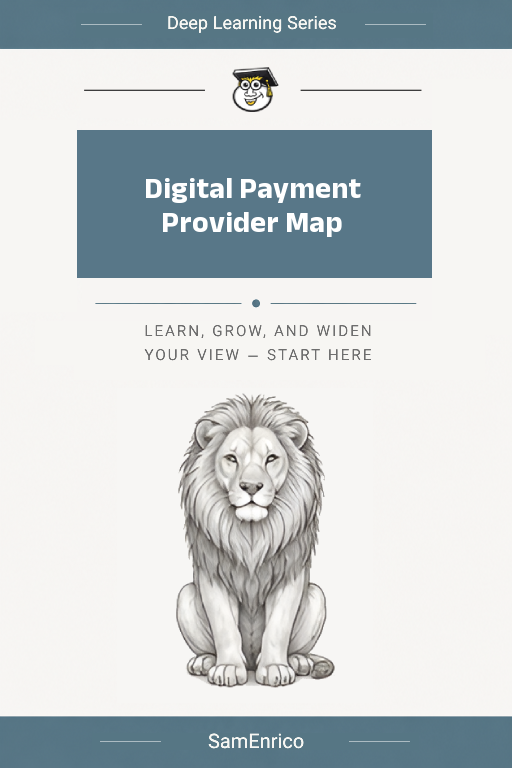
Digital Payment Provider Map
Map PayPal, Stripe, Adyen, and Square on online ve
Map PayPal, Stripe, Adyen, and Square on online versus in-person merchant payment specialization.
Formats
About this book
Free sample
Chapter 1: The Unbundling Heist--–- In 1998, a twenty-six-year-old entrepreneur named Elon Musk walked into a bank manager’s office in Palo Alto and asked for a merchant account. He had co-founded a company called X.com, which would later become part of Pay Pal, and he wanted to accept credit cards online. The bank manager laughed. Not a polite chuckle, but a full, dismissive laugh. She explained that online payments were a fad, that credit card fraud would destroy any internet business, and that even if she wanted to help, the application process took six months and required a personal guarantee, a physical storefront, and a minimum monthly volume of fifty thousand dollars.Musk left the office and, according to those who knew him, made a quiet decision that would alter the course of financial history.
He would not beg banks for permission. He would build a new system from scratch. That decision, made in frustration, became the first crack in a monolithic banking model that had stood for nearly half a century.This book is about what happened next. It is about how four companies—Pay Pal, Stripe, Square, and Adyen—took sledgehammers to that old model, each swinging from a different angle, each breaking off a different piece. And it is about why, today, choosing the wrong payment processor can cost you more than higher fees.
It can cost you your business.But to understand the heist, you must first understand the vault.The Merchant Account: A Prison Wrapped in Plastic Before Pay Pal, before Stripe, before the white dongle and the API key, there was the merchant account. In the pre-internet era, accepting credit cards was a privilege reserved for businesses with physical locations, established credit histories, and the patience of saints.Here is how it worked. A business owner would walk into a bank—usually a large, regional institution with a name like First Data or Wells Fargo Merchant Services—and fill out a paper application. The bank would run a credit check, verify the business’s physical address, and sometimes demand a personal guarantee from the owner. If the business sold…
This is the end of the free sample. Get the eBook to keep going. Buy now
Contents
- Chapter 1
- Chapter 2
- Chapter 3
- Chapter 4
- Chapter 5
- Chapter 6
- Chapter 7
- Chapter 8
- Chapter 9
- Chapter 10
- Chapter 11
- Chapter 12
Details
- Author
- Bartels Trish
- Publisher
- SamEnrico
- Language
- English
- Genre
- Non-Fiction, Strategic Atlas, Fintech
- Released
- 2026-06-01
- Pages (approx.)
- 146
- Available as
- eBook, Audiobook

Read better in the ZLOADR app
Your eBooks on your phone or tablet. Sign in with your SamEnrico account and start reading.
More by Bartels Trish
 Road Rage In Parking LotsBartels Trish$11.99
 Metta For Grief RecoveryBartels Trish$11.99
 Student Anger for TeachersBartels Trish$11.99
 Swift Transport Exit PlaybookBartels Trish$11.99
 The Postpartum Mental Health GuideBartels Trish$11.99
 The Ballad of the First Country Legend: The Untold Story of James DickersonBartels Trish$11.99
 One Page Plan for CreativesBartels Trish$12.99
 The Delphi Murders: Small Town MysteryBartels Trish$11.99
 A Beginners Guide to Fast Pitch (Volume 1)Bartels Trish$11.99
You may also like
 SoFi SWOT GuideShores Caron$12.99
 Block Inc SWOT LibraryClemmons Jamika$12.99
 Adyen SWOT LibraryGuenther Ward$12.99
 Robinhood SWOTLeslie Elfriede$12.99
 Coinbase SWOT LibraryLoyd Danae$12.99
 Block SWOT Library GuideFurman Fletcher$12.99
 PayPal SWOT GuideBillings Bethel$12.99
 Stripe SWOT GuideGrace Katrice$12.99
 Fintech Customer RetentionAlger Edwina$12.99