
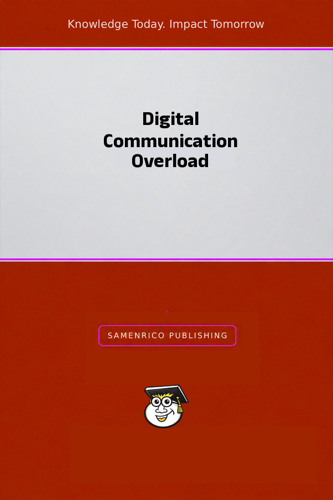
Non-FictionSelf-HelpDigital Wellness
Digital Communication Overload eBook
Manage email, Slack, and notifications without bur
Manage email, Slack, and notifications without burnout.
Formats
Free sample
Chapter 1: The Endless Day--–- The morning ritual is almost too embarrassing to admit, but you have done it thousands of times. Wake up. Silence the alarm. Roll over. And before your eyes have fully focused on the ceiling, before you have registered whether it is raining outside or whether you dreamed about work or whether your partner is still asleep beside you, your thumb has already unlocked the phone.
The screen glows blue in the half-darkness. Thirty-seven emails. Fourteen Slack messages. Three calendar notifications. A text from your boss sent at 11:47 PM.
And just like that, you are no longer in your bedroom. You are in the office. You have not brushed your teeth, you have not said good morning to anyone, you have not even taken a single breath of air that was not filtered through anxiety, but you are already working. This is not a personal failing. This is the availability trap, and you fell into it the moment you bought a smartphone.The trap works like this: the distance between you and work has collapsed to zero.
Forty years ago, leaving the office meant leaving work behind. The papers stayed on the desk. The phone stopped ringing. The commute home was a buffer zone of radio, silence, or a newspaper. Twenty years ago, the laptop made work portable, but you still had to open the lid, find a Wi-Fi connection, and deliberately choose to engage.
Ten years ago, the smartphone erased even those small barriers. Now the office lives in your pocket. It sleeps on your nightstand. It sits on the dinner table. It goes to the bathroom with you.
There is no physical separation anymore, and because there is no physical separation, there is no psychological separation either. You are always at work, even when you are not working, and the exhaustion you feel is not in your imagination. It is a measurable, predictable, and entirely rational response to an environment that never lets you off duty.This chapter is the diagnosis. Before we fix anything, before we change a single setting or adopt a single ritual, we have to understand what is actually happening to you. The story you have been told is that you are bad at managing your time, that you lack discipline, that if you just tried harder or woke up earlier or used the right productivity app, you would feel less overwhelmed.
That story is wrong. You are not overwhelmed because you are weak. You are overwhelmed because the basic contract between worker and work has been rewritten without your consent, and you have been left to cope with the consequences on your own.The chapter will walk you through three foundational ideas. First, the history of how we lost the boundary between work and life. Second, the concept of the availability paradox, which explains why more connectivity has produced less productivity.
Third, the four horsemen of digital overload, the specific channels that are eating your attention. And finally, the most important reframe of this entire book: you cannot manage your time if you cannot manage your attention. Time management assumes you have control over your schedule. Attention management assumes you are under constant siege. This book is written for the second reality.The History of the Boundless Workday Let us go back to the factory whistle.
For most of human history, work was a place. You went there, you did your tasks, and you left. The boundaries were physical and unmistakable. The factory whistle blew at eight in the morning, and you walked through the gates. The whistle blew at five in the evening, and you walked out.
What happened between those hours was work. What happened after was your life. The two did not mix because they could not mix. There was no email, no Slack, no way for your boss to reach you at home unless they came to your door, which almost no one did because even the most unreasonable managers understood that a person's home was their own.Then came the laptop. In the 1980s and 1990s, portable computers began to appear on desks and then in briefcases.
The promise was liberation. You could work from home. You could work from a coffee shop. You could take your work on vacation and still feel productive. And for a while, it worked.
The laptop required deliberate action. You had to open the lid, wait for it to boot, connect to the internet, and open your applications. There was friction. That friction protected you. You only worked from home when you chose to, and you never worked from the dinner table because lugging a laptop to dinner was obviously absurd.The smartphone changed everything.
The i Phone launched in 2007, and within five years, it had transformed not just how we communicate but where we could be reached. Suddenly, the office was not a place. It was a device. And that device lived in your pocket. The friction disappeared.
You did not have to open a laptop. You did not have to find Wi-Fi. You did not have to sit down at a desk. You just pulled out your phone, and there was work, waiting for you, wherever you were, whenever you wanted it, and more importantly, whenever it wanted you.This shift was not neutral. The technology companies that built these devices had a financial incentive to make you check them as often as possible.
More notifications meant more engagement, more engagement meant more data, more data meant more advertising revenue. They did not set out to destroy your work-life balance. They set out to build a product people would use. But the unintended consequence was the collapse of every boundary that had protected workers for a century. The factory whistle was replaced by the push notification.
The commute home was replaced by the infinite scroll. And you were left holding a device that demanded your attention twenty-four hours a day, seven days a week, with no off switch except the one you had to install yourself.The concept of the "boundless workday" comes from research on knowledge workers in the early 2010s. Sociologists noticed that professionals with smartphones were working more hours than ever before, not because their employers demanded it, but because the work was always there. An email arrived at nine PM, and it felt rude to ignore it. A Slack message came in on Saturday afternoon, and answering it seemed faster than explaining why you had not answered.
The boundaries dissolved from the inside, not because someone forced them to dissolve, but because the technology made it so easy to cross them. And once you cross a boundary a few times, it stops being a boundary. It becomes just another part of the terrain.The Availability Paradox Here is the strange thing. Technology was supposed to make us more productive. It was supposed to free up time, automate drudgery, and let us focus on creative, meaningful work.
Instead, most knowledge workers report feeling less productive than ever, even as they work more hours. This is the availability paradox: the more available you are, the less you actually accomplish.The paradox works through two mechanisms.…
This is the end of the free sample. Get the eBook to keep going. Buy now
About this book
Details
- Author
- Coffman Tiffiny
- Publisher
- SamEnrico
- Language
- English
- Genre
- Non-Fiction, Self-Help, Digital Wellness
- Released
- 2026-06-08
- Pages (approx.)
- 120
- Available as
- eBook, Audiobook

Read better in the ZLOADR app
Your eBooks on your phone or tablet. Sign in with your SamEnrico account and start reading.
More by Coffman Tiffiny
 The One Page Meeting AgendaCoffman Tiffiny$11.99
 The Lieutenant Governor's StoryCoffman Tiffiny$11.99
 Webb Simpson Process BiographyCoffman Tiffiny$11.99
 Conversation Starters for GymsCoffman Tiffiny$11.99
 The Bloomsbury Breakthrough: How Virginia Woolf and the Group Redefined ModernismCoffman Tiffiny$11.99
 Chroma Clash: The Day the World Painted Pink for Breast CancerCoffman Tiffiny$11.99
 Welder and FabricatorCoffman Tiffiny$11.99
 How to Start a Hobby in LEGO - including Brikwars - and Lego MindstormsCoffman Tiffiny$11.99
 Jumia YC Application LessonsCoffman Tiffiny$12.99
 Batch Production SequencingCoffman Tiffiny$12.99
 Understanding Cleidocranial Dysplasia Micrognathia Absent ThumbsCoffman Tiffiny$17.99
You may also like
 Hong Kong Handover 1997Dunn Johnnie$11.99
 Zumba For Postnatal Recovery CourseNeal Christian$11.99
 Zumba for BeginnersLadner Nikia$11.99
 YouTube Comment Mining GuideHumes Pandora$12.99
 Worry Box MeditationCarlin Rudy$11.99
 Workplace Stress MeditationNguyen Lynn$11.99
 Workplace Stress and Sleep RepairHawley Ivory$11.99
 Workplace Perfectionism CureDelaney Jeffry$11.99
 Workplace Injustice Anger GuideWallen Isabelle$11.99
 Work Addiction and Burnout LinkGreenwood Ester$11.99
 Women in Yoga and WellnessBeattie Galina$11.99
 Women in Stand Up ComedyChun Evangeline$11.99