
Non-FictionSelf-HelpAssessment
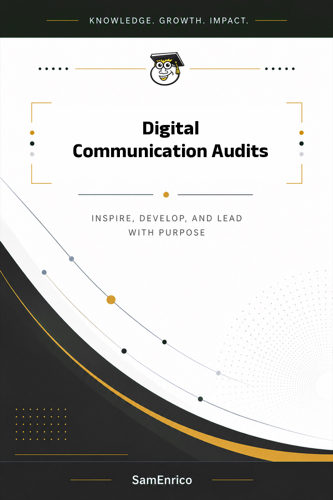
Digital Communication Audits eBook
Assess and improve your team's remote communicatio
Assess and improve your team's remote communication patterns.
Formats
Free sample
Chapter 1: The Silence Tax--–- In a brightly lit open office in Austin, Texas, a product manager named Sarah sent a Slack message to her engineering lead: “Is the backend ready for tomorrow’s demo?” She then turned to her second monitor and answered three emails, joined a Zoom call with marketing, and forgot she had asked the question. Forty-five minutes later, the engineering lead replied with a single word: “Yes.” Sarah saw the notification, assumed all was well, and closed the thread. The next morning, ten minutes before the demo with the company’s largest client, Sarah learned the truth: “Yes” meant “Yes, the database migration is complete,” not “Yes, the API endpoints are connected to the frontend.” The demo failed. The client was furious. And when Sarah asked why no one had clarified the ambiguity, every person on the team pointed to a different Slack message, a different interpretation of the word “ready,” and a shared feeling that asking for clarification would have made them look incompetent.This is not a story about bad technology.
It is not a story about lazy people. It is a story about the most expensive problem in modern work: invisible communication gaps that fester in digital spaces, cost companies millions in lost productivity, and erode the trust that teams need to function. And the most dangerous part? Most leaders have no idea these gaps exist until the demo fails, the client leaves, or the best employee quits without warning.Welcome to the first chapter of The Digital Communication Audit. Before we audit a single Slack channel, before we map your tool ecosystem, before we build a team charter or run a monthly retro, we must answer a more fundamental question: What actually breaks when teams communicate remotely?
And why do those breaks cost so much more than leaders realize?This chapter introduces the Five Hidden Disconnects of Virtual Work—a diagnostic framework drawn from Nick Morgan’s research in Can You Hear Me?, validated by case studies from over fifty remote teams, and designed to give you a common language for what is silently draining your team’s energy. By the end of this chapter, you will be able to name your team’s primary disconnect, calculate its approximate cost, and understand why every subsequent chapter in this book builds on this foundation.The Problem with Seeing the Gaps When teams work in the same physical room, communication gaps are visible. Someone frowns when they don’t understand. A raised hand signals a clarifying question. A confused silence prompts the speaker to rephrase.
These nonverbal cues act as real-time error correction, catching misunderstandings before they compound.Remote work strips away those cues.What remains is text on a screen—flat, stripped of tone, body language, and immediate feedback. And human brains are terrible at filling in missing context accurately. Research in social neuroscience shows that when people read ambiguous digital messages, they tend to project their own anxiety onto the sender. A simple “Okay” from a manager is interpreted as passive-aggressive by an anxious employee and as neutral by a confident one. The same message, two different realities, one inevitable collision.But the problem is worse than individual misinterpretation.
The Five Hidden Disconnects operate as a system, each gap reinforcing the others. When feedback disappears (Disconnect #1), empathy erodes (Disconnect #2). When empathy erodes, people feel less control over their work (Disconnect #3). Loss of control flattens emotional expression (Disconnect #4), which finally severs the sense of connection to teammates (Disconnect #5). By the time you notice the symptoms—missed deadlines, tense Slack threads, silent retreat from collaboration—the system has already been failing for weeks.Let us examine each disconnect in detail.Disconnect #1: The Feedback Void What it is: Digital silence after a message.
No acknowledgment of receipt. No timeline for response. No indication whether the message was read, understood, or ignored.How it manifests: A designer shares a mockup in a Slack channel and receives no replies for six hours. She assumes the work is rejected or irrelevant. In fact, the stakeholders were simply in back-to-back meetings and planned to respond after lunch.
But because the designer received no feedback—positive, negative, or neutral—she spent three hours redoing the mockup unnecessarily.The hidden cost: The Feedback Void creates an energy tax of approximately forty-five minutes per day per person in rework, worry, and follow-up messages. In a ten-person team, that is 7.5 hours of daily lost productivity—$75,000 annually at an average loaded cost of $80 per hour.Why it happens: Physical offices provide ambient feedback. A nod across the room. A thumbs-up while walking to the printer. These micro-signals cost nothing.
In digital spaces, providing feedback requires deliberate action: typing a reply, clicking a reaction emoji, scheduling a check-in. Deliberate action feels effortful, so people postpone it. And postponement becomes silence.The antidote preview: Chapter 5 (The Ambiguity Audit) will introduce the Response Time Expectation Framework, which distinguishes between True Async (24-hour reply windows) and Near-Sync (2-hour reply windows). But at the diagnostic level, simply naming the Feedback Void as a problem begins to shift behavior. Teams that acknowledge “we have a silence problem” start experimenting with lightweight acknowledgments: a ✅ emoji to confirm receipt, a “got it, will review by 3 PM” to set expectations.Disconnect #2: The Empathy Wall What it is: The inability to read nonverbal cues that would be obvious in person.
Posture, facial expression, tone of voice, eye contact—all erased.How it manifests: A product owner writes a terse update: “The timeline is slipping. We need to discuss.” In person, this same product owner would have said it with a worried expression and a collaborative shrug, inviting help. In text, it reads as an accusation. The engineering team becomes defensive. The product owner becomes frustrated by the defensiveness.
Neither realizes they are reacting to a phantom tone that never existed.The hidden cost: The Empathy Wall is the primary driver of “email wars”—chains of escalating passive-aggression that consume hours and leave everyone exhausted. Research from the University of Chicago found that remote teams take 67% longer to resolve interpersonal conflicts than co-located teams, almost entirely due to tone misinterpretation. Each unresolved conflict costs an average of $12,000 in lost focus and turnover risk.Why it happens: Human brains are wired for multimodal communication. We read faces and bodies simultaneously with words. When words arrive alone, the brain fills the missing channels with default assumptions.
For people with high anxiety or past negative experiences, those defaults skew negative. The Empathy Wall is not a technology problem; it is a cognition problem. Your brain is trying to help by guessing tone, and it is guessing wrong.The antidote preview: Chapter 5’s Ambiguity Assessment Protocol includes the “Tone Preview” technique: before sending any message that could be interpreted as negative, write a one-sentence tone disclaimer. Examples: “Said with genuine curiosity, not criticism” or “I’m frustrated at the situation, not at you.” This feels artificial at first, but it rebuilds the scaffolding that in-person body language provided for free.Disconnect #3: The Control Fracture What it is: The feeling of being at the mercy of notifications—unable to focus, constantly reactive, and perpetually behind.How it manifests: A senior engineer starts her day…
This is the end of the free sample. Get the eBook to keep going. Buy now
About this book
Details
- Author
- Sikes Ludivina
- Publisher
- SamEnrico
- Language
- English
- Genre
- Non-Fiction, Self-Help, Assessment
- Released
- 2026-06-09
- Pages (approx.)
- 158
- Available as
- eBook, Audiobook

Read better in the ZLOADR app
Your eBooks on your phone or tablet. Sign in with your SamEnrico account and start reading.
More by Sikes Ludivina
 The Weekly Meeting AuditSikes Ludivina$11.99
 Pinterest VA Pricing Power GuideSikes Ludivina$11.99
 Data Leak Employee Notification ScriptsSikes Ludivina$11.99
 Breast Self Exam Techniques HandbookSikes Ludivina$11.99
 The Tesla Turbulence: Elon Musk's High-Stakes Gamble to Electrify the WorldSikes Ludivina$11.99
 Echoes Over Everest: The Phantom Radio of the HimalayasSikes Ludivina$11.99
 Understanding Cockayne Syndrome Type 1Sikes Ludivina$17.99
 AFEX YC Application TipsSikes Ludivina$12.99
 Production Schedule ResilienceSikes Ludivina$12.99
 Ultimate Handbook Guide to Shunde : (China) Travel GuideSikes Ludivina$11.99
 Band Saw Operation (Industrial)Sikes Ludivina$11.99
You may also like
 Hong Kong Handover 1997Dunn Johnnie$11.99
 Zumba For Postnatal Recovery CourseNeal Christian$11.99
 Zumba for BeginnersLadner Nikia$11.99
 YouTube Comment Mining GuideHumes Pandora$12.99
 Worry Box MeditationCarlin Rudy$11.99
 Workplace Stress MeditationNguyen Lynn$11.99
 Workplace Stress and Sleep RepairHawley Ivory$11.99
 Workplace Perfectionism CureDelaney Jeffry$11.99
 Workplace Injustice Anger GuideWallen Isabelle$11.99
 Work Addiction and Burnout LinkGreenwood Ester$11.99
 Women in Yoga and WellnessBeattie Galina$11.99
 Women in Stand Up ComedyChun Evangeline$11.99