
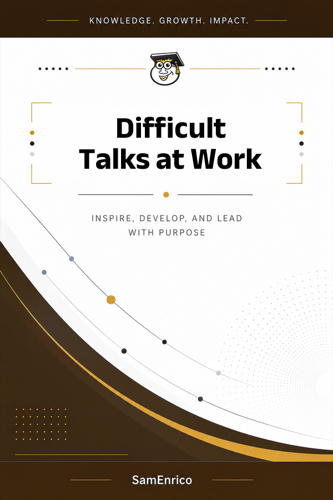
Difficult Talks at Work eBook
Handles performance reviews, salary negotiations,
by Kruger Renay
Handles performance reviews, salary negotiations, and coworker conflicts professionally.
Formats
Free sample
Chapter 1: The Three Traps--You are reading this because there is a conversation you are avoiding right now.You have rehearsed it in the shower. You have drafted the email and deleted it. You have told yourself “next week” or “after the holidays” or “once I have more data.” The knot in your stomach? That is not professionalism. That is fear dressed up as patience.
And it is costing you sleep, respect, and money.Let us name what you are avoiding. Perhaps it is a performance review for an employee who knows they are underperforming but deflects every attempt at feedback. Perhaps it is a salary negotiation where you know you are underpaid but dread sounding greedy. Perhaps it is a coworker who interrupts you in every meeting, and you have said nothing for six months.Whatever the specific situation, the shape of your avoidance is the same. You are stuck.
And you are stuck not because you lack courage or intelligence, but because you are trying to have three conversations at once without realizing it.This chapter reveals why most difficult talks fail before the first word is spoken. It introduces a framework that will transform how you see every workplace conflict. And it gives you a simple checklist to diagnose exactly which conversation is blocking you right now.The Three Conversations After decades of research at the Harvard Negotiation Project, scholars Douglas Stone, Bruce Patton, and Sheila Heen made a breakthrough discovery in their seminal work Difficult Conversations. They found that every difficult conversation is actually three conversations happening simultaneously. Most people try to have all three at once, fail at all of them, and conclude they are bad at conflict.
They are not bad at conflict. They are just trying to solve three different puzzles with one set of moves.Let us pull these three conversations apart.Conversation One: The “What Happened?” Debate The first conversation is about facts, blame, and truth. You think you are arguing about what actually occurred. Your counterpart thinks the same. But you are both wrong.Consider a common scenario.
A deadline was missed. You say, “You committed to Friday at 5 PM.” The employee says, “I said I would try my best, but the client kept changing requirements.” You hear an excuse. They hear an explanation. The argument spirals because both of you believe you are defending the truth.The hidden problem is that neither of you is debating facts. You are debating perceptions.
And perceptions are never purely factual because they are filtered through assumptions, past experiences, and unspoken expectations.When you argued about the deadline, what were you really arguing about? Perhaps you were arguing about what commitment means. To you, “I will have it by Friday” is a promise. To them, it is a target. Neither of you stated this difference upfront.Or perhaps you were arguing about fairness.
You feel you gave them plenty of lead time. They feel you dropped the project on them at the last minute. Both of you have receipts. Both of you feel right.Or perhaps you were arguing about standards. You believe “good enough” means polished and tested.
They believe “good enough” means functional. Neither of you defined the term.The “What Happened?” Debate always comes down to the same unspoken question: Who is right? But that is the wrong question. The right question is: What is actually happening from both perspectives?Shifting from “Who is right?” to “What is happening?” changes everything. It transforms a battle into an investigation.
You stop trying to prove your case and start trying to understand theirs. This does not mean you abandon your own perspective. It means you hold both perspectives side by side and ask: Given that we see this differently, what do we do now?Throughout this book, you will encounter variations of this principle. In Chapter 4, the SBI Model (Situation-Behavior-Impact) teaches you to separate observable facts from interpretations. In Chapter 9, the Ladder of Inference shows how you leap from data to conclusions in seconds.
In Chapter 10, you will learn why gaslighters exploit your desire to assume good intent, and why you must return to observable facts every time. These are not repetitions of the same idea. They are different tools for the same underlying problem: our brains are pattern-matching machines that mistake stories for reality.For now, the first shift is simply to notice when you are fighting about who is right. When you catch yourself saying “That is not what happened” or “You are misremembering,” pause. Ask yourself: What would happen if I stopped trying to win the fact war and instead asked, “Help me understand how you see this?”Conversation Two: The Feelings Conversation The second conversation is about emotions.
And most professionals handle it catastrophically.You have been told your entire career to be rational, objective, and unemotional at work. Leave your feelings at the door. Do not get defensive. Do not take it personally. This advice is not just wrong.
It is dangerous.Emotions are not a distraction from difficult conversations. Emotions are the conversation. They are the data. They are the reason you are avoiding the talk in the first place.Here is what actually happens when you ignore emotions. You walk into a performance review feeling anxious.
You pretend you are not anxious. Your employee feels defensive. They pretend they are not defensive. You both sit there performing calm while your nervous systems are on fire. The feedback you deliver is technically correct.
The employee nods and says they understand. Nothing changes. Three months later, the same problem reappears.Why? Because you addressed the surface issue (the missed deadline, the low sales number, the interrupted meeting) but never touched the emotional reality underneath. The employee did not change because they did not feel heard.
They felt managed. There is a difference.The Feelings Conversation has two parts: your feelings and their feelings. Most people focus entirely on managing the other person’s emotions while ignoring their own. This is a mistake. If you have not named your own fear, anger, or embarrassment before you speak, those feelings will leak out anyway.
They will show up as sarcasm, silence, or sudden rigidity.Try this before your next difficult talk. Sit alone. Ask yourself: What single word describes how I feel right now? Not a sentence. Not a story.
One word. Afraid. Embarrassed. Angry. Tired.
Resentful. That word is your data. It tells you what is at stake for you.Now ask: What single word describes how I think they feel? Defensive. Scared.
Overwhelmed. Unappreciated. That word is your hypothesis. You will test it in the conversation using the labeling technique from Chapter 3.Labeling is simple. You name the emotion you suspect they feel, starting with “It sounds like…” or “It seems like…” For example: “It sounds like you feel this deadline was unfair.” Or “It seems like you are frustrated with how the meeting went.”Labeling works because humans are wired to calm down when they feel heard.
Even if your label is wrong, they will correct you, and now they are engaged. Either way, the emotion is no longer hidden. It is on the table where you…
This is the end of the free sample. Get the eBook to keep going. Buy now
About this book
Details
- Author
- Kruger Renay
- Publisher
- SamEnrico
- Language
- English
- Genre
- Non-Fiction, Self-Help, Workplace Communication
- Released
- 2026-06-10
- Pages (approx.)
- 149
- Available as
- eBook, Audiobook

Read better in the ZLOADR app
Your eBooks on your phone or tablet. Sign in with your SamEnrico account and start reading.
More by Kruger Renay
 NVC for Hearing ImpairedKruger Renay$11.99
 Parent Blended Family ScheduleKruger Renay$11.99
 IBS And Pregnancy GuideKruger Renay$11.99
 The Fearless Moral InventoryKruger Renay$11.99
 Shift Work Employer GuideKruger Renay$11.99
 The PLEASE Skills GuideKruger Renay$11.99
 Visualization for Quitting TobaccoKruger Renay$11.99
 Peleus and Thetis: A Wedding Cursed by the SeaKruger Renay$11.99
 The Maestro of the African Renaissance: Samuel Coleridge-Taylor and the Symphony of GreatnessKruger Renay$11.99
 Service Providers Guide to OrthopedicsKruger Renay$11.99
 How to Produce Integrated Circuits and ChipsKruger Renay$11.99
 Mental Health Services for StudentsKruger Renay$12.99
You may also like
 Assertiveness at Work GuideFischer Arlena$11.99
 Office Small Talk GuideLeake Lenore$11.99
 NVC In The Workplace GuideKenney Kayce$11.99
 Handling Conflict At WorkIsaacs Angelique$11.99
 NVC at Work PrimerNichols Edwin$11.99
 Navigating Conflict At WorkCouch Remedios$11.99
 Navigating Conflict At Work GuideFinley Erich$11.99
 Assertiveness at Work HandbookAguiar Carmelo$11.99
 Small Talk at Work Made SimpleRoyster Charity$11.99
 NVC for Workplace ConflictLemieux Tandra$11.99
 Workplace NVC TrainingCota Lisette$11.99
 Difficult Workplace TalksMull Jaquelyn$11.99