
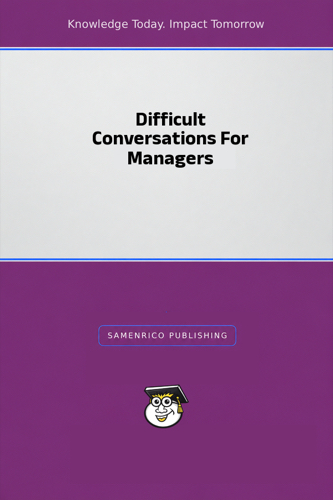
Difficult Conversations For Managers eBook
Equips leaders to handle layoffs, underperformance
by Inman Quinn
Equips leaders to handle layoffs, underperformance, and interpersonal team conflicts effectively.
Formats
Free sample
Chapter 1: The Seven-Week Lie--Every manager reading this book has done it. You saw the performance dip on a Tuesday. By Friday, you told yourself you would address it after the project launch. Two weeks became a month. A month became seven weeks.
By the time you finally spoke up, a minor issue had become a crisis, the client had complained, and your employee was blindsided in a public meeting.You told yourself you were being kind by waiting. You were not. You were being afraid.This chapter dismantles the single most damaging habit in management: the avoidance of hard conversations. We will name the fears that drive avoidance, introduce the Three Conversations framework that explains why these talks feel so complex, and reframe the manager’s job from “being nice” to “being clear.” By the end of this chapter, you will understand why delaying a difficult conversation is not kindness—it is a failure of leadership. And you will have the first building block of a new managerial identity: clarity delivered with respect is the highest form of care.The Seven-Week Statistic That Should Haunt You Research drawn from longitudinal studies of managerial behavior suggests that the average manager waits seven weeks between identifying a performance problem and addressing it directly with the employee.
Seven weeks. That is nearly two full months during which:The employee continues the behavior, unaware that anything is wrong The manager grows increasingly frustrated, silently building a case The team notices the tension and fills the gap with gossip The problem compounds, often involving clients or other departments Let us be precise about what happens in those seven weeks. Week one, you notice the issue. Week two, you hope it was a one-time anomaly. Week three, you mention it indirectly—“Hey, let’s try to get those reports in on time”—without naming the problem.
Week four, you complain to a colleague. Week five, you document the issue in your own notes, still without speaking to the employee. Week six, the problem worsens. Week seven, you finally schedule the conversation, now angry and exhausted, and the employee feels ambushed.This pattern is not just common. It is nearly universal.
And it destroys trust more effectively than any harsh word ever could.Why? Because when you finally speak, the employee hears not a corrective conversation but an indictment. They think: “You have been angry at me for seven weeks, and you never told me?” The trust deficit created by silence is almost impossible to repair. The employee does not remember the performance issue. They remember being left in the dark.The Three Fears That Freeze Every Manager Avoidance is not laziness.
It is fear. After interviewing hundreds of managers across industries, three fears emerge consistently. Name your fear, and you are halfway to overcoming it.Fear one: being seen as mean. Managers want to be liked. This is not vanity; it is survival.
Teams work better when members trust and respect each other, and managers know that harsh feedback can erode relationships. But the fear of being seen as mean leads to a catastrophic error: managers soften feedback until it becomes useless. “Your work has been a little inconsistent lately” is not feedback. It is a riddle. The employee cannot solve it, and you feel falsely virtuous for having “said something.”Fear two: triggering an emotional outburst.
No manager wants to be the person who makes an employee cry in a one-on-one meeting. The discomfort of tears, anger, or silence is real. But here is the truth that most management books avoid: you cannot control another person’s emotional response. You can only control your delivery. And avoiding the conversation because you fear an emotional reaction is like avoiding the doctor because you fear a diagnosis.
The problem does not disappear. It worsens.Fear three: damaging the relationship beyond repair. This fear is rooted in a false binary: that honesty and relationship are opposites. They are not. Relationships built on withheld truth are fragile.
Relationships built on clear, respectful feedback are resilient. The employee who knows exactly where they stand—what is working, what is not, and what needs to change—can trust you. The employee who senses you are hiding something cannot.Every manager in this book—including the author—has made these mistakes. This is not an indictment. It is a pattern to break.
The first step is naming the fear instead of hiding behind “being nice.”The Shadow Culture You Create by Staying Silent When you avoid a difficult conversation, you do not preserve peace. You create what this book calls a shadow culture—the invisible space where gossip grows, anxiety builds, and silent resentment replaces direct feedback.Let us define this term operationally. A shadow culture exists when you can observe any of the following on your team:Employees complain to you about a colleague instead of speaking directly to that colleague Meetings become quiet, with fewer questions and less debate than six months ago Good employees leave without a clear explanation, citing “culture fit” or “new opportunities”You hear about problems after they have become crises, not when they were small and solvable Team members say “it’s fine” in a tone that clearly means it is not fine You cannot see a shadow culture on a spreadsheet. But you can feel it. And once a shadow culture takes root, it is self-reinforcing.
Each avoided conversation signals to the team that hard truths are unwelcome. Each piece of indirect feedback (“Maybe someone should talk to Sarah about her tone”) signals that directness is dangerous. Soon, the team operates in a fog of politeness while problems multiply in the dark.Here is the counterintuitive truth: the manager who avoids conflict is not keeping the peace. They are building a powder keg. The explosion comes later, usually in the form of a quiet resignation or a public blowup that could have been prevented by a fifteen-minute conversation seven weeks earlier.The Three Conversations Framework To understand why difficult conversations feel so complex, we must understand what is actually happening inside both people’s heads.
Based on the foundational work of Douglas Stone and Bruce Patton in Difficult Conversations, every hard conversation is not one conversation but three simultaneous conversations. You cannot succeed in any of them until you recognize all of them.The first is the “What Happened?” Conversation. This is the surface-level dispute about facts, fault, or intent. Who said what? Who is to blame?
What actually happened? Most managers enter a difficult conversation focused entirely on this layer. They prepare facts, rehearse timelines, and gather evidence. And then they are blindsided when the employee reacts emotionally or questions their motives.The second is the Feelings Conversation. This is the emotional impact of the situation, almost always unspoken but leaking through tone, posture, and word choice.
Every difficult conversation carries an emotional charge—hurt, anger, fear, shame—and pretending otherwise is a recipe for failure. When an employee becomes defensive or tearful, they are not being unprofessional. They are being human. And your job is not to ignore their feelings but to acknowledge them without being derailed by them.The third is the Identity Conversation.…
This is the end of the free sample. Get the eBook to keep going. Buy now
About this book
Details
- Author
- Inman Quinn
- Publisher
- SamEnrico
- Language
- English
- Genre
- Non-Fiction, Self-Help, Leadership
- Released
- 2026-06-08
- Pages (approx.)
- 124
- Available as
- eBook, Audiobook

Read better in the ZLOADR app
Your eBooks on your phone or tablet. Sign in with your SamEnrico account and start reading.
More by Inman Quinn
 The High Achiever Tech StackInman Quinn$11.99
 Literacy Nonprofit Fraud Cases CourseInman Quinn$11.99
 Weekend Sleep ScheduleInman Quinn$11.99
 Perfectionism Recovery for TeensInman Quinn$11.99
 The Architect of the Skyline: Gaudí’s Unfinished DreamInman Quinn$11.99
 Understanding Wyburn–mason's SyndromeInman Quinn$17.99
 High Rated Test Feedback GuideInman Quinn$12.99
 CAC Dashboard BlueprintInman Quinn$12.99
 How to Start a Barrels Made of Aluminium Business (Beginners Guide)Inman Quinn$11.99
 Elon Musk: The World's Most Disruptive BillionaireInman Quinn$11.99
You may also like
 Managerial Stress Reduction WorkbookHolden Heike$11.99
 Emotional Regulation For LeadersWolf Chantel$11.99
 CEO Flow StatesFinnegan Jonah$11.99
 Validation for LeadersLackey Debi$11.99
 The Calm Leader GuideStrand Alverta$11.99
 The Assertiveness for New ManagersThomson Margit$11.99
 Pomodoro for Managers GuideLoftin Page$11.99
 Nonverbal Cues In Leadership CourseTRUE Betsey$11.99
 Navigating Workplace ConflictNoyes Sherly$11.99
 Legacy for LeadersSadler Rusty$11.99
 Improv for LeadershipSkaggs Lura$11.99
 Fear Of Failure In LeadershipHendrickson Lavern$11.99