
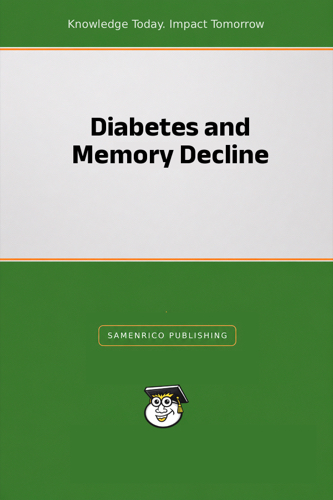
Non-FictionSelf-HelpDiabetes Management
Diabetes and Memory Decline
Control blood sugar to protect cognitive function
Control blood sugar to protect cognitive function using this medical guide.
Formats
About this book
Free sample
Chapter 1: The Diagnosis That Changes Everything--The first time Margaret forgot how to drive home from the grocery store, she blamed it on stress. She was 62 years old, a retired schoolteacher with a lifetime of organized lesson plans and sharp memories of every student she had ever taught. Her Type 2 diabetes had been "well-controlled" for nearly a decade. Her Hb A1c was 6.8 percent, a number her primary care physician had praised at every visit. "Keep doing what you are doing," the doctor said, six months before Margaret got lost on a route she had driven three thousand times before.The second time it happened, Margaret’s husband found her circling the same intersection for twenty-five minutes, her knuckles white on the steering wheel, tears streaming down her face.
She could not explain why she could not find the turn. She could not explain why the familiar landmarks—the red brick church, the old oak tree, the gas station on the corner—had become meaningless shapes. She only knew that something was wrong. Her blood sugar that morning had been 118 mg/d L. Perfectly normal.
Perfectly meaningless.Margaret’s story is not unusual. It is not a rare complication or an outlier case. It is the hidden epidemic of diabetic cognitive decline, and it is happening right now to millions of people who believe their diabetes is "under control" because their lab numbers look good.The Statistic That Should Keep You Up Tonight Let us begin with a number that demands your full attention: 60 to 70 percent.Adults with diabetes have a 60 to 70 percent higher risk of developing some form of cognitive decline compared to adults without diabetes. This is not a minor elevation in risk. This is not a "maybe later" concern.
This is one of the strongest modifiable risk factors for dementia in existence, rivaling the APOE4 gene (the most well-known genetic risk factor for Alzheimer’s) in its predictive power.To put this in perspective, consider the following: among adults over the age of 65 who do not have diabetes, approximately 10 to 15 percent will develop some form of dementia.…
This is the end of the free sample. Get the eBook to keep going. Buy now
Contents
- Chapter 1
- Chapter 2
- Chapter 3
- Chapter 4
- Chapter 5
- Chapter 6
- Chapter 7
- Chapter 8
- Chapter 9
- Chapter 10
- Chapter 11
- Chapter 12
Details
- Author
- George Kathleen
- Publisher
- SamEnrico
- Language
- English
- Genre
- Non-Fiction, Self-Help, Diabetes Management
- Released
- 2026-06-08
- Pages (approx.)
- 151
- Available as
- eBook, Audiobook

Read better in the ZLOADR app
Your eBooks on your phone or tablet. Sign in with your SamEnrico account and start reading.
More by George Kathleen
 Cryptocurrency Trading AddictionGeorge Kathleen$11.99
 Step Five Choosing Your Confidant Wisely GuideGeorge Kathleen$11.99
 Forgiveness for Thoughtless WordsGeorge Kathleen$11.99
 Voiceover Contract TemplateGeorge Kathleen$11.99
 Divorce Recovery Affirmations GuideGeorge Kathleen$11.99
 Breaking the Yelling Habit GuideGeorge Kathleen$11.99
 Anniversary of Pet DeathGeorge Kathleen$11.99
 Baba Yaga's Last Flight: The Witch Who Rode the WindGeorge Kathleen$11.99
 Jingwei's Ceaseless Flight: The Phoenix Who Tamed the SeaGeorge Kathleen$11.99
 How to Produce Air Cleaning Equipment PartsGeorge Kathleen$11.99
 Growing Aporoheliocereus (Hybrid Genus)George Kathleen$11.99
 Mailchimp Double Opt In SetupGeorge Kathleen$12.99
You may also like
 Hong Kong Handover 1997Dunn Johnnie$11.99
 Zumba For Postnatal Recovery CourseNeal Christian$11.99
 Zumba for BeginnersLadner Nikia$11.99
 YouTube Comment Mining GuideHumes Pandora$12.99
 Worry Box MeditationCarlin Rudy$11.99
 Workplace Stress MeditationNguyen Lynn$11.99
 Workplace Stress and Sleep RepairHawley Ivory$11.99
 Workplace Perfectionism CureDelaney Jeffry$11.99
 Workplace Injustice Anger GuideWallen Isabelle$11.99
 Work Addiction and Burnout LinkGreenwood Ester$11.99
 Women in Yoga and WellnessBeattie Galina$11.99
 Women in Stand Up ComedyChun Evangeline$11.99