
Non-FictionMental WealthWorkplace Wellness
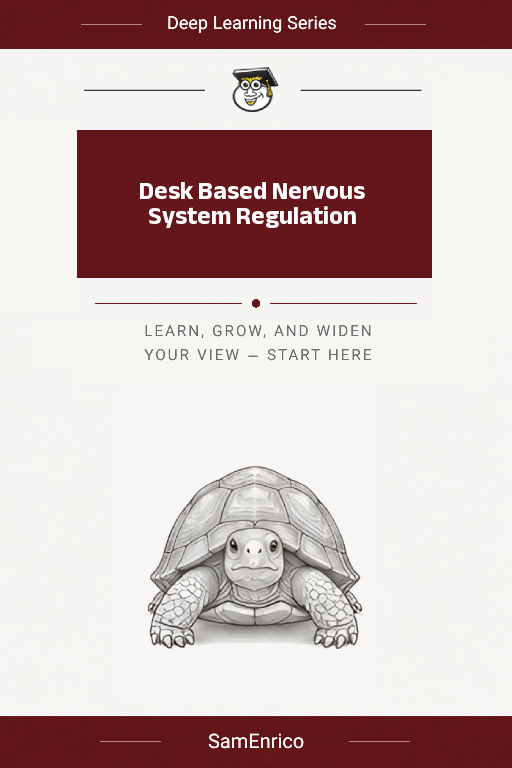
Desk Based Nervous System Regulation
Performs micro-breaks at your desk including eye m
by Kroll Leigha
Performs micro-breaks at your desk including eye movements, shoulder rolls, and breathwork that calm the nervous system without leaving your chair.
Formats
About this book
Free sample
Chapter 1: The Three Hidden Switches--You are about to learn something that most desk workers never discover: your body has three distinct nervous system states, and you have been trying to solve all of them with the same tools. That is why you feel exhausted after eight hours of sitting still. That is why a single rude email can ruin your entire afternoon. And that is why “just relax” has never worked.Your nervous system is not broken. It is doing exactly what evolution designed it to do.
The problem is that your office environment—the screens, the sounds, the deadlines, the endless notifications—constantly triggers survival responses that were meant for lions and wolves, not spreadsheets and Slack messages. Your body cannot tell the difference between a predator in the grass and a passive-aggressive email from your manager. The same neural circuitry fires. The same stress hormones release. The same exhaustion follows.But here is the good news: once you learn to identify which of the three states you are in, you can choose a micro-practice that works specifically for that state.
No more guessing. No more forcing yourself to “breathe deeply” when your body needs something entirely different.This chapter gives you the map. The rest of the book gives you the tools to navigate it.The Polyvagal Discovery You Never Learned in School In the 1990s, Dr. Stephen Porges, a behavioral neuroscientist at the University of Illinois at Chicago, made a breakthrough that fundamentally changed how we understand the nervous system. He called it the Polyvagal Theory—poly meaning “many” and vagal referring to the vagus nerve, the longest nerve in your body, running from your brainstem down through your chest and abdomen.Before Porges, most scientists believed the nervous system had two states: fight-or-flight (sympathetic) and rest-and-digest (parasympathetic).
That model worked for basic physiology, but it could not explain something crucial: why do humans freeze like deer in headlights? And why do we sometimes feel safe and social, while other times we feel completely shut down?Porges discovered that the vagus nerve is actually two separate systems, evolved…
This is the end of the free sample. Get the eBook to keep going. Buy now
Contents
- Chapter 1
- Chapter 2
- Chapter 3
- Chapter 4
- Chapter 5
- Chapter 6
- Chapter 7
- Chapter 8
- Chapter 9
- Chapter 10
- Chapter 11
- Chapter 12
Details
- Author
- Kroll Leigha
- Publisher
- SamEnrico
- Language
- English
- Genre
- Non-Fiction, Mental Wealth, Workplace Wellness
- Released
- 2026-06-01
- Pages (approx.)
- 123
- Available as
- eBook, Audiobook

Read better in the ZLOADR app
Your eBooks on your phone or tablet. Sign in with your SamEnrico account and start reading.
More by Kroll Leigha
 Anger Journal for EmployeesKroll Leigha$11.99
 Wrecks Submarine ArchaeologyKroll Leigha$11.99
 Forgiving Parents For DivorceKroll Leigha$11.99
 Overcoming Workaholism HandbookKroll Leigha$11.99
 The Being Chased Dream GuideKroll Leigha$11.99
 The Ghosts of Actium: Cleopatra’s Last StandKroll Leigha$11.99
 Tanzania Cooperative GuideKroll Leigha$12.99
 Academic TutorKroll Leigha$11.99
 How to Start a Churns Made of Iron or Steel Business (Beginners Guide)Kroll Leigha$11.99
 Understanding Split Hand Split Foot X LinkedKroll Leigha$17.99
You may also like
 Hong Kong Handover 1997Dunn Johnnie$11.99
 Zumba For Postnatal Recovery CourseNeal Christian$11.99
 Zumba for BeginnersLadner Nikia$11.99
 YouTube Comment Mining GuideHumes Pandora$12.99
 Worry Box MeditationCarlin Rudy$11.99
 Workplace Stress MeditationNguyen Lynn$11.99
 Workplace Stress and Sleep RepairHawley Ivory$11.99
 Workplace Perfectionism CureDelaney Jeffry$11.99
 Workplace Injustice Anger GuideWallen Isabelle$11.99
 Work Addiction and Burnout LinkGreenwood Ester$11.99
 Women in Yoga and WellnessBeattie Galina$11.99
 Women in Stand Up ComedyChun Evangeline$11.99