
Non-FictionSelf-HelpDesign Thinking
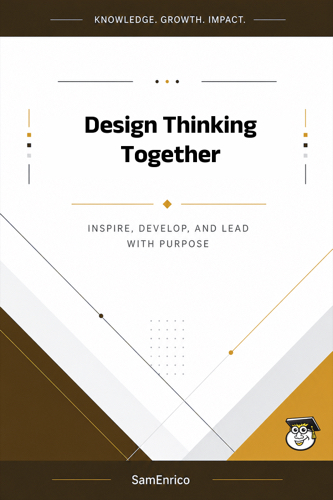
Design Thinking Together eBook
Walks teams through empathy, ideation, and prototy
by Grigsby Ling
Walks teams through empathy, ideation, and prototyping as a unified creative unit.
Formats
Free sample
Chapter 1: The Lonely Genius Trap–- In the winter of 2012, a team of thirty-seven engineers, designers, and product managers at a Fortune 500 automotive company spent four months building a feature that exactly zero users ever touched. The feature was beautiful. The code was elegant. The presentations were flawless. And it solved a problem that did not exist.
When the post-mortem arrived, the team did what most teams do: they found a single person to blame. The lead designer had fallen in love with his own vision. The product manager had approved the wrong requirements. The engineers had built what they were told. One scapegoat, one narrative, one tidy failure.
But here is the truth that no one at that company wanted to admit: the problem was never the lone designer or the weak product manager. The problem was that the team had never learned to think together. They had thirty-seven brilliant individual brains and zero collective intelligence.This chapter dismantles the most seductive and dangerous myth in modern innovation: the belief that creativity flows from solitary geniuses who bark orders and magically intuit the future. It is a myth perpetuated by Hollywood biopics, breathless founder profiles, and our own deep-seated cultural longing for a hero to save us from complexity. The Steve Jobs archetype—the brilliant jerk who sees what others cannot and drags the team across the finish line through sheer force of will—has done more damage to collaborative creativity than any other single idea in the last fifty years.
Not because Steve Jobs was not brilliant. He was. Not because lone geniuses never exist. Occasionally, they do. But because the myth teaches us to organize our teams around the exception rather than the rule.
Most of us are not Steve Jobs. Most problems are not the i Phone. And most organizations cannot afford to wait for a messianic figure to descend from on high and save them from their own mediocrity.The Hidden Cost of Genius Worship Let us begin with a provocation: the "brilliant jerk" model does not just fail to produce better outcomes—it actively reduces a team's creative capacity. This is not opinion. It is empirical.
Research from Harvard Business School spanning over a decade and more than five hundred teams found that teams with a single dominant, high-ego performer generated fewer novel solutions than teams with balanced participation, even when the dominant performer was objectively the most talented individual in the room. Why? Because the other team members learned to suppress their own ideas. They learned to wait for the genius to speak first. They learned that proposing a half-baked notion or a contrarian perspective would be met with dismissal, ridicule, or worse, silence.
Psychological safety—the belief that one can speak up without fear of punishment or humiliation—evaporated. And with it, the team's ability to diverge, to explore, to stumble into the unexpected connections where breakthrough ideas actually live.The psychologist Charlan Nemeth at UC Berkeley demonstrated this decades ago in a series of now-classic experiments on group creativity. When groups were told to brainstorm with the instruction "do not criticize," they produced more ideas than groups told to "avoid mistakes," but still fewer than groups given a third instruction: "do criticize, but also debate and dissent." The highest-performing groups were not the polite ones or the genius-led ones. They were the groups that engaged in structured, respectful conflict—what Nemeth called "authentic dissent." The myth of the lone genius teaches us the opposite: it teaches us to centralize dissent in one person, to treat disagreement as insubordination, and to mistake consensus for alignment.This chapter introduces a radical reframe: design thinking is not a five-step process map to be memorized and executed. It is a social operating system for groups.
Empathy, ideation, and prototyping are not individual skills to be mastered in isolation. They are relational practices that only function when the team shares a common language, a common trust, and a common willingness to be wrong together. You cannot have a team where one person holds all the empathy data, another controls all the ideation rituals, and a third decides what gets prototyped. That is not a team. That is a feudal system, and feudal systems are terrible at innovation because serfs do not challenge the king.The Vulnerability Audit: A Diagnostic Tool Before we go any further, I want you to stop reading and take a quiet assessment of your own team.
Not your organization at large. Not your industry. Your team—the people you sit next to, Slack with, and produce work alongside. Ask yourself the following four questions, and answer them honestly. If you are reading this alone, answer for yourself.
If you are in a team meeting, answer silently and then discuss only what feels safe.First, can you say "I don't know" in a meeting without immediately following it with a justification, a hedge, or a deflecting question? Or does "I don't know" feel like an admission of professional failure? Second, can you bring a half-baked idea—something barely formed, still rough at the edges—to your team without someone seizing on its flaws before exploring its potential? Third, when someone disagrees with you, does your body instinctively prepare for a fight (increased heart rate, clenched jaw, defensive posture), or do you find yourself genuinely curious about their perspective? Fourth, have you ever watched a teammate propose an idea that you knew would fail, said nothing, and watched them walk into the wall anyway because correcting them would have required a confrontation you wanted to avoid?These four questions form the core of The Vulnerability Audit, a diagnostic tool that measures the psychological safety of your creative unit.
The Audit has no numerical score because safety is not a metric to be gamified. Instead, it produces a pattern: teams that answer "no" to the first two questions and "yes" to the last two are teams operating in survival mode, not creative mode. They are teams where people have learned to protect themselves first and solve problems second. And no amount of design thinking training—no workshops, no sticky notes, no "How Might We" posters—will fix that until the underlying social dynamics change.I have administered the Vulnerability Audit to more than two hundred teams over the last decade, from global banks to small nonprofits. The results are depressingly consistent: approximately seventy percent of teams cannot say "I don't know" without hedging.
Sixty percent admit to withholding half-baked ideas. And forty-five percent have watched a teammate fail in silence to avoid conflict. These are not bad people. They are not lazy or cowardly. They are rational actors responding to the incentives their environments have created.
If your organization rewards certainty and punishes exploration, you will get certainty and zero exploration. If your organization celebrates the loudest voice in the room, you will get performative confidence and suppressed dissent. The myth of the lone genius is not just a narrative error; it is an incentive structure that teaches teams to perform genius rather than pursue it.Psychological Safety Is Not Politeness Before we go further, I need to address a common and dangerous misunderstanding that has…
This is the end of the free sample. Get the eBook to keep going. Buy now
About this book
Details
- Author
- Grigsby Ling
- Publisher
- SamEnrico
- Language
- English
- Genre
- Non-Fiction, Self-Help, Design Thinking
- Released
- 2026-06-05
- Pages (approx.)
- 142
- Available as
- eBook, Audiobook

Read better in the ZLOADR app
Your eBooks on your phone or tablet. Sign in with your SamEnrico account and start reading.
More by Grigsby Ling
 Overcoming Loneliness with Therapy GroupsGrigsby Ling$11.99
 Lagos Fashion Pop UpGrigsby Ling$11.99
 Commuter Stress ReductionGrigsby Ling$11.99
 Meals on Wheels GuideGrigsby Ling$11.99
 SAD And Work PerformanceGrigsby Ling$11.99
 Breathwork for De escalationGrigsby Ling$11.99
 Resilience for TruckersGrigsby Ling$11.99
 The Shadow VP: How Walter Mondale Reshaped the OfficeGrigsby Ling$11.99
 Beneath the Siege: Love and Blood at Barcelona (1705–1714)Grigsby Ling$11.99
 How to Produce Lawn GamesGrigsby Ling$11.99
 Service Providers Guide to Employee TrainingGrigsby Ling$11.99
 Fibery Custom Scrum GuideGrigsby Ling$12.99
You may also like
 Hong Kong Handover 1997Dunn Johnnie$11.99
 Zumba For Postnatal Recovery CourseNeal Christian$11.99
 Zumba for BeginnersLadner Nikia$11.99
 YouTube Comment Mining GuideHumes Pandora$12.99
 Worry Box MeditationCarlin Rudy$11.99
 Workplace Stress MeditationNguyen Lynn$11.99
 Workplace Stress and Sleep RepairHawley Ivory$11.99
 Workplace Perfectionism CureDelaney Jeffry$11.99
 Workplace Injustice Anger GuideWallen Isabelle$11.99
 Work Addiction and Burnout LinkGreenwood Ester$11.99
 Women in Yoga and WellnessBeattie Galina$11.99
 Women in Stand Up ComedyChun Evangeline$11.99