
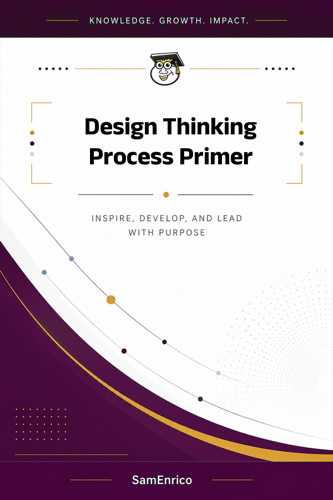
Design Thinking Process Primer eBook
Master the five stages of empathy, definition, ide
Master the five stages of empathy, definition, ideation, prototyping, and testing for complex challenges.
Formats
Free sample
Chapter 1: The Meeting That Should Have Been an Email--–It was 2:47 PM on a Tuesday, and the seventh-floor conference room smelled faintly of stale coffee and exhausted ambition. Fourteen people sat around a polished mahogany table, each holding a forty-seven-page slide deck that had cost an estimated $84,000 in collective salary hours to produce. The project had been running for eleven weeks. The team had held thirty-two meetings. They had created a hundred and twelve action items.
They had built exactly nothing. And the product they were designing—a simple employee onboarding app—was now three months behind schedule.The director of product stood up, clicked to slide thirty-eight, and said the seven words that predict failure more reliably than any financial metric: “Based on our analysis, we believe the user wants…”No one in the room had ever spoken to an actual user.This is not an anomaly. This is not a cautionary tale from a failing startup. This is how most organizations approach complex problems in the twenty-first century. They assemble smart people.
They give them spreadsheets and slide decks. They ask for analysis, recommendations, and business cases. And then they are genuinely surprised when the result solves nothing, pleases no one, and costs three times the original estimate.The problem is not the intelligence of the people in the room. The problem is the assumption that intelligence alone is sufficient.The Superman Fallacy There is a myth that pervades corporate culture, MBA programs, and the way we celebrate business leaders. It is the myth of the lone genius—the superhuman executive who gazes upon a complex problem, intuits the correct solution, and issues directives that lead to triumphant success.
Steve Jobs returning to Apple. Jeff Bezos writing the 1997 shareholder letter. Elon Musk tweeting a product roadmap at 2 AM.Call this Superman Thinking.Superman Thinking assumes that the right person, armed with the right data and the right authority, already knows the answer. The job of everyone else is simply to execute. If the solution fails, it must be because the genius did not have enough data, or the team failed to execute properly, or the market shifted unpredictably.
The framework itself is never questioned because the framework is invisible. It is simply how business is done.Here is the uncomfortable truth that the best-selling books on design thinking have been shouting for two decades: Superman Thinking works only for simple problems.For simple problems—ordering office supplies, approving expense reports, scheduling a meeting—a competent expert can indeed produce a correct answer quickly and reliably. You do not need a design thinking process to figure out which vendor delivers printer toner the fastest. You need a spreadsheet and a phone call.But the problems that keep leaders awake at night are not simple. They are complex, messy, human, and stubbornly resistant to expert intuition.
Why do patients keep missing their follow-up appointments? Why do teachers burn out within three years? Why do engineering teams reject the beautiful new workflow tool that headquarters spent two million dollars building? Why does your brilliant new product launch generate a collective shrug from the market?These are not problems that yield to Superman Thinking. They are problems that require a different mindset entirely.The VUCA World (And Why Your Spreadsheet Can’t Save You)In the late 1980s, the U.S.
Army War College introduced a framework to describe the post-Cold War strategic environment. They called it VUCA—Volatility, Uncertainty, Complexity, and Ambiguity. The term has since migrated into business literature because it perfectly captures the conditions under which modern organizations struggle.Let us break each term down, because understanding VUCA is the first step toward knowing when to use design thinking and when to reach for a simpler tool.Volatility Volatility describes a situation where the rate of change is high and unpredictable. The challenge itself may be straightforward, but the environment shifts so quickly that any fixed solution becomes obsolete before it is implemented. Think of a social media algorithm that changes every six weeks, or a supply chain that must route around new shipping regulations monthly.
In volatile conditions, the expert answer that was correct last quarter is almost certainly wrong this quarter.Uncertainty Uncertainty means that cause and effect are not clearly understood. You can observe what is happening, but you cannot predict what will happen if you take a particular action. Launching a new product in an uncertain market is not like pressing a light switch; it is like dropping a stone into murky water and trying to predict exactly where the ripples will go. Experts disagree. Historical data may not apply.
The only way to reduce uncertainty is to run small experiments and observe the results directly.Complexity Complexity arises when a system has many interconnected parts, and those parts interact in nonlinear ways. A hospital emergency department is complex. A software development team is complex. A school district with thirty-seven schools and fourteen unions is complex. In complex systems, you cannot change one variable without unintentionally affecting dozens of others.
The expert who claims to understand the entire system is almost certainly deluded. The best you can do is probe, sense, and respond.Ambiguity Ambiguity is the most subtle and the most dangerous. It means that the problem itself is not clearly defined. Different stakeholders have different, equally valid interpretations of what is happening and what success would look like. In ambiguous conditions, asking “What is the solution?” is premature because no one has agreed on what the problem is.
The first task is not to solve but to frame.Most organizations are built to handle volatility and complexity reasonably well. They hire experts. They build models. They create contingency plans. But they collapse under uncertainty and ambiguity because these conditions violate the core assumption of Superman Thinking: that the problem is understood well enough to prescribe a solution.Design thinking exists precisely for uncertainty and ambiguity.
It is not a faster way to get to the answer. It is a different way of being in the presence of not knowing.The Expert Mindset vs. The Designer Mindset Roger Martin, former dean of the Rotman School of Management and author of The Design of Business, draws a crucial distinction between two modes of thinking. The Analytical Mindset reduces risk by narrowing possibilities. It asks: Given the data, what is the most likely correct answer?
It values reliability, prediction, and closure. Analytical thinking is essential for execution. It tells you how to build something once you know what to build.The Design Mindset embraces mystery by expanding possibilities. It asks: What if we looked at this problem differently? What are we not seeing?
It values validity, learning, and openness. Design thinking is essential for exploration. It tells you what to build before you figure out how to build it.Neither mindset is superior. They serve different purposes. The disaster occurs when organizations apply the analytical mindset to problems that require the design mindset.
That is like using a hammer to diagnose a fever. The hammer is a fine tool, but it is the wrong tool for the job.Consider the following comparison:Analytical Mindset Designer Mindset Assumes the…
This is the end of the free sample. Get the eBook to keep going. Buy now
About this book
Details
- Author
- Cherry Pandora
- Publisher
- SamEnrico
- Language
- English
- Genre
- Non-Fiction, Self-Help
- Released
- 2026-06-09
- Pages (approx.)
- 133
- Available as
- eBook, Audiobook

Read better in the ZLOADR app
Your eBooks on your phone or tablet. Sign in with your SamEnrico account and start reading.
More by Cherry Pandora
 Empathy Course WorkbookCherry Pandora$11.99
 Parent Reading Time HackCherry Pandora$11.99
 Detox Staff Training ManualCherry Pandora$11.99
 Group Flow State TriggersCherry Pandora$11.99
 Blue Zone Green Leafy GuideCherry Pandora$11.99
 Anger Restructuring For CouplesCherry Pandora$11.99
 Remote Productivity SchedulingCherry Pandora$11.99
 The Mosaic Lovers of Pompeii: A Forgotten Tale of Art and DevotionCherry Pandora$11.99
 The Ballad of the Heike: Ghostly Lament of the Fallen SamuraiCherry Pandora$11.99
 How to Produce HygrometersCherry Pandora$11.99
 A Collector's Handbook to the Healey 2.4-litre SportsmobileCherry Pandora$11.99
 Study Abroad Scholarship GuideCherry Pandora$12.99
You may also like
 Workplace Stress MeditationNguyen Lynn$11.99
 Volcano Monitoring ScientistCox Alexis$11.99
 The Tech Professional NetAguiar Nevada$11.99
 The Morning Metta RitualCanales Anya$11.99
 The Chunking Memory TechniqueClanton Hyacinth$11.99
 The Beginner Mistake FixAmmons Cassondra$11.99
 Surrendering to What IsGrimm Reatha$11.99
 Self Hypnosis for Fear of FireBillups Eli$11.99
 Road Rage for Professional DriversBrackett Janise$11.99
 Psychiatric Ward Nurse StressDunning Wyatt$11.99
 Observation vs Evaluation NVCTimmons Alda$11.99
 Networking for Nonprofit ProfessionalsPoole Jesse$11.99