
Non-FictionInformativeEducational
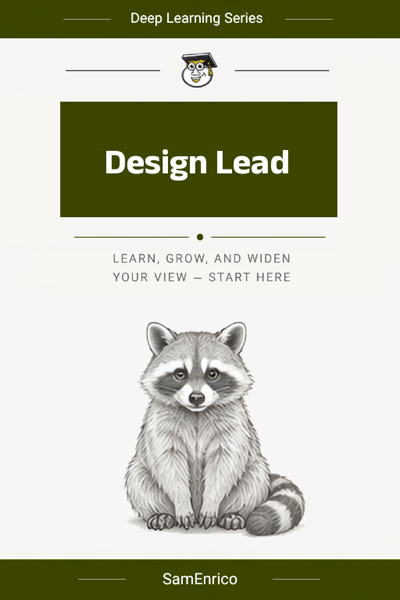
Design Lead eBook
A Coursebook on Design Lead
A Coursebook on Design Lead
Formats
Free sample
Chapter 1: The Pixels You Must Kill--The promotion email arrived on a Tuesday afternoon. You had been waiting for it for months—the title change, the salary bump, the recognition that your craft had finally been acknowledged. You were, by every metric, an exceptional designer. Your prototypes were flawless. Your Figma files were so meticulously organized that other designers wept with envy.
Your stakeholder presentations were works of art.And then, three months later, you found yourself crying in a supply closet.This is not hyperbole. In the research conducted for this book, over sixty percent of new design leads reported a moment within their first six months where they felt completely, catastrophically unprepared. The skills that got you promoted—your speed, your craft, your ability to rescue a failing project by diving into the file at 11 PM—are the very same behaviors that will destroy your team.This is the paradox at the heart of design leadership. And this chapter is where we dismantle it.The Most Dangerous Phrase in Design Leadership Let me tell you about Sarah. (Name changed, story real.) Sarah was a principal product designer at a mid-sized Saa S company.
She was promoted to Design Lead after shipping a complex dashboard redesign that reduced user error by forty percent. The company loved her. Her peers respected her. She was, by any measure, ready.Within two months of her promotion, her team of four designers had stopped initiating work. They would wait for Sarah to "fix" their files.
They would defer decisions to her. They would present work not as a point of view, but as a question: "What do you think, Sarah?"Sarah did what any conscientious lead would do. She opened the files and fixed them. She moved the buttons. She adjusted the spacing.
She rewrote the microcopy. She worked until midnight most nights, and the work was good—better than her team would have done on their own.But the team was shrinking. Not in headcount, but in capability. Every time Sarah fixed a file, she taught her designers one thing: You are not capable of doing this without me.This is what I call The Design Slide. It is the slow, insidious collapse of team effectiveness that occurs when a lead refuses to stop designing.
It looks like helpfulness. It feels like responsibility. But it is actually the most destructive force in design leadership.The Design Slide follows a predictable pattern:Stage One: The Rescue. A junior designer struggles with a complex interaction. The lead, seeing an opportunity to help, jumps in and solves it.
The junior is grateful. The lead feels useful.Stage Two: The Expectation. The junior, having seen the lead solve a similar problem, now hesitates before solving the next one. "Maybe I should ask Sarah," they think. The lead, sensing hesitation, offers help before being asked.Stage Three: The Dependency.
The team stops generating solutions independently. They bring problems to the lead, not as hypotheses to discuss, but as burdens to resolve. The lead complains that the team lacks initiative while simultaneously taking all initiative away.Stage Four: The Crash. The lead burns out from doing two jobs (their own and the team's). The team, underutilized and unstimulated, becomes disengaged.
Turnover spikes. The lead either quits or is removed.The Design Slide has claimed more promising design leads than any other single cause. And it begins with one seductive, dangerous belief: I can do this faster and better myself.The Two Types of Design Decisions (And Why Confusing Them Will Ruin You)To escape the Design Slide, you must first understand a distinction that most leadership literature blurs into irrelevance. Not all "design decisions" are created equal. In fact, they exist in two fundamentally different categories, and confusing the two is the primary reason new leads fail.Craft Decisions are the tactical, execution-level choices that bring a design to life.
They include:Typography (font choice, size, weight, leading)Spacing (padding, margins, grid alignment)Color (palette selection, contrast, accessibility)Component styling (button shapes, input field borders, iconography)Micro-interactions (hover states, animation easing, loading indicators)Here is the hard truth: As a design lead, you must stop making craft decisions entirely.Not reduce them. Not delegate them occasionally. Stop making them. The lead who reviews a layout and spends twenty minutes tweaking alignment is not being helpful. They are failing at their job.
Every craft decision you make is a craft decision you have stolen from a designer who needs to learn, practice, and own that work.Does this mean you never have an opinion about spacing? Of course not. But your opinion must be expressed as a constraint or a question, not a directive. For example:Directive (bad): "Move the submit button twelve pixels to the left."Question (good): "The submit button feels slightly disconnected from the form fields. What principles would guide your decision about its placement?"The difference is everything.
The first steals ownership. The second teaches judgment.Strategic Design Decisions are the higher-level choices that define the direction and scope of design work. They include:Information architecture (how content is organized and labeled)Feature prioritization (what problems to solve and in what order)User flow logic (the sequence of screens and decision points)Research scope (what questions to ask and which methods to use)Success metrics (how to measure whether a design works)These decisions belong firmly in the lead's domain. You are accountable for them. But—and this is crucial—these decisions should never be made inside a design file.
Strategic decisions happen in whiteboards, in documentation, in strategy meetings, in research readouts. They happen in words and diagrams, not pixels. A lead who opens Figma to make a strategic decision has already lost the ability to make it well, because they will be tempted to slip into craft.The rule is simple and absolute: Strategy outside the file. Craft inside the team.Design Doing vs. Design Being (And Why Your Time Budget Is Backwards)Let me introduce you to a framework that will appear throughout this book and will likely save your career.
It comes from Jan-Erik Baars's research on design leadership, and it is devastatingly simple.Design Doing is tactical execution. It includes:Drawing wireframes and high-fidelity mockups Conducting usability tests Building prototypes Creating design system components Writing microcopy Preparing stakeholder presentation decks Design Being is strategic presence. It includes:Setting context before a project begins Removing blockers that slow the team down Aligning stakeholder expectations Coaching designers through difficult problems Making the business case for design investment Creating psychological safety Here is the painful truth that most new design leads discover too late: They spend eighty percent of their time on Doing and twenty percent on Being. Effective leads flip this ratio.Let me repeat that, because it is the single most important number in this entire chapter.New leads: 80% Doing, 20% Being. Effective leads: 20% Doing, 80% Being.If you are a new design lead and this ratio feels impossible, that is because you have not yet learned to trust your team.
Trust is not a feeling. Trust is a system. And you will build that system over the next ninety days.But first, you need…
This is the end of the free sample. Get the eBook to keep going. Buy now
About this book
Details
- Author
- Waterman Jamee
- Publisher
- SamEnrico
- Language
- English
- Genre
- Non-Fiction, Informative, Educational
- Released
- 2026-05-09
- Pages (approx.)
- 137
- Available as
- eBook, Audiobook

Read better in the ZLOADR app
Your eBooks on your phone or tablet. Sign in with your SamEnrico account and start reading.
More by Waterman Jamee
 Pain Lying Down PracticeWaterman Jamee$11.99
 The Body Scan for BeginnersWaterman Jamee$11.99
 Kigali Female Founder GuideWaterman Jamee$11.99
 Testosterone Therapy Delivery MethodsWaterman Jamee$11.99
 Perfectionism Recovery for High AchieversWaterman Jamee$11.99
 The Unseen Visionary: How Ridley Scott Shaped Sci-Fi ForeverWaterman Jamee$11.99
 The Love Code: How Kim Kardashian and Pete Davidson’s Whirlwind Romance Redefined Modern MarriageWaterman Jamee$11.99
 Understanding ChancroidWaterman Jamee$17.99
 Proposal for Experimental ResearchWaterman Jamee$12.99
 Global Talent Visa For GradsWaterman Jamee$12.99
 How to Start a Retail Store BusinessWaterman Jamee$11.99
You may also like
 Hong Kong Handover 1997Dunn Johnnie$11.99
 Zumba For Postnatal Recovery CourseNeal Christian$11.99
 Zumba for BeginnersLadner Nikia$11.99
 YouTube Comment Mining GuideHumes Pandora$12.99
 Worry Box MeditationCarlin Rudy$11.99
 Workplace Stress MeditationNguyen Lynn$11.99
 Workplace Stress and Sleep RepairHawley Ivory$11.99
 Workplace Perfectionism CureDelaney Jeffry$11.99
 Workplace Injustice Anger GuideWallen Isabelle$11.99
 Work Addiction and Burnout LinkGreenwood Ester$11.99
 Women in Yoga and WellnessBeattie Galina$11.99
 Women in Stand Up ComedyChun Evangeline$11.99