
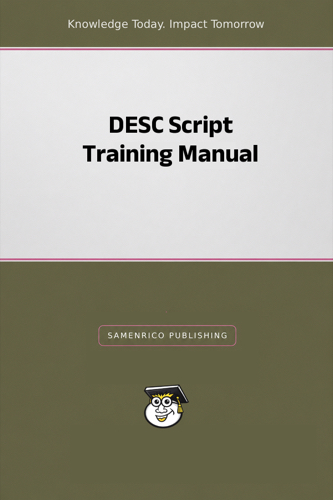
Non-FictionSelf-HelpDESCDifficult Conversations
DESC Script Training Manual eBook
Apply Describe, Express, Specify, Consequences for
by Maes Kiara
Apply Describe, Express, Specify, Consequences format for difficult conversations.
Formats
Free sample
Chapter 1: The Silence Tax...--–- Every morning, Maria wakes up at 5:30 AM, packs lunches for three children, commutes forty-five minutes to an open-plan office, and spends eight hours being interrupted, talked over, and assigned work that isn't hers. Every evening, she drives home, makes dinner, helps with homework, puts the children to bed, and lies awake at 2:00 AM mentally rehearsing what she should have said to her colleague who took credit for her idea, to her manager who dumped another last-minute project on her desk, to her mother-in-law who criticized her parenting, to her neighbor who parks across her driveway. Then she does it all again. Maria is not an anomaly. She is the average reader picking up this manual.The Cost of Not Speaking Up Every unexpressed thought carries a price tag.
Most people never calculate it. They feel the weight—the heaviness in the chest after swallowing a response, the sleepless nights replaying conversations, the slow erosion of self-respect that comes from repeatedly choosing silence over conflict—but they never put a number on it. Let us do that now.Research in organizational psychology has quantified what Maria experiences daily. The average professional spends nearly three hours per week mentally replaying conversations they wished had gone differently. That is 156 hours per year—the equivalent of four full work weeks—spent in post-conversation rumination.
Add to that the productivity loss from unaddressed workplace conflicts, which Gallup estimates costs the US economy over $350 billion annually. Add to that the health care costs associated with chronic stress from suppressed communication: hypertension, insomnia, depression, gastrointestinal disorders. Add to that the relationship costs: marriages that drift apart not because of one big fight but because of ten thousand small silences.This is the Silence Tax. It is the cumulative cost of every moment you chose safety over honesty, peace over progress, silence over assertion. And it is the problem this manual exists to solve.Maria has been paying the Silence Tax for eleven years.
She does not remember when she first learned that her voice was optional—perhaps in childhood, when speaking up was met with "children should be seen and not heard," or in her first job, when questioning a manager was labeled "insubordinate," or in her marriage, when expressing a need was framed as "nagging." The origin does not matter. What matters is that the pattern is now automatic, invisible, and expensive.This chapter will help you do three things. First, you will identify your current communication style across four distinct behavioral patterns: passive, aggressive, passive-aggressive, and assertive. Second, you will complete the Assertiveness Inventory—a diagnostic tool that measures how you respond to thirty common scenarios across work, home, and social contexts. Third, you will calculate your personal Silence Tax and understand, with numerical clarity, what non-assertion is costing you.
By the end of this chapter, you will have a baseline. The remaining eleven chapters will give you the tools to change it.The Four Communication Styles: Which One Is Yours?Before you can change how you communicate, you must know how you currently communicate. Most people believe they have one default style—"I'm usually passive" or "I'm a bit aggressive"—but the reality is more nuanced. Communication styles are situational. You may be assertive at work but passive with your partner.
You may be aggressive with telemarketers but passive-aggressive with your parents. The goal is not to label yourself permanently but to identify patterns so you can intervene where they cause the most damage.Let us define the four styles clearly.Passive Communication: The Art of Self-Erasure Passive communicators prioritize others' needs, rights, and feelings above their own—always. They speak softly, avoid eye contact, apologize excessively, and use qualifying language ("This might be a stupid question, but..."). Their core belief is: "My needs don't matter as much as yours."The passive person says: "Oh, it's fine, don't worry about it" (when it is not fine). "I don't really have a preference" (when they do).
"Sorry, sorry, I'm so sorry" (when they have done nothing wrong).The short-term payoff is safety. Passive communication avoids conflict, reduces immediate tension, and keeps the peace. The long-term cost is devastating. Passive individuals experience chronic resentment because their needs go unmet. They are often taken advantage of by more assertive or aggressive people.
Their self-esteem erodes because they receive constant evidence that their preferences do not matter—because they never express them. Physiologically, chronic passivity correlates with elevated cortisol levels, suppressed immune function, and higher rates of depression.Consider David, a project manager who never pushes back when stakeholders add scope to his projects. He works sixty-hour weeks, misses family dinners, and silently resents everyone who asks him for "just one more thing." His body keeps score: tension headaches, back pain, insomnia. His marriage keeps score: distance, frustration, eventual separation. His career keeps score: he is promoted to "reliable workhorse" but never to leadership, because leaders must speak up.Aggressive Communication: Winning at Others' Expense Aggressive communicators prioritize their own needs, rights, and feelings above others'—always.
They speak loudly, maintain intimidating eye contact, interrupt frequently, and use blaming language ("You always...", "You never...", "What is wrong with you?"). Their core belief is: "My needs matter, and yours are irrelevant or an obstacle."The aggressive person says: "That's your problem, not mine." "You need to get your act together." "Because I said so."The short-term payoff is immediate results. Aggressive people often get what they want because others are too intimidated to resist. They experience a dopamine rush from "winning" confrontations. The long-term cost is relationship destruction.
Aggressive communicators alienate colleagues, partners, friends, and children. They may achieve compliance but never commitment. Their teams suffer from high turnover, low morale, and quiet quitting. Personally, aggressive communication correlates with higher rates of cardiovascular disease—the constant adrenaline spikes take a toll.Consider Priya, a department head who yells when deadlines are missed. Her team meets every deadline but does nothing more.
They do not bring problems to her attention because they fear her reaction. They do not innovate because mistakes are punished brutally. They update their resumes quarterly and leave within eighteen months. Priya cannot understand why she works harder than everyone else yet cannot retain talent. She has confused fear with respect, compliance with leadership.Passive-Aggressive Communication: The Indirect Attack Passive-aggressive communicators appear passive on the surface but express aggression indirectly.
They agree to requests verbally while sabotaging them behaviorally. They use sarcasm, the silent treatment, procrastination, and "forgetting" as weapons. Their core belief is: "I am angry, but I am too afraid to express it directly, so I will express it in ways you cannot confront."The passive-aggressive person says: "Fine. Whatever." (said with a sigh, meaning "not fine"). "I'm not mad." (said while clearly mad).
"Oh, you want me to do that now? I thought you meant eventually." (after letting a deadline pass).The short-term payoff is emotional release without direct confrontation. The passive-aggressive person gets to express their anger while maintaining plausible deniability ("I didn't say anything wrong; you're too sensitive"). The long-term cost is the destruction of trust. Passive-aggressive behavior is confusing and maddening to receive because the victim…
This is the end of the free sample. Get the eBook to keep going. Buy now
About this book
Details
- Author
- Maes Kiara
- Publisher
- SamEnrico
- Language
- English
- Genre
- Non-Fiction, Self-Help, DESC, Difficult Conversations
- Released
- 2026-06-11
- Pages (approx.)
- 156
- Available as
- eBook, Audiobook

Read better in the ZLOADR app
Your eBooks on your phone or tablet. Sign in with your SamEnrico account and start reading.
More by Maes Kiara
 Child Star Stage Moms Tell AllMaes Kiara$11.99
 The Nostril Sensation FocusMaes Kiara$11.99
 Bill Gates The Road AheadMaes Kiara$11.99
 Relationship Stress and Mindfulness for TwoMaes Kiara$11.99
 The Ghosts of Manila Bay: Dewey’s Phantom Fleet and the Birth of American Naval PowerMaes Kiara$11.99
 Understanding Loose Anagen Hair SyndromeMaes Kiara$17.99
 Finance LeadMaes Kiara$11.99
 How to Become a Service Supervisor IMaes Kiara$11.99
 Pet Product Spending GuideMaes Kiara$12.99
 Florida LLC For Non Residents GuideMaes Kiara$12.99
You may also like
 Hong Kong Handover 1997Dunn Johnnie$11.99
 Zumba For Postnatal Recovery CourseNeal Christian$11.99
 Zumba for BeginnersLadner Nikia$11.99
 YouTube Comment Mining GuideHumes Pandora$12.99
 Worry Box MeditationCarlin Rudy$11.99
 Workplace Stress MeditationNguyen Lynn$11.99
 Workplace Stress and Sleep RepairHawley Ivory$11.99
 Workplace Perfectionism CureDelaney Jeffry$11.99
 Workplace Injustice Anger GuideWallen Isabelle$11.99
 Work Addiction and Burnout LinkGreenwood Ester$11.99
 Women in Yoga and WellnessBeattie Galina$11.99
 Women in Stand Up ComedyChun Evangeline$11.99