
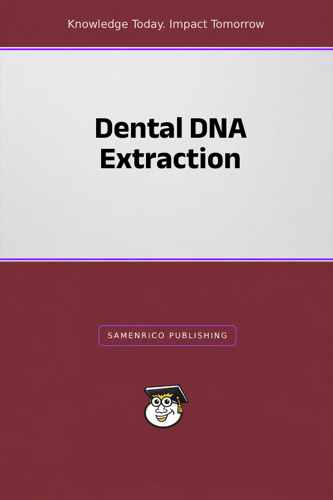
Dental DNA Extraction
undefined
undefined
Formats
About this book
Free sample
Chapter 1: The Enamel Fortress...–- Every tooth tells a story. But not every story is written in bone. In the quiet darkness of a mass grave, beneath the ash of a volcanic eruption, or inside the sealed pulp chamber of a thousand-year-old molar, a different kind of archive awaits—one written not in ink or stone, but in the delicate, double-helix language of deoxyribonucleic acid. For decades, forensic anthropologists and archaeologists focused their attention on the long bones, the skull, the pelvis—the traditional landmarks of identification. They overlooked the humble tooth, dismissing it as little more than a grinding surface or a clue to diet and age.
That was a mistake. A catastrophic one.The tooth is not merely a calcified organ of mastication. It is a biological fortress, a time capsule, and a genetic treasure chest all rolled into one tiny, unassuming package. While bone undergoes constant remodeling—a process of destruction and rebuilding that slowly replaces cells over a lifetime—the tooth, once fully formed, becomes static. Its cellular inhabitants, the odontoblasts and cementocytes, are entombed within mineralized walls, preserved like insects in amber.
This biological stasis means that the DNA inside a tooth degrades far more slowly than DNA in any other human tissue. For the forensic odontologist, the crime scene investigator, and the molecular anthropologist, this single fact changes everything.Consider the alternatives. Soft tissues like muscle, liver, and skin decompose within days or weeks post-mortem, their DNA consumed by the very enzymes that once sustained life. Blood, so rich in nucleated cells, becomes a hostile environment as bacteria proliferate. Even bone, the traditional gold standard for ancient and forensic DNA analysis, presents serious challenges.
Its porous structure allows groundwater, microbes, and environmental contaminants to infiltrate, carrying with them PCR inhibitors like humic acids and collagen breakdown products. Worse still, bone's natural porosity and high surface area make it a magnet for modern DNA contamination—the silent killer of low-copy-number analysis.Teeth, by contrast, are sealed systems. The enamel that crowns the tooth is the hardest substance in the human body, composed of 96% hydroxyapatite crystals arranged…
This is the end of the free sample. Get the eBook to keep going. Buy now
Contents
- Chapter 1
- Chapter 2
- Chapter 3
- Chapter 4
- Chapter 5
- Chapter 6
- Chapter 7
- Chapter 8
- Chapter 9
- Chapter 10
- Chapter 11
- Chapter 12
Details
- Author
- Collins Matthew
- Publisher
- SamEnrico
- Language
- English
- Genre
- Non-Fiction, True Crime / DNA
- Released
- 2026-06-07
- Pages (approx.)
- 135
- Available as
- eBook, Audiobook

Read better in the ZLOADR app
Your eBooks on your phone or tablet. Sign in with your SamEnrico account and start reading.
More by Collins Matthew
 Shopping Addiction and PregnancyCollins Matthew$11.99
 Stroke Recovery Anticipatory GriefCollins Matthew$11.99
 Crime Scene Reconstruction CourseCollins Matthew$11.99
 The Postpartum Guilt GuideCollins Matthew$11.99
 Post Lunch Nap GuideCollins Matthew$11.99
 Body Language for FirefightersCollins Matthew$11.99
 Self Hypnosis for Sugar CravingsCollins Matthew$11.99
 The Cape Town Spy Ring: The First Modern Espionage Trial in Africa (1895)Collins Matthew$11.99
 The Forgotten Pioneers: Japan's First Women Athletes and the Fight for EqualityCollins Matthew$11.99
 Monkeys: Primate Behavior, Species & Social StructureCollins Matthew$11.99
 How to Produce Percussion StandsCollins Matthew$11.99
 A Collector's Handbook to the Vauxhall Victor FCollins Matthew$11.99
You may also like
 Hong Kong Handover 1997Dunn Johnnie$11.99
 Zumba For Postnatal Recovery CourseNeal Christian$11.99
 Zumba for BeginnersLadner Nikia$11.99
 YouTube Comment Mining GuideHumes Pandora$12.99
 Worry Box MeditationCarlin Rudy$11.99
 Workplace Stress MeditationNguyen Lynn$11.99
 Workplace Stress and Sleep RepairHawley Ivory$11.99
 Workplace Perfectionism CureDelaney Jeffry$11.99
 Workplace Injustice Anger GuideWallen Isabelle$11.99
 Work Addiction and Burnout LinkGreenwood Ester$11.99
 Women in Yoga and WellnessBeattie Galina$11.99
 Women in Stand Up ComedyChun Evangeline$11.99