
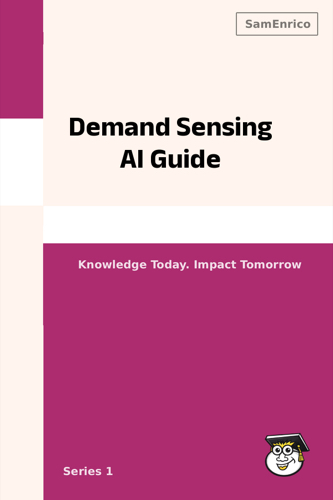
Non-FictionAI OperatorSupply Chain Analytics
Demand Sensing AI Guide eBook
Use machine learning to detect real time demand sh
by Kurtz Josiah
Use machine learning to detect real time demand shifts from sales data.
Formats
Free sample
Chapter 1: The Vanishing Forecast--–- On a Tuesday morning in March, a supply chain director named Elena Vasquez walked into her quarterly review meeting confident. Her team had spent six weeks building the forecast. They had run time series models. They had adjusted for seasonality. They had incorporated input from sales, marketing, and finance.
The forecast said demand for their flagship wireless headphones would be 45,000 units in April. Based on this number, production had ordered components, factories had scheduled lines, and warehouses had reserved space.On Wednesday, a Tik Tok video featuring those headphones received 12 million views in 14 hours. By Thursday, demand had spiked 400 percent. By Friday, the company was out of stock. By Monday, competitors had captured the surge.
Elena’s forecast was not wrong. It was worse than wrong. It was irrelevant.This is not a story about bad forecasting. It is a story about the wrong tool for the problem. A hammer is an excellent tool, but it will not screw in a bolt.
Traditional demand forecasting is an excellent tool for planning capacity, budgeting, and long-term strategy. It is a terrible tool for detecting what happens to demand in the next hour, tomorrow, or the day after. And in the digital economy, the gap between what you forecasted last week and what consumers actually do today is where businesses lose billions of dollars.This chapter establishes the core problem that the rest of this book solves. You will learn why traditional forecasting fails in the digital economy, what demand sensing actually means, why the “last mile” of forecasting is the most dangerous part of the supply chain, and how AI bridges the gap between historical orders and live consumption. By the end of this chapter, you will understand why demand sensing is not a replacement for forecasting but a complementary discipline—and why ignoring it is no longer a viable option.The Forecast Illusion Every supply chain professional has experienced the forecast illusion.
It works like this. You build a forecast using the best available methods. You validate it against historical data. The error metrics look acceptable. You present it to leadership with confidence.
Then reality arrives, and the forecast dissolves. A competitor launches a surprise promotion. A social media influencer mentions your product. A weather event changes buying patterns. A global event shifts consumer priorities overnight.
Your forecast, which looked solid three weeks ago, now looks like a guess.The forecast illusion persists because forecasting as a discipline evolved in a different era. Traditional demand forecasting emerged from statistical process control and time series analysis developed in the 1950s and 1960s. These methods assumed a relatively stable world where patterns repeated. Seasonality came and went the same way every year. Promotions had predictable lift.
Consumers behaved like rational actors. The future, in other words, looked roughly like the past.That assumption is now false.Consider the data. In 2010, the average consumer encountered approximately 3,000 marketing messages per day. By 2024, that number exceeded 10,000. The half-life of a social media trend is measured in hours, not days.
A product can go from unknown to sold out to forgotten in the span of a single weekend. The “long tail” of e-commerce means that millions of products sell intermittently, with no predictable pattern. Supply chains have become faster, leaner, and more global—and therefore more vulnerable to disruption.Traditional forecasting tools cannot keep up because they were not designed to. A weekly forecast that takes six hours to run and produces numbers for the next four weeks is useful for purchasing raw materials and planning factory utilization. It is useless for answering the question: “What is happening to demand right now, and what should I do about it in the next shift?”This distinction is not academic.
It is financial. A 2023 study of retail supply chains found that companies using traditional forecasting alone experienced stockout rates between 8 and 15 percent for promoted items. The same study found that companies using demand sensing reduced stockouts to under 3 percent for the same categories. The difference was not better long-term planning. The difference was the ability to see demand shifting in real time and react before the shelf went empty.Defining Demand Sensing Demand sensing is the practice of detecting demand shifts in near-real time using current sales data, then adjusting short-term predictions and actions accordingly.
The key phrase is “near-real time.” Demand sensing does not predict what will happen six months from now. It predicts what will happen in the next few hours to a few days. This time horizon is what separates sensing from forecasting.Forecast: “We expect to sell 45,000 units next month based on historical patterns, planned promotions, and market conditions.”Sensing: “Based on POS data from the last four hours, web traffic patterns, and the fact that a competitor just sold out, we predict demand of 1,200 units tomorrow—up from the forecast of 800.”The difference in time horizon drives every other difference. Forecasting optimizes for accuracy over long windows. Sensing optimizes for speed and responsiveness.
Forecasting can tolerate running once a week because monthly demand does not change hour by hour. Sensing must run continuously because demand tomorrow is being shaped by what consumers are doing right now.Demand sensing is not a specific algorithm or technology. It is a capability. That capability can be built using simple methods—like tracking a seven-day moving average and flagging deviations—or sophisticated machine learning models like the ones covered in later chapters of this book. The sophistication of the method should match the volatility of the demand being sensed.
A grocery store sensing demand for milk can use simpler methods than an online fashion retailer sensing demand for a viral jacket.What unites all demand sensing approaches is a shift in mindset. Forecasting asks: “What do we think will happen?” Sensing asks: “What is happening right now, and what does that tell us about what happens next?” The first question looks backward and forward. The second question looks at the present and extrapolates.The Last Mile Problem The “last mile” of supply chain planning is the gap between a statistical forecast and what actually happens at the point of sale. This gap exists for three reasons.First, forecasts are aggregated. Most forecasts are built at the weekly or monthly level for groups of products or store types.
But demand shifts happen at the individual SKU level, at specific locations, at specific times. A forecast that says “sales will be strong in the Northeast region next week” is useless when the demand spike is actually happening for a single product at three specific stores in Boston.Second, forecasts are delayed. Even the most rigorous weekly forecast is operating on data that is at least several days old. Orders placed by distributors represent what retailers thought they would sell, not what consumers actually bought. By the time a traditional forecast is refreshed, the demand shift has already occurred—and the stockout or overstock has already happened.Third, forecasts are smoothed.
Traditional time series models remove noise to reveal signal. But in volatile markets, what looks like noise may actually be the signal. A 20 percent sales spike on a Tuesday might be a statistical…
This is the end of the free sample. Get the eBook to keep going. Buy now
About this book
Details
- Author
- Kurtz Josiah
- Publisher
- SamEnrico
- Language
- English
- Genre
- Non-Fiction, AI Operator, Supply Chain Analytics
- Released
- 2026-06-10
- Pages (approx.)
- 142
- Available as
- eBook, Audiobook

Read better in the ZLOADR app
Your eBooks on your phone or tablet. Sign in with your SamEnrico account and start reading.
More by Kurtz Josiah
 Self Esteem Mentorship GuideKurtz Josiah$11.99
 Bipolar In Teens GuideKurtz Josiah$11.99
 Competitive Intensity MapKurtz Josiah$11.99
 Anticipatory Grief For SpouseKurtz Josiah$11.99
 The Adaptive Thermogenesis GuideKurtz Josiah$11.99
 Public Speaking for AccountantsKurtz Josiah$11.99
 Improv for ScientistsKurtz Josiah$11.99
 The Gold Bullion Express: The Great Train Robbery of 1855Kurtz Josiah$11.99
 The Djinn-Knight of Camelot: A Sultan’s Oath in the Round TableKurtz Josiah$11.99
 How to Produce Concrete MixKurtz Josiah$11.99
 Pay Equity Audits Before First HireKurtz Josiah$12.99
 UAE VAT on Cross Border ServicesKurtz Josiah$12.99
You may also like
 Hong Kong Handover 1997Dunn Johnnie$11.99
 Zumba For Postnatal Recovery CourseNeal Christian$11.99
 Zumba for BeginnersLadner Nikia$11.99
 YouTube Comment Mining GuideHumes Pandora$12.99
 Worry Box MeditationCarlin Rudy$11.99
 Workplace Stress MeditationNguyen Lynn$11.99
 Workplace Stress and Sleep RepairHawley Ivory$11.99
 Workplace Perfectionism CureDelaney Jeffry$11.99
 Workplace Injustice Anger GuideWallen Isabelle$11.99
 Work Addiction and Burnout LinkGreenwood Ester$11.99
 Women in Yoga and WellnessBeattie Galina$11.99
 Women in Stand Up ComedyChun Evangeline$11.99