
Non-FictionSelf-HelpDecision Making
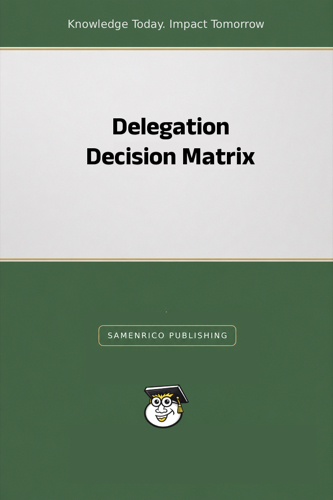
Delegation Decision Matrix eBook
Uses tool to decide what to keep or give away.
by Gillen Libby
Uses tool to decide what to keep or give away.
Formats
Free sample
Chapter 1: The $84,000 Mistake--–- Sarah had been a marketing executive for eleven years. She had launched three major product lines, managed a team of twenty-three, and increased her company's market share by fourteen percent in her first eighteen months as CMO. By any reasonable measure, she was successful. But on a rainy Thursday afternoon in October, sitting in her parked car outside a Starbucks, she did something she had not done in years. She cried.The trigger was not a firing, a failed campaign, or a family emergency.
The trigger was a spreadsheet.For the past eighteen months, Sarah had spent every Thursday afternoon from 2:00 PM to 5:00 PM reformatting expense reports. Not reviewing them for strategic insights. Not approving or denying them. Reformatting them. Adjusting column widths.
Fixing font inconsistencies. Correcting date formats. Three hours every week. Fifty-two weeks per year. Eighteen months.That afternoon, her new financial analyst had asked a simple question: "Why don't you just have the system do this automatically?" Sarah had dismissed the question at first.
But then she did the math. Her annual compensation, including bonus and benefits, was approximately $312,000. Her effective hourly rate, assuming fifty productive weeks per year and forty-five actual working hours per week, was roughly $139 per hour. Three hours per week times $139 times seventy-two weeks equaled just over $30,000 in direct salary cost. But that was only the beginning.While she was reformatting expense reports, she was not working on the Q4 go-to-market strategy.
She was not mentoring her senior product marketing manager. She was not analyzing the competitive landscape. The opportunity cost of those seventy-two Thursday afternoons, calculated conservatively at 2x her hourly rate based on the revenue-generating value of her strategic work, pushed the total past $84,000.Eighty-four thousand dollars. For spreadsheet formatting.Sarah was not an outlier. She was not uniquely foolish or bad at time management.
She was suffering from something far more common and far more insidious: the Heroic Fallacy.The Heroic Fallacy Defined The Heroic Fallacy is the subconscious belief that your unique touch is required for every task, even those far below your pay grade. It is the quiet voice that whispers, "No one can do this as well as you." It is the sense of responsibility that morphs into control. It is, in the words of Benjamin Hardy, co-author of Who Not How, "the ego disguised as diligence."This fallacy is not humility. Humility would say, "I am not the only person capable of doing this work." The Heroic Fallacy says, "I am so capable that only I can be trusted with it." It is arrogance wearing a mask of duty.In my fifteen years of advising executives, entrepreneurs, and team leaders across six countries, I have never encountered a high-performer who did not struggle with this to some degree. The smarter you are, the harder you work, and the more you care about quality, the more susceptible you become.
Your competence becomes a trap.The Heroic Fallacy manifests through three distinct psychological traps. Understanding these traps is the first step toward escaping them.Trap One: The Control Trap The Control Trap is the false belief that doing a task yourself is the only way to ensure it is done correctly. It sounds like: "If I want something done right, I have to do it myself."This trap has a seductive logic. You have experience. You have standards.
You have a track record of success. Why would you risk that on someone else? The answer, which the Control Trap obscures, is that perfection is not the goal. Sufficiency is the goal. The Control Trap convinces you that a task done at 98% quality by you is superior to a task done at 90% quality by someone else.
But it ignores three critical facts.First, the difference between 98% and 90% is often invisible to everyone except you. The client does not notice the font choice. The boss does not see the extra hour of polishing. The market does not reward the unnecessary perfection.Second, the opportunity cost of chasing that 8% improvement is enormous. The hour you spent perfecting a Power Point slide is an hour you did not spend on strategy, relationship building, or revenue generation.Third, and most importantly, the person you did not train because you did everything yourself remains at 0% forever.
Every task you hoard is a lesson you steal from your team.The Control Trap is particularly dangerous for founders and high-level executives because their early success was often built on doing everything themselves. In a startup of five people, the founder should do the books, write the copy, and handle customer support. That is survival. The problem is that many leaders never update their operating system. They continue doing startup tasks in a scale-up organization, and the Control Trap becomes a bottleneck.Trap Two: The Guilt Trap The Guilt Trap is the fear that delegating is "passing the buck," being lazy, or asking others to do your dirty work.
It sounds like: "I should not give this to them. They already have too much to do."This trap is especially common among leaders who were promoted from within. They remember what it felt like to be overloaded. They do not want to become the boss they once resented. So they absorb more and more work, telling themselves they are being considerate.The Guilt Trap has a devastating irony.
By refusing to delegate because you do not want to burden your team, you actually increase the team's burden. Here is why.When you hoard tasks, you create a single point of failure. If you are the only person who knows how to prepare the monthly board report, then your illness, vacation, or burnout becomes a crisis. The team suffers more from your absence than they would from a few extra delegated tasks.Furthermore, your guilt assumes that delegation is inherently unpleasant for the recipient. But research on job satisfaction consistently shows that employees crave autonomy, responsibility, and the opportunity to learn.
When you delegate a task, you are not dumping garbage. You are offering a gift. You are saying, "I trust you with this. I believe you can do it. And I will support you as you learn."The Guilt Trap also ignores the reality of compensation.
Your team members are paid to do work. If you are doing work that falls within their job description, you are effectively stealing their purpose and their growth opportunities.Trap Three: The Speed Trap The Speed Trap is the illusion that doing a task yourself is faster than explaining it to someone else. It sounds like: "It will take me ten minutes to do this. It will take me thirty minutes to explain it, and then they will take an hour to do it. I am saving time by doing it myself."On a single-task basis, this logic is often correct.
In the moment, doing it yourself is almost always faster. The Speed Trap is a trap because it only looks at the first iteration.Consider a task that recurs weekly, such as generating a sales report. Doing it yourself takes fifteen minutes. Explaining it to a junior analyst takes forty-five minutes, and the analyst's first attempt takes…
This is the end of the free sample. Get the eBook to keep going. Buy now
About this book
Details
- Author
- Gillen Libby
- Publisher
- SamEnrico
- Language
- English
- Genre
- Non-Fiction, Self-Help, Decision Making
- Released
- 2026-06-05
- Pages (approx.)
- 142
- Available as
- eBook, Audiobook

Read better in the ZLOADR app
Your eBooks on your phone or tablet. Sign in with your SamEnrico account and start reading.
More by Gillen Libby
 Promotion Self Advocacy GuideGillen Libby$11.99
 TM Technique Step by StepGillen Libby$11.99
 Flow for Programmers GuideGillen Libby$11.99
 Failure Post Traumatic GrowthGillen Libby$11.99
 Cold Exposure HGH ActivationGillen Libby$11.99
 Postnup Emotional RecoveryGillen Libby$11.99
 Cannabis WithdrawalGillen Libby$11.99
 Enki’s Abzu: The Chaos Beneath the WatersGillen Libby$11.99
 Tangaroa’s Tide: The Architect of the First WaveGillen Libby$11.99
 How to Produce Puffed Rice CakesGillen Libby$11.99
 Five Hour Digital Afternoon GuideGillen Libby$12.99
 A B Testing Mailchimp GuideGillen Libby$12.99
You may also like
 Hong Kong Handover 1997Dunn Johnnie$11.99
 Zumba For Postnatal Recovery CourseNeal Christian$11.99
 Zumba for BeginnersLadner Nikia$11.99
 YouTube Comment Mining GuideHumes Pandora$12.99
 Worry Box MeditationCarlin Rudy$11.99
 Workplace Stress MeditationNguyen Lynn$11.99
 Workplace Stress and Sleep RepairHawley Ivory$11.99
 Workplace Perfectionism CureDelaney Jeffry$11.99
 Workplace Injustice Anger GuideWallen Isabelle$11.99
 Work Addiction and Burnout LinkGreenwood Ester$11.99
 Women in Yoga and WellnessBeattie Galina$11.99
 Women in Stand Up ComedyChun Evangeline$11.99