
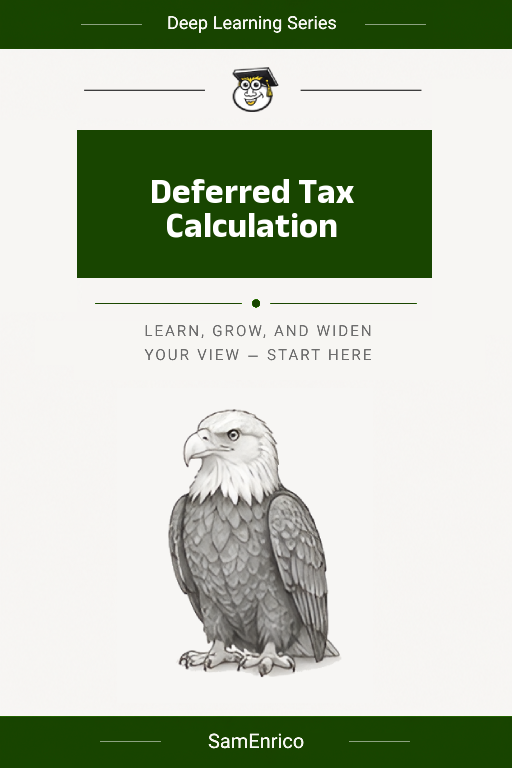
Non-FictionStudent's ShortcutDeferred Tax
Deferred Tax Calculation Audiobook
Compute deferred tax assets and liabilities using
Compute deferred tax assets and liabilities using temporary differences times tax rate.
Formats
Free sample
Chapter 1: Beyond the Payable...--–- On a quiet Tuesday afternoon in March, a seasoned chief financial officer named Sarah stared at her company’s draft financial statements. Revenue had grown 15%, operating margins were healthy, and the balance sheet showed strong liquidity. Yet the effective tax rate—the one number analysts would scrutinize—was a mystery even to her. The current tax payable from the Form 1120 was clear enough: 4.2millionowedtothe IRS.Buttheincometaxexpenseonthe GAAPincomestatementwas4.2 million owed to the IRS. But the income tax expense on the GAAP income statement was 4.2millionowedtothe IRS.Buttheincometaxexpenseonthe GAAPincomestatementwas5.8 million.
That $1.6 million gap was not a mistake, not a rounding error, and not something she could explain to the audit committee without a deeper understanding of a concept that confounds even experienced accountants: deferred taxes.That gap—between taxes actually payable to the government today and the tax expense reported to shareholders today—is the entire reason this book exists. And at the heart of that gap lies a simple-looking formula: Temporary Difference × Tax Rate. But as Sarah discovered during that long afternoon, the simplicity is deceptive. The real challenge is not multiplication. It is identifying which differences count, determining which future tax rate applies, and judging whether a deferred tax asset will ever deliver real cash savings.This chapter dismantles the common misconception that deferred tax is merely a timing adjustment—a bookkeeping nuisance to be solved by software.
Instead, we will build the conceptual foundation of the asset-liability model, the framework required by ASC 740 (the U.S. GAAP standard for income taxes) and followed by virtually all public companies worldwide under IFRS as well. By the end of this chapter, you will understand why deferred taxes exist, how they differ from current taxes payable, and why the simple formula Cumulative Temporary Difference × Enacted Future Tax Rate is both powerful and perilous.The Two Masters: Why GAAP and Tax Law Do Not See Eye to Eye To understand deferred taxes, you must first understand that corporations serve two masters with two different rulebooks.The first master is financial accounting (GAAP) . Its goal is to present a fair, accurate, and conservative picture of economic performance to investors, creditors, and regulators. Under GAAP, revenue is recognized when earned, and expenses are matched to the revenues they helped generate—regardless of when cash changes hands.
This is the accrual accounting framework.The second master is the Internal Revenue Code (IRC) . Its goal is to collect…
This is the end of the free sample. Get the Audiobook to keep going. Buy now
About this book
Details
- Author
- Gorman Giovanni
- Publisher
- SamEnrico
- Language
- English
- Genre
- Non-Fiction, Student's Shortcut, Deferred Tax
- Released
- 2026-06-01
- Pages (approx.)
- 159
- Available as
- eBook, Audiobook

Listen in the VoxFlicks app
Audiobooks and audio dramas wherever you go. Sign in with your SamEnrico account and press play.
More by Gorman Giovanni
 Eye Fixation Self Trance CourseGorman Giovanni$11.99
 ED and CyclingGorman Giovanni$11.99
 The ED Doppler UltrasoundGorman Giovanni$11.99
 Deck Cards Palace GuideGorman Giovanni$11.99
 Working Parent Self Care PlanGorman Giovanni$11.99
 Pet Loss and Work PerformanceGorman Giovanni$11.99
 Alcohol Reduction SuggestionGorman Giovanni$11.99
 REIT Tax AdvantagesGorman Giovanni$11.99
 The Last Analog: When the Internet Died for 54 MinutesGorman Giovanni$11.99
 Shadows of Tenochtitlan: The Ghosts of Montezuma's RevengeGorman Giovanni$11.99
 How to Produce Faucet AccessoriesGorman Giovanni$11.99
 A Collector's Handbook to the Allard M2xGorman Giovanni$11.99
You may also like
 Hong Kong Handover 1997Dunn Johnnie$11.99
 Zumba For Postnatal Recovery CourseNeal Christian$11.99
 Zumba for BeginnersLadner Nikia$11.99
 YouTube Comment Mining GuideHumes Pandora$12.99
 Worry Box MeditationCarlin Rudy$11.99
 Workplace Stress MeditationNguyen Lynn$11.99
 Workplace Stress and Sleep RepairHawley Ivory$11.99
 Workplace Perfectionism CureDelaney Jeffry$11.99
 Workplace Injustice Anger GuideWallen Isabelle$11.99
 Work Addiction and Burnout LinkGreenwood Ester$11.99
 Women in Yoga and WellnessBeattie Galina$11.99
 Women in Stand Up ComedyChun Evangeline$11.99