
Non-FictionSelf-HelpDigital Minimalism
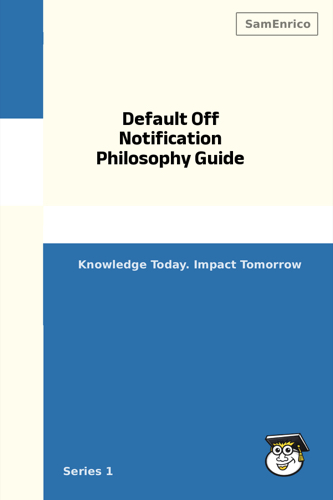
Default Off Notification Philosophy Guide eBook
Turns off all non-essential notifications by defau
Turns off all non-essential notifications by default, adding back only critical ones.
Formats
Free sample
Chapter 1: The Billion-Dollar Buzz--The average smartphone user checks their phone 96 times per day. That is once every ten waking minutes. And here is the detail the tech companies do not want you to know: on 67 of those checks, there is no notification at all. You are not responding to a ping. You are fishing for one.This chapter pulls back the curtain on the hidden economy driving your phone's constant interruptions.
It argues that notifications are not designed for your benefit, your safety, or your connection to loved ones. They are designed for one purpose only: to capture and hold your attention long enough to sell it to the highest bidder. By the time you finish this chapter, you will never look at a notification the same way again.The Trillion-Dollar Heist Let us begin with a simple question. Who pays for your free apps?You have never sent Facebook a check. You have never Venmoed Google for search results.
You have never mailed cash to Instagram. And yet, these companies are among the most profitable in human history. Facebook alone generates over $130 billion in annual revenue. Google tops $300 billion. These are not charities.
They are not public services. They are advertising companies that happen to make software.Here is how the model works. You open an app. The app shows you content. The content surrounds advertisements.
Advertisers pay the app company every time you see or click those ads. Therefore, the more time you spend in the app, the more money the app company makes. This creates a simple, brutal incentive: every app you use has a financial interest in keeping you there for as long as possible, as often as possible, and with as little self-control as possible.Notifications are the primary tool for maximizing this metric. A notification is not a neutral update. It is a revenue-generating event.
Every buzz, badge, or banner is a tiny victory in a trillion-dollar war for your time. When you silence a notification, you cost someone money. When you ignore one, you deny a company its expected return on investment. When you turn them all off, you become what the industry fears most: a user who cannot be harvested.This is not a conspiracy theory. It is the public business model of every major technology company.
They call it the attention economy. We should call it what it is: a trillion-dollar heist of human focus.The Architecture of Interruption To understand how notifications work, you must first understand how they are designed. The process begins with a choice: every app developer decides which notifications to send, how often to send them, and how urgent to make them feel. But the most important choice happens before any of that. It is the choice that gave this book its name.The Default On Exploit When you install a new app, the operating system asks: "Allow this app to send you notifications?" The buttons are typically labeled "Allow" and "Don't Allow." Most people tap "Allow" without thinking.
This is not an accident. It is a design exploit.Behavioral economists have documented a phenomenon called "status quo bias." Humans tend to stick with whatever default option they are given, even when changing the default would benefit them. Automatically renewing subscriptions exploit this bias. Pre-checked boxes exploit this bias. And notification prompts exploit this bias with ruthless efficiency.App developers know that if they ask for permission, most people will grant it.
They also know that once granted, most people will never revoke it. Studies show that fewer than one in seven users ever changes their notification settings after the initial setup. The remaining six out of seven leave every single notification enabled for every single app they have ever installed.Think about that number. You are not lazy. You are not weak.
You are outmatched by a system designed to exploit your brain's natural tendency to accept whatever is easiest. Default On is not a neutral choice. It is a design exploit that profits from your inertia.The Variable Reward Engine Once notifications are enabled, the real manipulation begins. Notifications are not sent at regular intervals. They are sent on variable schedules.
Sometimes you get a like immediately. Sometimes you wait hours. Sometimes you open the app to find nothing at all. This unpredictability is not a bug. It is the engine.Psychologists have studied variable rewards for nearly a century.
The most famous experiments involved pigeons pressing levers for food pellets. When the pigeons received a pellet every time they pressed the lever, they pressed only when hungry. But when the pellets became unpredictable—sometimes one press worked, sometimes ten, sometimes none—the pigeons pressed obsessively. They pressed until exhaustion. They pressed even after the food stopped coming altogether.Your phone works exactly the same way.
The notification is the lever. The reward is the message, the like, the news alert, the social validation. Because the reward is unpredictable, your brain releases more dopamine than it would for a guaranteed reward. This is the same neurological mechanism that makes slot machines addictive. You are not checking your phone because you are weak.
You are checking because a multi-billion-dollar industry has reverse-engineered your neurochemistry.The Red Dot Tyranny Among all notification types, one stands out as uniquely harmful. The red badge icon. That small circle with a number inside. It sits on your app icons, on your home screen, in your notification center. Unlike a sound or a banner that fades after a few seconds, a red dot remains indefinitely.
It waits for you. It demands your attention. It never stops asking.Psychologists call this an "open loop." Your brain hates open loops. When you see an unfinished task, an unanswered question, or an unread message, your brain maintains a background thread of cognitive load until the loop is closed. This is why cliffhangers are effective.
This is why suspense works. And this is why a persistent red dot drains your mental energy even when you are not looking at your phone.Research cited in multiple studies shows that the mere presence of an unread notification badge can reduce cognitive performance on unrelated tasks by up to ten percent. Ten percent. That is the difference between an A and a B, between a promotion and a pass, between remembering your child's school event and showing up a day late. All from a tiny red circle.The chapter will later address a practical limitation: while you can eliminate home-screen badges, you cannot eliminate all in-app indicators (like bolded unread messages inside Whats App).
The goal is not perfection but containment. By removing external badges and limiting your exposure to in-app indicators to scheduled batch times, you reduce their harm by approximately ninety percent. But the first step is recognizing that every red dot is a tax on your attention.The Real Cost of a Single Ping Let us get specific. What does one notification cost you?Not the abstract cost of lost focus or increased stress. The actual, measurable, minute-by-minute cost.Researchers studying task switching have found that after any interruption, it takes an average of twenty-three minutes to return to the same level of focus.
Twenty-three minutes. That is not the time to respond to the notification. That is the time to recover. The ping…
This is the end of the free sample. Get the eBook to keep going. Buy now
About this book
Details
- Author
- Sessions Lavonia
- Publisher
- SamEnrico
- Language
- English
- Genre
- Non-Fiction, Self-Help, Digital Minimalism
- Released
- 2026-06-10
- Pages (approx.)
- 113
- Available as
- eBook, Audiobook

Read better in the ZLOADR app
Your eBooks on your phone or tablet. Sign in with your SamEnrico account and start reading.
More by Sessions Lavonia
 Physics Essay AI PromptsSessions Lavonia$11.99
 Indian Agent Quality AssuranceSessions Lavonia$11.99
 Calm Response to Colleague AggressionSessions Lavonia$11.99
 The Vilna Gaon Opposing GuideSessions Lavonia$11.99
 The Underdog Champion: Pat McDermott's Olympic DreamSessions Lavonia$11.99
 How to Start a Opera House Business (Beginners Guide)Sessions Lavonia$11.99
 QuickBooks Tax Preparation GuideSessions Lavonia$12.99
 Dialysis Clinic M&ASessions Lavonia$12.99
 Automation ArchitectSessions Lavonia$11.99
 Understanding Platyspondylic Lethal ChondrodysplasiaSessions Lavonia$17.99
You may also like
 Hong Kong Handover 1997Dunn Johnnie$11.99
 Zumba For Postnatal Recovery CourseNeal Christian$11.99
 Zumba for BeginnersLadner Nikia$11.99
 YouTube Comment Mining GuideHumes Pandora$12.99
 Worry Box MeditationCarlin Rudy$11.99
 Workplace Stress MeditationNguyen Lynn$11.99
 Workplace Stress and Sleep RepairHawley Ivory$11.99
 Workplace Perfectionism CureDelaney Jeffry$11.99
 Workplace Injustice Anger GuideWallen Isabelle$11.99
 Work Addiction and Burnout LinkGreenwood Ester$11.99
 Women in Yoga and WellnessBeattie Galina$11.99
 Women in Stand Up ComedyChun Evangeline$11.99