
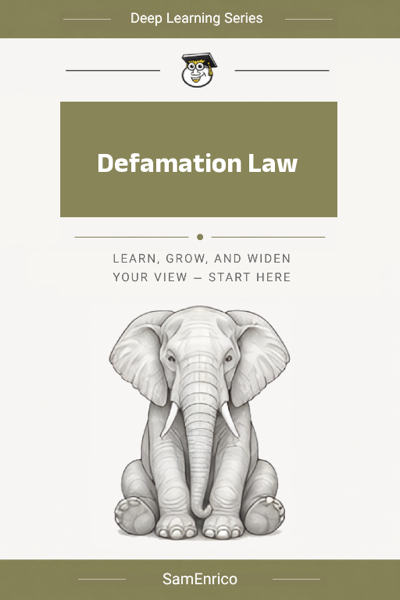
Non-FictionInformativeEducational
Defamation Law eBook
A Coursebook on Defamation Law
A Coursebook on Defamation Law
Formats
Free sample
Chapter 1: The Reputation Trap--–- On a Tuesday morning in suburban Phoenix, Maria Gonzalez opened her Yelp app and discovered that her life’s work had been reduced to a pile of lies. A competitor had posted a review accusing her family’s restaurant of serving “rat-infested food” and claimed she had been cited by health inspectors for “roaches in the kitchen.” The review was completely fabricated. Maria had never received a single health violation in twelve years of business. But within seventy-two hours, the damage was done. Regular customers canceled reservations.
Her son’s teachers whispered at pickup. A local news blogger picked up the story and ran with it under the headline “Scottsdale Eatery Under Investigation.” By Friday, revenue had dropped forty percent. Maria hired a lawyer. The lawyer asked her a single question that would change everything: “Are you a public figure?”That question—simple, almost innocent—is the trap door of defamation law. Most people who believe they have been defamed fall through it before they ever see a courtroom.
They assume that if someone told a lie about them, and the lie hurt their reputation, the law will step in and make things right. That assumption is wrong. Defamation law does not exist to make you feel better. It does not exist to punish every liar. It exists to strike a delicate, almost impossible balance between two fundamental values: the protection of individual reputation and the preservation of free speech.
And in that balancing act, reputation often loses.This chapter will walk you through the foundations of that balance. You will learn why the law treats written lies (libel) differently from spoken ones (slander). You will travel from the brutal courtrooms of the English Star Chamber to the landmark 1964 Supreme Court decision that remade American defamation law overnight. You will see how the United States became an outlier among Western nations—far more protective of speakers than of plaintiffs. And by the end, you will understand why Maria Gonzalez’s lawyer asked that question, why the answer probably devastated her, and why the very same question might protect you if someone ever tries to sue you for something you said online.But before we dive into doctrine and cases, let us be honest about what this book is and what it is not.
This is not an academic treatise written for law professors to cite in footnotes. It is a practical, irreverent, and occasionally uncomfortable guide to defamation law as it actually operates in the real world. You will encounter real cases, real disasters, and real people who learned the hard way that defamation law is not about truth—it is about who has to prove what, and that distinction changes everything.The Dual Goals: Protecting Reputation Versus Safeguarding Free Speech Every defamation case is a collision between two rights that cannot both fully win. On one side stands the individual’s right to reputation. Your good name is a form of property.
It determines whether you get hired, promoted, loaned money, invited to dinner, or trusted with secrets. A single lie can unravel years of hard-won credibility. The law recognizes this by allowing you to sue those who damage your reputation with false statements.On the other side stands society’s right to free speech—in the American context, the First Amendment’s guarantee that Congress (and by extension the states) shall make no law abridging the freedom of speech or of the press. This right is not absolute. You cannot shout fire in a crowded theater, solicit murder, or publish national security secrets with impunity.
But when it comes to speech about public affairs, about government officials, about matters of legitimate public concern, the First Amendment throws up an enormous shield. That shield protects not just true speech, but false speech. It protects not just careful journalism, but reckless ranting. It even protects speech that causes real, demonstrable harm—because the drafters of the First Amendment concluded that the occasional injury to reputation is a price worth paying for a society where citizens can criticize their leaders without fear.Here is the core tension that every defamation case must resolve: How much protection does reputation deserve? How much freedom does speech require?
If the law tilts too far toward reputation, we silence whistleblowers, satirists, and ordinary citizens afraid of lawsuits. If the law tilts too far toward speech, we abandon innocent people to the wolves of lies and character assassination. Different countries solve this tension differently. The United States, as we shall see, has tilted further toward speech than any other Western democracy.Before we examine those solutions, however, we need a working vocabulary. Defamation is the umbrella term for two distinct legal claims: libel and slander.Libel Versus Slander: Why the Distinction Still Matters Libel refers to defamation in a permanent form.
Traditionally, that meant writing—newspapers, books, letters, signs. But as technology evolved, the definition expanded to include photographs, cartoons, films, television broadcasts, and (critically for modern life) social media posts, blog entries, You Tube videos, and memes. The unifying feature of libel is fixity. A libelous statement is recorded in some medium that can be preserved, replayed, and distributed indefinitely.Slander refers to defamation in a transient form. Typically, that means spoken words—conversations, speeches, phone calls, gossip.
The distinction matters because the law presumes that libel causes greater harm than slander. A written lie can be copied, shared, and rediscovered years later. A spoken lie vanishes into the air, leaving behind only memory. For this reason, most libel claims allow plaintiffs to recover “presumed damages”—money awarded without proof of actual financial loss. If someone writes falsely that you are a convicted felon, you do not need to prove that you lost a job or a friend.
The law presumes that such a statement is so inherently damaging that compensation is automatic.Slander, by contrast, usually requires proof of “special damages.” That is legalese for actual economic loss—a cancelled contract, a lost promotion, a specific customer who walked away. But here is where the trapdoor opens. There are four categories of slander that are treated as seriously as libel. Known as slander per se, these include false statements that:Accuse someone of a crime punishable by imprisonment;Allege that someone has a loathsome or contagious disease (historically leprosy or venereal disease, though courts have modernized the list);Impute professional incompetence or misconduct (saying a lawyer cheats clients or a doctor kills patients); or(In some states) accuse a woman of unchastity, though this archaic category is fading.If your spoken defamation falls into one of these categories, you are in the same boat as a libel plaintiff: presumed damages, no need to prove economic loss. If not, you had better have documentary evidence of lost revenue.Now, you might be thinking: This distinction between libel and slander feels like a historical accident.
Why should a lie on Twitter (libel) be treated more harshly than the same lie spoken at a dinner party (slander)? The answer is that most courts and legislatures agree with you. Many states have merged libel and slander into a single claim for “defamation,” though…
This is the end of the free sample. Get the eBook to keep going. Buy now
About this book
Details
- Author
- Bittner Tiana
- Publisher
- SamEnrico
- Language
- English
- Genre
- Non-Fiction, Informative, Educational
- Released
- 2026-05-06
- Pages (approx.)
- 147
- Available as
- eBook, Audiobook

Read better in the ZLOADR app
Your eBooks on your phone or tablet. Sign in with your SamEnrico account and start reading.
More by Bittner Tiana
 Last Mile On Demand Delivery Models GuideBittner Tiana$11.99
 Energy Efficient Workspace DesignBittner Tiana$11.99
 E Mental Health In Low BandwidthBittner Tiana$11.99
 Self Esteem Parenting Together GuideBittner Tiana$11.99
 Silicon Shadows: The Great Chip Heist of 1978Bittner Tiana$11.99
 The Quantum Cartographers: Mapping the Unknown in the Medieval OutbackBittner Tiana$11.99
 AI Industry Outlook 2026-2030Bittner Tiana$12.99
 GoFundMe Personal Campaign PrimerBittner Tiana$12.99
 Understanding HerpetophobiaBittner Tiana$17.99
 How to Start a Bridges for Telecommunications Business (Beginners Guide)Bittner Tiana$11.99
You may also like
 Hong Kong Handover 1997Dunn Johnnie$11.99
 Zumba For Postnatal Recovery CourseNeal Christian$11.99
 Zumba for BeginnersLadner Nikia$11.99
 YouTube Comment Mining GuideHumes Pandora$12.99
 Worry Box MeditationCarlin Rudy$11.99
 Workplace Stress MeditationNguyen Lynn$11.99
 Workplace Stress and Sleep RepairHawley Ivory$11.99
 Workplace Perfectionism CureDelaney Jeffry$11.99
 Workplace Injustice Anger GuideWallen Isabelle$11.99
 Work Addiction and Burnout LinkGreenwood Ester$11.99
 Women in Yoga and WellnessBeattie Galina$11.99
 Women in Stand Up ComedyChun Evangeline$11.99