
Non-FictionBiographyNautical Archeology
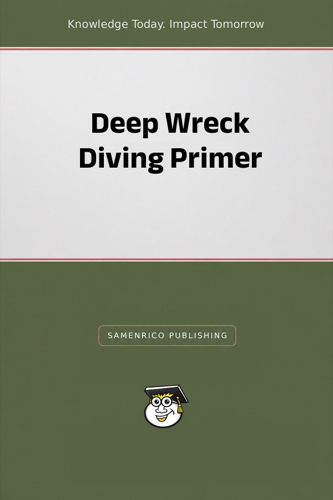
Deep Wreck Diving Primer eBook
Exploring a WWII aircraft carrier's debris field w
Exploring a WWII aircraft carrier's debris field while avoiding entanglement hazards.
Formats
Free sample
Chapter 1: The Carrier’s Graveyard...–- The water was colder than he expected. Not the sharp, bracing cold of a winter quarry dive, but the deep, bone-settling cold of the open Atlantic, hundreds of miles from any shore. John had been dreaming of this moment for three years—ever since he first read the sonar report that hinted at a massive, man-shaped silhouette resting on the abyssal plain. Now, descending past 130 feet, the blue of the surface had faded to a bruised indigo, and the world had narrowed to the beam of his primary light.His dive buddy, Elena, was a ghost to his right, a dim form outlined by her own lamp. They followed the shot line down—a thick, yellow rope tethered to a concrete block the dive boat had dropped an hour earlier.
The line was their umbilical cord to the world above, their only guarantee of a return path through the featureless void. At 150 feet, John checked his dive computer. Thirty seconds of bottom time already consumed just on the descent. He signaled to Elena with a flashlight flick: I’m okay. Going slow.Then the line ended.The block sat on a bed of gray, featureless sand.
John hovered, neutrally buoyant, and shone his light in a slow circle. Nothing. Just sand and the silt of ages. For a sickening moment, he wondered if the sonar had lied—if the wreck was a phantom, a trick of overlapping fish schools and thermal layers. Elena tapped her tank with a metal pointer: ping, ping, ping.
She pointed into the gloom, her light beam catching something.At first, it looked like a low cloud, a smear of darker gray against the water column. But clouds don't have right angles. As John swam closer, the cloud resolved into a wall—a steel wall, encrusted with seventy years of marine growth. Anemones waved from rusted rivets. A forest of barnacles and tube worms had transformed the vertical surface into a living reef.
John touched it. The steel was cold, solid, and utterly indifferent to his presence. He had found the flank of the USS Yorktown.He swam upward, following the wall, until the steel curve flattened into a horizontal plane. The flight deck. He had read about this moment in every memoir and technical report he could find, but no description had prepared him for the sheer scale.
The deck stretched away into darkness like an abandoned city street. Here and there, his light picked out the wreckage of aircraft—a crumpled wing, an engine block torn from its mountings, the ghostly skeleton of a landing gear strut. But it was the wires that made him pause.From the deck surface, trailing like the tentacles of a dead jellyfish, came dozens of thin, dark lines. Some were straight. Others looped and tangled with each other in impossible knots.
Arresting gear cables. The very wires that had once caught landing planes in the heat of battle now hung motionless, waiting for the unwary diver. John felt a primal urge to push forward, to swim over the deck and toward the island structure where the bridge and antennas waited. But he stopped.He placed his hand on his left hip, feeling the trauma shears in their holster. He reached to his right shoulder, confirming the Z-knife was still clipped in place.
He swept his hand down to his calf, touching the heavy knife, then to his right hip, where the cable cutter rode. The Quartet. All present. He signaled to Elena: Looking. Not touching.
Moving slow.They had made their first rule of the dive: stop, freeze, evaluate. They had broken nothing—yet. But John knew, with the certainty of every diver who has ever pushed their luck, that the real test was still ahead. Somewhere in that tangle of steel and wire, in that silent, frozen moment of history, something would reach out and grab him. The question was not if, but when.
And whether his training would be enough to cut him free.This is the reality of exploring a WWII aircraft carrier's debris field. It is not a sport. It is not a sightseeing tour. It is a calculated negotiation with a seventy-year-old trap, where the entanglement hazards are not incidental—they are the defining feature of the environment. To survive, you must understand not only the wreck's history, but its anatomy.
You must know where the wires hide, why the debris field is more dangerous than the intact hull, and why the most important piece of equipment you carry is not your light or your rebreather, but the three inches of stainless steel on your hip.This chapter is your first step into that world. Not a step onto the wreck—you are not ready for that yet—but a step into the knowledge that will determine whether you return from the depths or become part of them.The Irresistible Allure of the Carrier Wreck Why are WWII aircraft carriers so compelling to technical divers? The answer is layered, like the wreck itself.First, there is history. These ships fought the largest naval war in human history. The USS Yorktown (CV-5) was scuttled after the Battle of Midway, having taken three direct bomb hits and two torpedo strikes.
She went down fighting, with her crew still manning the pumps. The IJN Kaga, one of the carriers that attacked Pearl Harbor, was so thoroughly wrecked by American dive bombers that her captain ordered her scuttled rather than surrender. The USS Lexington (CV-2), nicknamed "Lady Lex," was lost in the Coral Sea after an internal explosion turned her into a floating inferno. To dive on these wrecks is to touch a moment when the course of the 20th century hung in the balance.Second, there is scale. A WWII fleet carrier was over 800 feet long—longer than three football fields.
Her flight deck was a city block of open steel. Her hangar bay could hold seventy aircraft. Her island structure rose seven stories above the deck. When you swim over a carrier's wreck, you are not exploring a "site." You are exploring an environment. The visibility may be only thirty feet, but the wreck extends beyond that limit in every direction, creating a sense of infinite, alien space.Third, and most relevant to this book, there is the debris field.
Unlike a battleship or a cruiser, a carrier carries most of her offensive power above the hull. Aircraft—fully loaded with fuel, ammunition, and complex mechanical systems—are scattered across the seafloor like toys thrown by a giant. A carrier's debris field is not a neat pile of wreckage. It is a chaotic scatter of sharp metal, trailing wires, hydraulic lines, control cables, and, in many cases, unstable ordnance. This is where the entanglement hazards are most concentrated and most unpredictable.But the allure cuts both ways.
The same features that make carrier wrecks irresistible also make them lethally dangerous. A diver who is seduced by the history without respecting the hazard will not survive the dive. This book is designed to ensure you are not that diver.The Three Iconic Wrecks: A Comparative Study To understand the entanglement hazards…
This is the end of the free sample. Get the eBook to keep going. Buy now
About this book
Details
- Author
- Fitzpatrick Jaimie
- Publisher
- SamEnrico
- Language
- English
- Genre
- Non-Fiction, Biography, Nautical Archeology
- Released
- 2026-06-06
- Pages (approx.)
- 153
- Available as
- eBook, Audiobook

Read better in the ZLOADR app
Your eBooks on your phone or tablet. Sign in with your SamEnrico account and start reading.
More by Fitzpatrick Jaimie
 The Mount Carmel CemeteryFitzpatrick Jaimie$11.99
 Accumulating Positive EmotionsFitzpatrick Jaimie$11.99
 Startup Founder Self EsteemFitzpatrick Jaimie$11.99
 Prompt Engineering for Legal ReviewFitzpatrick Jaimie$11.99
 Thoth Wisdom GodFitzpatrick Jaimie$11.99
 Burn Emergency Treatment KitFitzpatrick Jaimie$11.99
 Password Memory PalaceFitzpatrick Jaimie$11.99
 Nutrition Against BurnoutFitzpatrick Jaimie$11.99
 Love Letters in the Server Room: The Secret Romance That Saved a Tech StartupFitzpatrick Jaimie$11.99
 The Last Whispers of the Great Barrier ReefFitzpatrick Jaimie$11.99
 The Caravels of Destiny: Portugal’s Path to the New WorldFitzpatrick Jaimie$11.99
 Facebook Ad Creative Size GuideFitzpatrick Jaimie$12.99
You may also like
 Hong Kong Handover 1997Dunn Johnnie$11.99
 Zumba For Postnatal Recovery CourseNeal Christian$11.99
 Zumba for BeginnersLadner Nikia$11.99
 YouTube Comment Mining GuideHumes Pandora$12.99
 Worry Box MeditationCarlin Rudy$11.99
 Workplace Stress MeditationNguyen Lynn$11.99
 Workplace Stress and Sleep RepairHawley Ivory$11.99
 Workplace Perfectionism CureDelaney Jeffry$11.99
 Workplace Injustice Anger GuideWallen Isabelle$11.99
 Work Addiction and Burnout LinkGreenwood Ester$11.99
 Women in Yoga and WellnessBeattie Galina$11.99
 Women in Stand Up ComedyChun Evangeline$11.99