
Non-FictionSelf-HelpEnvironmental Design
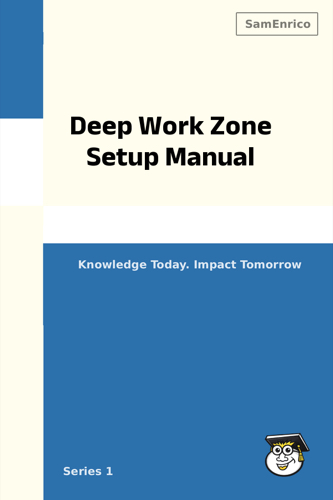
Deep Work Zone Setup Manual eBook
Design a distraction free environment for focused
Design a distraction free environment for focused work using this practical interruption management guide.
Formats
Free sample
Chapter 1: The Leak You Never See--–- You are losing more time than you think. Much more.Not in obvious ways. Not in the hour you spend scrolling social media or the twenty-minute watercooler chat that ran long. Those you notice. Those you can count.
The real loss happens in the spaces between—in the ninety seconds it takes to glance at a Slack message, the thirty seconds to check a text, the momentary flicker of attention when a notification lights up your phone screen.You recover from those, you tell yourself. You get back to work. No harm done.This is wrong.The harm is not in the ninety seconds you lost. The harm is in what happens after you return. Because you do not return to the same place you left.
You return to a shallower version of yourself, and it takes nearly half an hour to descend back to the depths you were exploring before you looked away.This chapter will prove this to you with numbers, with neuroscience, and with a simple calculator that will change how you see every interruption for the rest of your career. By the time you finish reading, you will know exactly how much distraction is costing you—not in vague feelings of busyness, but in hours, dollars, and creative potential.And you will be ready to do something about it.The Twenty-Three-Minute Ghost In 2014, researchers at the University of California, Irvine made a discovery that should have stopped every knowledge worker on the planet cold. They studied software developers and found that after a typical interruption—an instant message, a phone call, a colleague stopping by—it took an average of twenty-three minutes and fifteen seconds for the developer to return to the original task.Not to settle into a new task. To return to the original task.Let that number sit with you for a moment. Twenty-three minutes.
Not ninety seconds. The interruption itself was brief. The recovery was an eternity.Worse, the researchers found something else. In many cases, the developers never fully returned. They resumed the original task, yes, but at a shallower level of concentration.
They had lost the cognitive context—the mental map of variables, dependencies, next steps, and open questions that they had been holding in working memory. Without that map, they worked more slowly, made more errors, and often abandoned complex problems for simpler ones.This is the switch cost effect, and it is one of the most replicated findings in cognitive psychology. Every time your brain shifts from Task A to Task B, it does not simply "pause" Task A. It performs a series of expensive operations:Attention disengagement: Your brain must actively withdraw focus from Task A.Context switching: It must flush the active variables of Task A from working memory.Goal reactivation: It must load the rules, constraints, and next steps for Task B.Orientation: It must re-establish where you were in Task B.When you switch back to Task A, you repeat steps 1 through 4. The cost is not linear.
It is exponential. The more complex Task A is, the more expensive each switch becomes.Writing a difficult paragraph? Solving a thorny algorithm? Analyzing a dense contract? Those tasks have high "context loads." They require you to hold multiple variables in mind simultaneously.
A single interruption can wipe out ten minutes of mental assembly.This is not a theory. This is measurable neuroscience.Deep Work Versus Shallow Work: A Necessary Distinction Before we go further, we need a shared vocabulary. The writer and computer scientist Cal Newport gave us two terms that have become indispensable:Deep Work is professional activity performed in a state of distraction-free concentration that pushes your cognitive capabilities to their limit. These efforts create new value, improve your skill, and are hard to replicate. Examples: writing a report from scratch, debugging complex code, designing a system architecture, learning a new language, analyzing data to find a pattern.Shallow Work is logistical, non-cognitive tasks that can be performed while distracted.
These efforts do not create much new value and are easy to replicate. Examples: sending routine emails, scheduling meetings, moving files between folders, filling out forms, approving expense reports.Here is the crucial clarification that most productivity books get wrong: Shallow Work is not bad. It is necessary. You cannot run a career without responding to emails or attending status meetings. The problem is not the existence of shallow work.
The problem is mixing shallow and deep work.When you alternate between deep and shallow tasks, the shallow tasks act as constant interruptions to the deep ones. Each email you check during a writing session is not a pause. It is a reset. And each reset costs you twenty-three minutes of depth.The goal of this book is not to eliminate shallow work. The goal is to contain it—to give it its own time and place so that it does not bleed into your deep work hours.The Math of Cognitive Bleed Let us make this concrete.
Assume you are a knowledge worker with eight hours in your workday. Assume you have the potential for four hours of genuine deep work—the biological maximum for sustained concentration, as we will explore in Chapter 11.Now assume you are interrupted three times per hour. Not by major disasters. By small things. A Slack ping.
A text from your partner. A browser tab you open to check the news. Three interruptions per hour is actually low for most office workers; studies show averages between four and seven. But let us be conservative.Three interruptions per hour across a four-hour deep work block means twelve interruptions. Each interruption takes ninety seconds of direct time.
That is eighteen minutes of direct loss.But you do not lose only the ninety seconds. You also lose twenty-three minutes of cognitive context after each interruption. Twelve interruptions times twenty-three minutes is 276 minutes. That is four hours and thirty-six minutes.Add the eighteen minutes of direct interruption time. You have lost nearly five hours of cognitive capacity in a single four-hour block.Do you see the problem?
You intended to do four hours of deep work. You actually produced zero. Because after the first interruption, you were never really in deep work again. You were in a shallow, fragmented, post-interruption haze that you mistook for deep work.This is the leak you never see. It is invisible because you do not feel the twenty-three minutes passing.
You feel yourself typing. You feel yourself thinking. But you are typing and thinking at half speed, with half the working memory, making twice the errors. And you have no idea.The Focus Leak Calculator Now we will make this visible. The Focus Leak Calculator is a simple tool that will quantify your cognitive loss.
You will complete it over two typical workdays. Do not pick unusually good or bad days. Pick Tuesday and Wednesday of a normal week.Step 1: Log every interruption.For two days, keep a small notebook or a note-taking app open. Every time you are interrupted—by a notification, a person, a thought, a self-initiated tab switch—write down:Time of interruption Duration of interruption (estimate)What you were doing…
This is the end of the free sample. Get the eBook to keep going. Buy now
About this book
Details
- Author
- Tipton Murray
- Publisher
- SamEnrico
- Language
- English
- Genre
- Non-Fiction, Self-Help, Environmental Design
- Released
- 2026-06-06
- Pages (approx.)
- 144
- Available as
- eBook, Audiobook

Read better in the ZLOADR app
Your eBooks on your phone or tablet. Sign in with your SamEnrico account and start reading.
More by Tipton Murray
 Networking Through HobbiesTipton Murray$11.99
 Pet Caregiver BurnoutTipton Murray$11.99
 Food Addiction and ADHD HandbookTipton Murray$11.99
 Cortisol Lowering Breakfast GuideTipton Murray$11.99
 The Vanishing Phantom: The Hunt for the 19th-Century Ghost ThiefTipton Murray$11.99
 The Panama Papers: The Ghosts in the FilesTipton Murray$11.99
 Understanding Ectopia CordisTipton Murray$17.99
 Director of ProductTipton Murray$11.99
 Voiceover Success StoriesTipton Murray$12.99
 Breach Notification InsuranceTipton Murray$12.99
 How to Become a CarpenterTipton Murray$11.99
You may also like
 Hong Kong Handover 1997Dunn Johnnie$11.99
 Zumba For Postnatal Recovery CourseNeal Christian$11.99
 Zumba for BeginnersLadner Nikia$11.99
 YouTube Comment Mining GuideHumes Pandora$12.99
 Worry Box MeditationCarlin Rudy$11.99
 Workplace Stress MeditationNguyen Lynn$11.99
 Workplace Stress and Sleep RepairHawley Ivory$11.99
 Workplace Perfectionism CureDelaney Jeffry$11.99
 Workplace Injustice Anger GuideWallen Isabelle$11.99
 Work Addiction and Burnout LinkGreenwood Ester$11.99
 Women in Yoga and WellnessBeattie Galina$11.99
 Women in Stand Up ComedyChun Evangeline$11.99